

Bitcoin’s price has hit $70,000 after Strategy, the world’s largest publicly traded company holder of the top cryptocurrency, sold part of its BTC treasury for the first time since 2022.
Data from CryptoSlate showed that the price of BTC fell 4% on the news to a low of $69,690 before recovering to $70,120 at the time of writing. This is the lowest price level in six weeks.
This price movement came as a strategy revealed on June 1 that it sold 32 Bitcoin between May 26 and May 31. The sale generated approximately $2.5 million at an average execution price of $77,135.
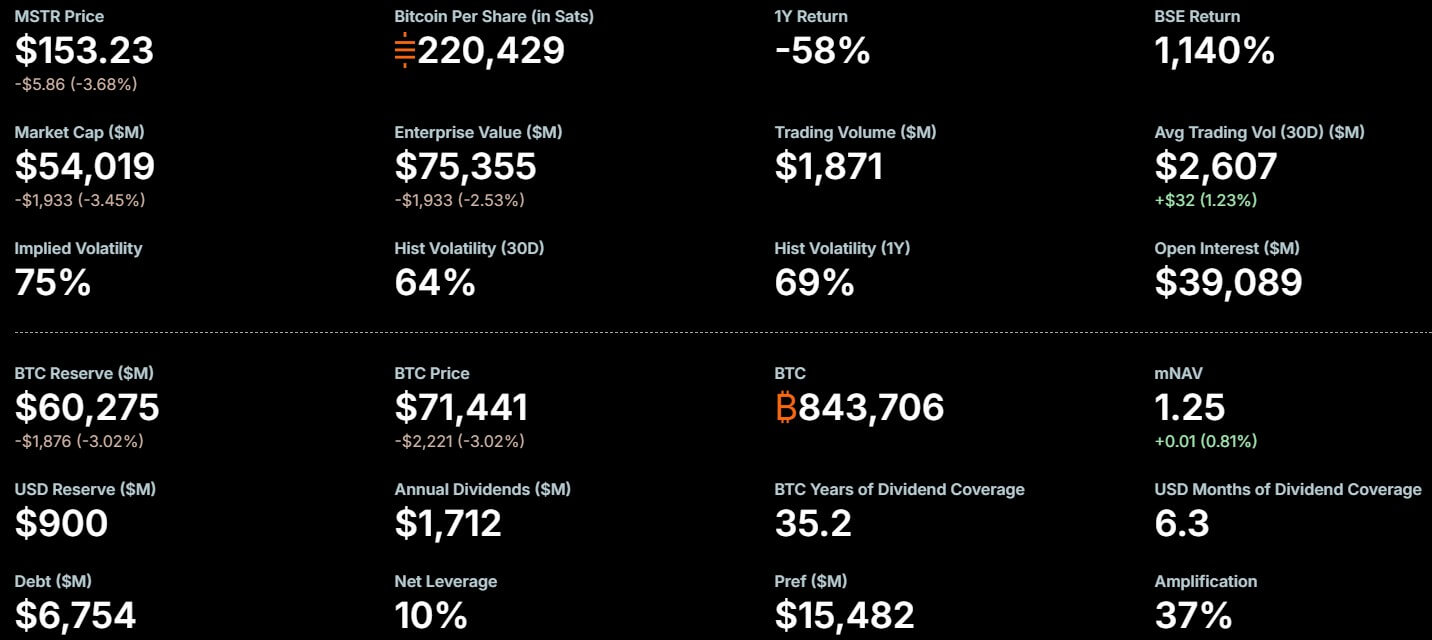
Digital asset sales represent a microscopic 0.0038% of total holdings, versus a total company stock of 843,706 Bitcoin, acquired at an average price of $75,699.
Market observers were quick to emphasize the importance of Strategy’s decision to sell as a formal departure from founder Michael Saylor’s long-standing doctrine of absolute retention. Jim Cramer, host of CNBC, Mad Money said:
“Strategy (Micro) is selling Bitcoin for $2.5 million. The pro-bitcoin stance may need to be re-evaluated given how much Strategy has supported it. A major trampoline for years. Some say manipulation. I think that’s too strong.”
More importantly, the sale highlights an underlying structural risk as Strategy becomes increasingly reliant on volatile assets to fund fixed dollar-denominated corporate liabilities.
STRC draws Strategy deeper into the credit markets
According to the filing, Strategy said it sold its BTC holdings “to fund distributions on preferred stock.”
Over the past year, Strategy has launched several publicly traded perpetual preferred stocks, including STRK, STRC, STRF and STRD, to provide fixed income returns in addition to its Bitcoin treasury business.
The most popular of these is STRC, a perpetual preferred stock launched in July 2025 under the moniker Stretch.

In recent months, security has been central to Saylor’s efforts to convert the company’s Bitcoin holdings from a passive reserve into a funding platform that can attract investors looking for returns rather than direct exposure to the token.
Saylor has said Strategy wants STRC to become one of the leading credit instruments in global markets, a goal that hinges on keeping the product stable enough to function more as an income vehicle than a volatile crypto-linked stock.
STRC pays monthly cash distributions and currently maintains an annualized dividend rate of 11.5%, a level the strategy has maintained for four consecutive months. The rate is reviewed monthly and can be adjusted to ensure the shares continue to trade close to their par value of €100.
That price anchor is important to the company’s broader financing strategy.
If STRC remains essentially flat, Strategy can issue additional shares through its at-the-market program on more favorable terms, raising capital to purchase more Bitcoin, meet dividend obligations, and manage liabilities.
However, the product has shown some tension lately. STRC has not traded at the same level since mid-May, falling to a low of $97.11 last week before recovering to around $99.10. Still, the product has financed the purchase of over 122,000 BTC.
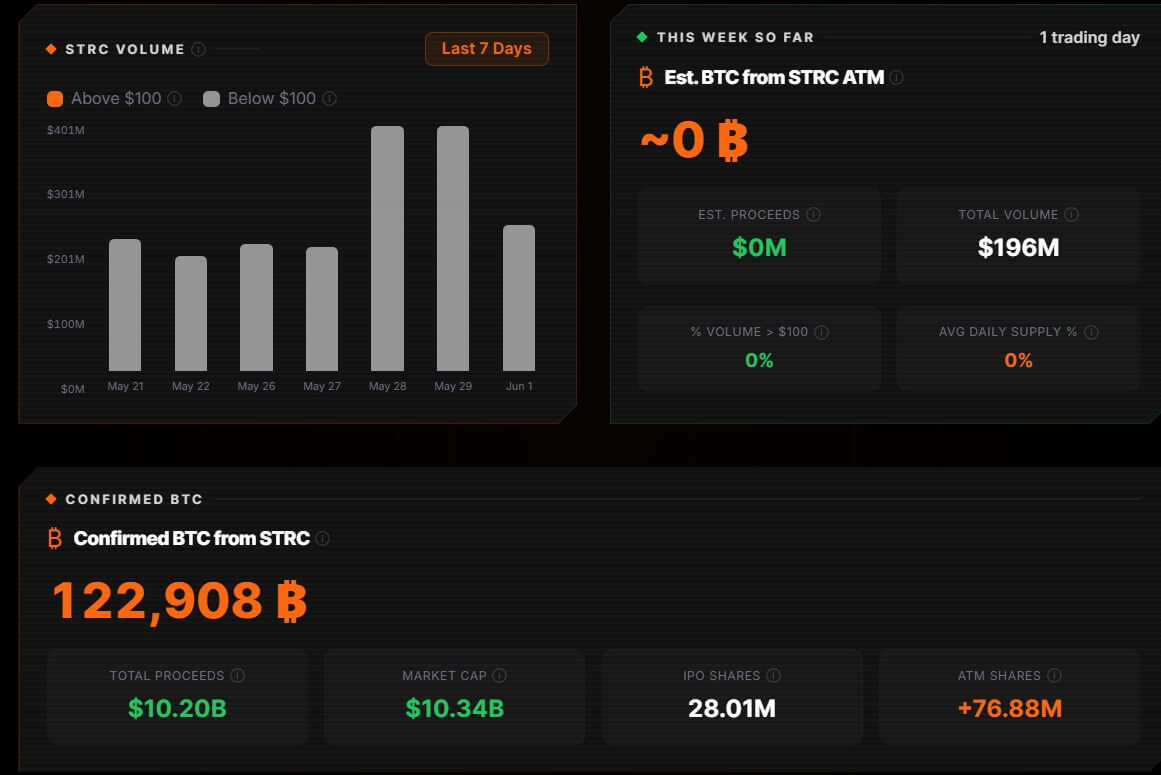
Meanwhile, shares could move closer to $100 ahead of the June 15 ex-dividend date, when investors must own the shares to receive the next payout.
This trading pattern has drawn attention to the mechanics behind the new Strategy model.
STRC works best when investor demand keeps security close to levels. If that support weakens, the company may have to rely more heavily on higher returns, issuing shares or its Bitcoin treasury to keep the structure running smoothly.
The more difficult question is not whether Bitcoin can be sold
Strategy and its supporters have presented the sale of 32 Bitcoins as a way to show that the treasury is not closed off from the market.
The company claims it can sell if doing so will shore up its balance sheet, improve its per-share metrics or help meet obligations associated with the securities it has issued around its Bitcoin holdings.
However, critics argue that this statement only addresses some of the concerns now forming around the company.
Glenn Cameron, global head of institutional at Onramp Bitcoin, noted that Bitcoin’s liquidity has never been the central question for institutional investors. The asset is continuously traded in global locations and routinely clears tens of billions of dollars in daily volumes.
He said the more difficult question is whether Strategy can rely on that liquidity during a sustained downturn, when fixed dollar payments are still due and other financing channels may be less attractive.
He wrote that the company’s model rests in part on the idea that Bitcoin only needs to appreciate about 2.3% per year to cover an estimated $1.6 billion STRC dividend bill over time.
According to him, the calculation is based on the dividend bill relative to the current notional value of Strategy’s Bitcoin holdings. At current prices, a modest gain in the treasury may seem enough to offset the cash costs of the payout.
However, dividends are not paid with market value gains. They need dollars. That distinction becomes more important when the value of the underlying government bonds falls.
If the price of Bitcoin were to be halved, the same dividend obligation would eat up a larger portion of the company’s asset base.
However, if Strategy continues to issue preferred shares, its cash burden would also increase. A manageable breakeven rate in a rising market could become more demanding if the value of government bonds shrinks and the dividend bill remains unchanged.
That’s where the sale of 32 Bitcoins takes on more significance than its size suggests. The transaction did not test Strategy’s ability to sell Bitcoin at scale. It showed how the treasury can be used once the cash obligations associated with the preferred stock structure mature.
A recession would limit Strategy’s options
In a supportive market, Strategy can use different financing channels simultaneously. The issuance of common stock can generate cash. Preferred shares can trade close to par. Bitcoin sales can be limited and presented as selective balance sheet management. A rising Bitcoin price also strengthens the value of the treasury that supports the structure.
During a recording, it becomes more difficult to rely on these conditions. A weaker common stock price causes dilution of share issuance. A lower STRC price may force the company to offer more output to restore demand.
Meanwhile, dividend payments must still be made in cash regardless of where Bitcoin is traded.
That’s the scenario that’s drawing analysts’ attention. If capital markets remain open, Strategy can fund its liabilities without relying heavily on the Bitcoin stack. As market access shrinks, the treasury becomes a more visible source of liquidity.

Repeated sales in a declining market would carry their own risks. A lower Bitcoin price would require more coins to meet the same dollar obligation, while any selling could increase investor concerns about whether the preferred stock structure is starting to feed on the assets it is meant to support.
Jeff Dorman, chief investment officer at Arca, has done just that argued that the small sale can prepare investors for larger sales later.
He has also warned that Strategy’s $900 million cash reserve only covers about five months of dividend obligations, leaving the preferred share structure more vulnerable if issuance becomes more difficult.
Dorman described the setup as a “ticking time bomb” and said the interests of common shareholders, preferred holders and Bitcoin investors will not always move in tandem once fixed cash payouts are piled onto a volatile treasury.
Meanwhile, that tension extends beyond Strategy. Public Bitcoin treasury companies are no longer simple holders of reserve assets.
Once they issue yield-bearing securities and rely on traditional capital markets, they incur liabilities to shareholders and capital providers that can complicate a pure hold-through volatility strategy.
Simon Dixon, a Bitcoin analyst, said investors should recognize that the managers of government bond companies now operate within a broader financial structure. He said:
“Those who care about Bitcoin need to understand who Adam, Saylor and others running Bitcoin treasury companies are ultimately working for, and adjust their expectations accordingly.”
Strategy has made Bitcoin the foundational layer of a corporate credit strategy. The question now is how that structure behaves if the market stops providing the conditions that make it work: rising Bitcoin prices, stable investor demand, and open access to new capital.