
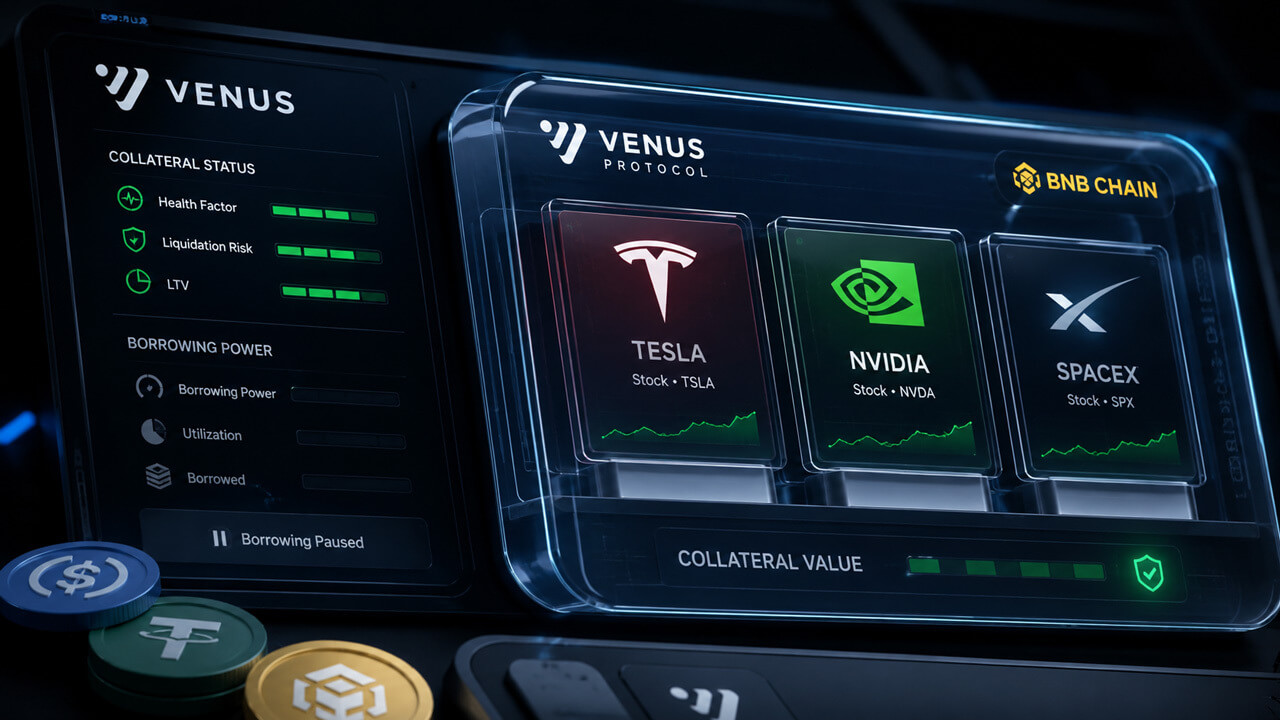
Venus Protocol has turned the use of tokenized stocks as DeFi collateral into a 2026 BNB Chain test by adding bStocks markets to its Core Pool, creating a way to assess credit risk controls before active lending becomes the main story.
The Rollout on June 20 includes bStocks associated with exposure to Tesla, Nvidia and SpaceX: TSLAB, NVDAB and SPCXB. The change gives eligible users a way to supply equity-linked assets to bStocks’ collateral markets within Venus’s lending framework, while leaving active stablecoin loans outside the verified launch claim.
Creating guardrails market parameters which list collateral factors and ceilings and show that lending has been paused, with lending limits set to 0 at launch.
Venus has been the first to open the collateral framework, with real loan demand, stablecoin usage and post-launch liquidation behavior yet to be proven.
The risk profile differs from that of a normal token listing. Tokenized stock collateral depends on an issuer, permitted jurisdictions, market access, after-hours pricing, oracle design, collateral factors, supply ceilings and liquidation rules.
Venus tests whether equity-linked tokens can serve as productive collateral in a cryptocurrency market before the regulatory and market structures surrounding tokenized equities have become established.
Venus starts with tokenized stocks as DeFi collateral before open lending
The initial assets are well known enough to attract attention, but the risk parameters send a stronger signal. Venus’ proposal lists TSLAB and NVDAB with 60% collateral factors and SPCXB with a 50% collateral factor, in addition to caps and an oracle protection trigger.
These numbers show that the markets are designed as controlled exposure and not as an open invitation to immediately borrow against tokenized stocks.
| Venus Market | Equity-linked exposure | Collateral factor | Launch loan status |
|---|---|---|---|
| vTSLAB | Tesla-connected TSLAB | 60% | Borrowing paused / borrowing ceiling 0 in proposal |
| vNVDAB | Nvidia-connected NVDAB | 60% | Borrowing paused / borrowing ceiling 0 in proposal |
| vSPCXB | SpaceX-linked SPCXB | 50% | Borrowing paused / borrowing ceiling 0 in proposal |
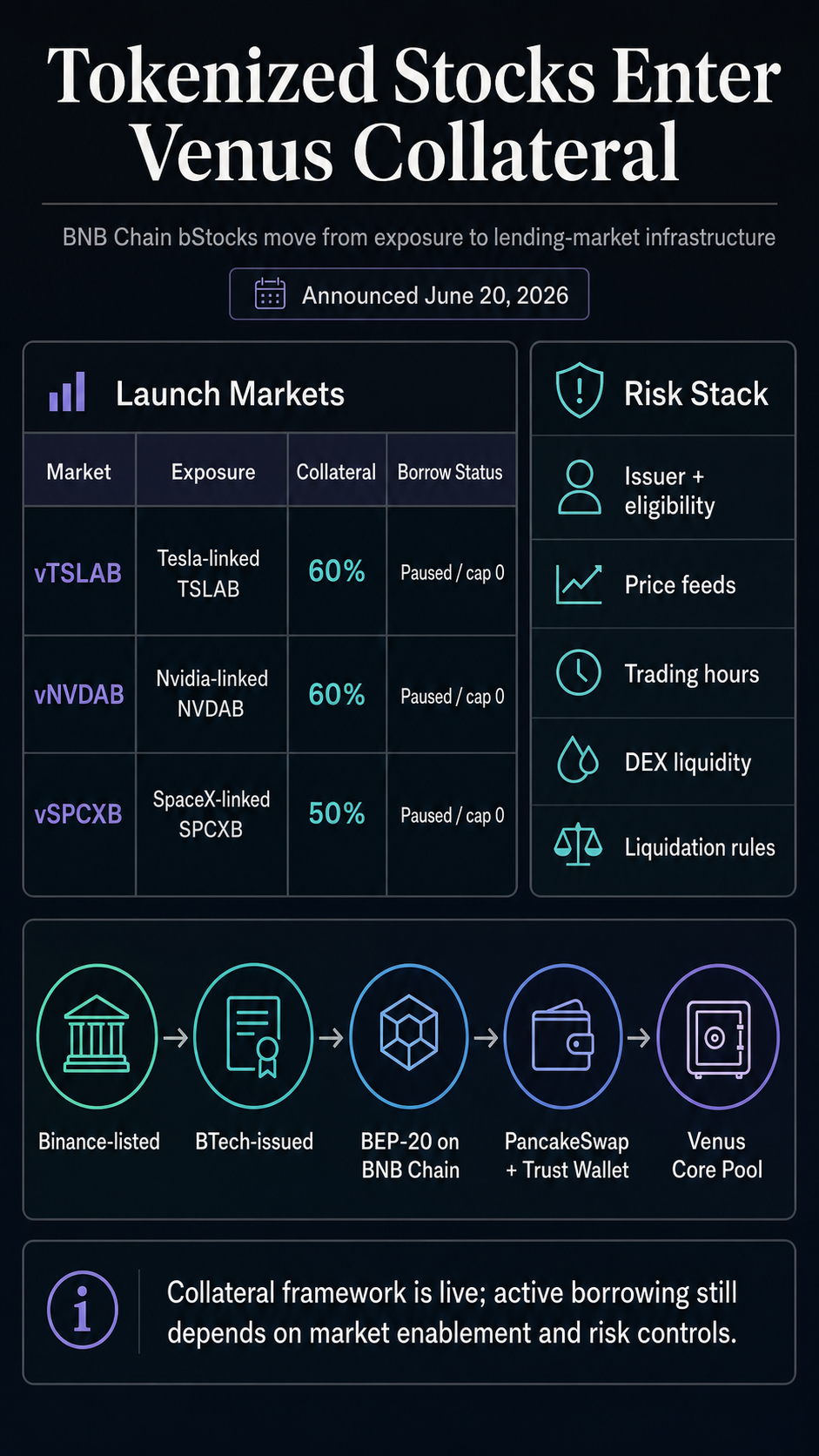
Venus has created a place for these assets to serve as collateral, while its verified launch record supports caution regarding claims that users are already borrowing USDT or USDC against the bStocks markets.
Stablecoins remain the likely practical category of lending assets as they provide the main liquidity track in DeFi.
The staged design gives Venus space to observe the assets before loan demand arrives. A collateral market needs sufficient supply, reliable prices and predictable liquidation paths before debt can be safely built on it.
That job is more difficult when the collateral refers to equity exposure rather than a token that is naturally traded on crypto platforms.
DeFi collateral markets usually start with crypto-native assets or stablecoins, as these markets trade continuously and have deep on-chain liquidity.
Tokenized stocks introduce a different set of timing and issuer dependencies. A position tied to a US stock may appear on-chain 24 hours a day, while the underlying stock market, issuer permissions, and price feeds may behave differently than that of a 24/7 crypto asset.
The collateral framework must take this mismatch into account before the product can be treated as another liquid token.

The issuer’s lines are now in the credit stack
The assets Venus adds are separate from common stock. Binance describes bStocks as 1:1-backed tokenized securities available to eligible users in permitted jurisdictions, and the Binance product materials identify BTech Holdings Limited as the issuer.
Users should think of the tokens as stock-linked exposure rather than direct ownership of Tesla, Nvidia or SpaceX stock. The product structure, eligibility rules and controls on the issuer remain part of the risk profile of the asset.
Binance separately listed the spot pairs TSLAB and NVDAB on June 11 and added SPCXB soon after, creating the exchange access layer before Venus added the collateral market layer.
BNB Chain then framed bStocks as BEP-20 tokenized US securities that can be staked via DeFi protocols, explicitly mentioning Venus as one of the integrations in its bStocks launch post.
The distribution process also has practical weight. PancakeSwap provides a decentralized trading route for bStocks, while Trust wallet provides wallet access.
Together, these integrations help move the tokens from centralized listing locations to self-custody and DeFi interfaces. When accessed via a wallet or DEX, the underlying eligibility, issuer, and market structure restrictions associated with equity-linked tokens remain.
The test for lending will be whether these rails can support a market in which the benefits of new collateral outweigh the additional constraints. A collateral market needs reliable prices, predictable liquidation processes, sufficient liquidity to sell collateral when necessary, and a clear insight into who can hold or redeem the underlying product.
These conditions can be more easily met for BTC, ETH, BNB or major stablecoins than for a token tied to an equity product, which is subject to jurisdiction and issuer-level limits.
This makes the BNB Chain Distribution more than just a reach statistic. If bStocks can switch between exchange access, wallets, DEX liquidity, and credit interfaces while keeping eligibility and risk controls intact, they will become a more serious test of the possibility of tokenized equity composability.
If one of these layers breaks down, the market could remain a collateral list with limited debt activity.
The test shifts from access to utility
CryptoSlate has been following the broader push to bring tokenized equity and real-world assets to DeFi, including the BNB Chain expansion of xStocks and the gap between tokenized asset issuance and true DeFi composability.
The launch of Venus fits into that broader pattern because it gives tokenized stocks a more demanding task than sitting in a wallet or trading on a DEX. That makes the launch an early test of collateral for real assets in a live cryptocurrency market.
The timing also puts Venus in the middle of a troubled regulatory conversation, as recent reporting on CryptoSlate has noted that tokenization leaves securities handling unresolved.

For tokenized equity lending, a two-part test arises. Protocols focus on liquidation mechanisms, while regulators and issuers focus on who has access to the instrument and what rights the token represents.
The market context gives the experiment some weight. CryptoSlate’s Venus page showed around $1.04 billion in TVL, while BNB is still one of the largest on-chain assets by market value.
Tether’s USDT and USD Coin remain the main liquidity rails in the crypto markets. The launch of bStocks is early and not on day one of systemic importance, but places the test within an ecosystem of locations and chains large enough that the outcome will count as supply and lending evolve later.
The following signals are clear. First, whether Venus will allow lending in these specific markets and what assets will become available. Second, whether there will be collateral supply without relying primarily on incentives.
Third, whether price feeds and liquidation rules hold if crypto is continuously traded, but equity-linked exposure, depends on the off-chain market structure. Finally, the question is whether Venus will expand beyond TSLAB, NVDAB, and SPCXB while maintaining similar limits and protections.
The originating record shows an early, revelatory phase: Venus has built the first layer of a collateral market for equity-linked tokens, and the first guardrails show how much needs to happen before that exposure can function as productive DeFi collateral.