
Crypto charts can look simple after a big green move. Then price stalls, candles shrink, and you’re left guessing: is the rally cooling off, or is the market just catching its breath?
That’s where the bull flag pattern helps. It gives you a cleaner way to read a sharp price increase, a controlled pullback, and a possible continuation before you risk a long position.
What Is a Bull Flag Pattern in Crypto?
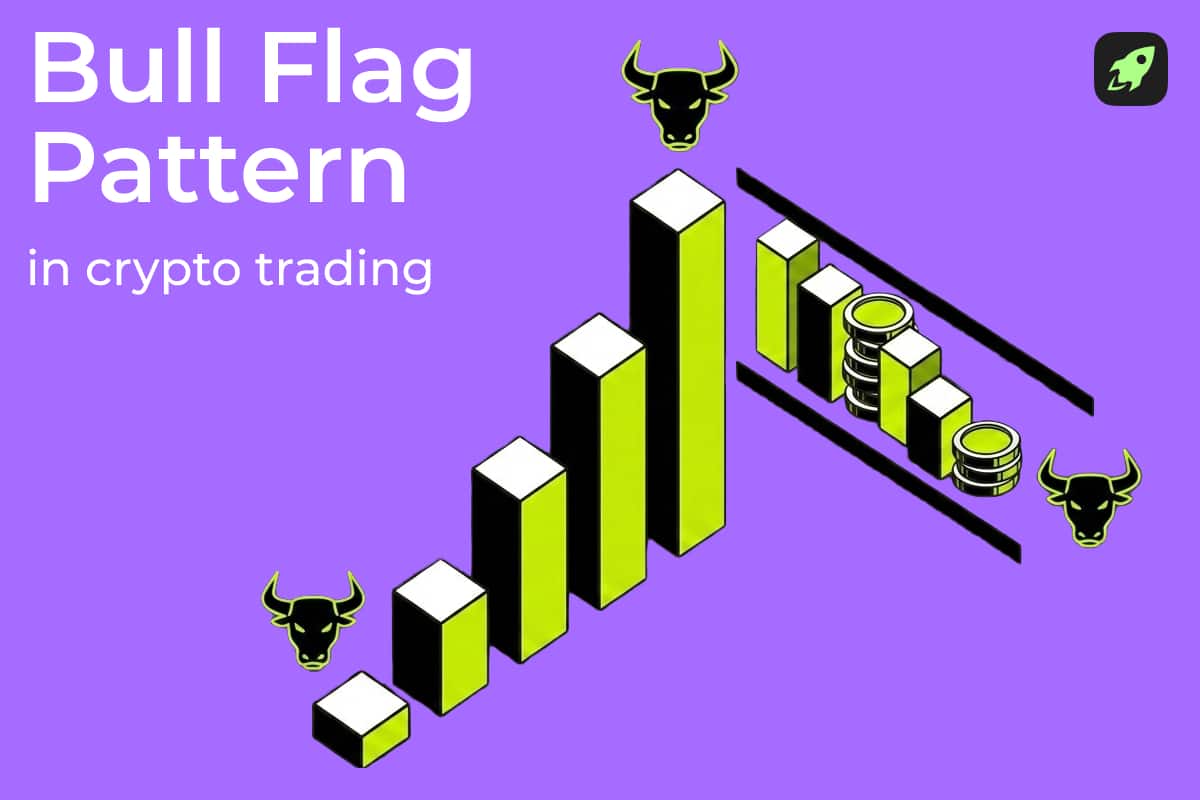
A bull flag pattern is a bullish continuation pattern used in technical analysis. It appears after a strong upward price movement, followed by a short consolidation phase, and then a possible breakout higher.
The pattern has two main parts:
- Flagpole: the sharp price increase that starts the setup.
- Flag: the flag consolidation channel where price moves sideways or slightly lower.
The bull flag belongs to the broader flag pattern family. These are continuation patterns because they suggest a temporary pause in the current trend, not necessarily a reversal.
A bull flag crypto setup depends on a prior upward trend. Without a clear move higher first, the structure is usually just ordinary consolidation or range-bound price action.
A confirmed bull flag breakout happens when price breaks above the flag’s upper boundary. Many traders wait for a candle close above the upper trendline instead of relying on a brief wick.
Why Do Crypto Traders Watch Bull Flag Patterns?
Crypto traders watch bull flag patterns because they can help show whether bullish momentum is still alive after a fast move. The setup can act like a planning tool, not a prediction machine.
Think of it like a sprinter catching their breath. The flagpole shows strong buying pressure. The flag portion shows a temporary pause where price consolidates in a narrow range. If buyers step back in and price breaks higher, the bullish trend may continue.
You can find bull flag setups on Bitcoin, Ethereum, and altcoin charts. They can appear on intraday charts, daily charts, or higher time frames. Still, market conditions matter. A pattern that looks clean on a price chart can fail fast if volatility spikes, liquidity dries up, or news changes market sentiment.
That’s why bull flags work best when you combine them with broader market context, support and resistance levels, volume confirmation, and clear risk management strategies.
What Are the Main Parts of a Bull Flag Pattern?
A well formed bull flag has a few clear parts. If one of them is missing, the setup becomes weaker.
- Flagpole: The flagpole is the strong upward move before consolidation. It shows sharp price action and strong buying pressure.
- Flag consolidation channel: The flag is the period of consolidation after the impulse move. Price moves sideways or slightly downward, often inside a parallel channel.
- Upper trendline: The upper trendline acts as resistance. You watch this level for the bull flag breakout.
- Lower trendline: The lower trendline acts as support. You can use it as a stop-loss reference or invalidation area.
- Breakout point: The breakout point appears when price breaks above the flag’s upper boundary.
- Trading volume: Volume helps confirm the setup. A healthy pattern often shows high trading volume during the flagpole, lower volume during consolidation, and renewed volume expansion on the breakout.
The cleaner these parts are, the easier it is to judge the market structure. If the flag formation looks too wide, messy, or retraces too deeply, the setup may not be a reliable continuation pattern.
How Does a Bull Flag Pattern Form?
A bull flag usually begins with a strong prior uptrend. Buyers push the asset higher, and the price moves quickly. This creates the flagpole.
After the sharp price increase, price slows down. Some buyers take profit, while new buyers wait for a better entry point. This creates a controlled pullback or sideways consolidation.
During the consolidation period, trading volume often decreases. That can suggest weaker selling pressure rather than a full trend reversal. The market enters a temporary pause, and price consolidates inside a narrow range.
Next comes the breakout attempt. If price breaks above the upper boundary with stronger volume, the bullish flag pattern may confirm. If price fails to hold above resistance, the setup can turn into a false breakout.
Essentially, a bull flag pattern fails when the market loses structure. More on that below.
How Can You Identify a Bull Flag on a Crypto Chart?
Start with the trend. A bull flag chart pattern needs a clean upward trend before the flag. If there’s no obvious flagpole, there’s no bull flag.
Next, look at the consolidation phase. A healthy bullish flag usually moves sideways or slightly downward. It shouldn’t retrace too deeply or collapse through key support.
Then draw the trendlines. The flag structure usually has two parallel or near-parallel trendlines. The upper boundary marks resistance, while the lower boundary marks support.
Use this checklist:
- Price makes a sharp move higher.
- The flagpole is easy to see.
- Price consolidates in a controlled range.
- The flag slopes sideways or slightly downward.
- The upper and lower trendlines are roughly parallel.
- Volume drops during the flag portion.
- Price breaks above the upper trendline.
- The breakout candle closes above resistance.
- Volume expands during the breakout.
You don’t need every chart to look perfect. But if you have to force the lines, the setup probably isn’t clean enough.
What Does Volume Tell You About a Bull Flag?
Trading volume helps you judge conviction. It doesn’t prove the pattern, but it can make the signal stronger or weaker.
A healthy bull flag often shows this rhythm:
- High volume during the flagpole.
- Lower volume during the consolidation phase.
- Higher volume during the breakout.
Lower volume during the flag can suggest that sellers aren’t in control. Volume expansion during the breakout can show renewed market participation.
Weak breakout volume is a warning sign. Price may move above resistance, then fall back inside the pattern. That’s one common way false breakouts happen.
In crypto, volume can be tricky. Spot volume, futures volume, and perpetual markets don’t always show the same activity. So don’t use volume on its own. Read it together with price action, market momentum, liquidity, and broader market conditions.
How Can You Trade a Bull Flag Pattern in Crypto?

There are three common ways to trade a bull flag. Each one has a different risk profile.
Aggressive Entry Near Flag Support
Some traders enter near the lower trendline while the flag is still forming. This can offer a better risk-reward ratio because the stop-loss can sit close to support.
The downside is confirmation. You’re entering before the breakout, so the pattern can still fail.
Breakout Entry Above Resistance
A breakout entry happens when price breaks above the flag’s upper boundary. This confirms the bullish flag chart pattern more clearly than an early entry.
The risk is slippage. Crypto can move fast, especially on low-liquidity altcoins. If you enter too late, your entry point may weaken the trade’s risk-reward ratio.
Retest Entry After the Breakout
A retest entry happens after price breaks out, pulls back to the breakout level, and holds it as support. This approach can reduce false breakout risk. But you may miss the move if price doesn’t retest and keeps climbing.
No entry style is perfect. Pick one that fits your trading strategy, time frame, and risk management plan.

How to Get Free Crypto
Simple tricks to build a profitable portfolio at zero cost

Where Should Stop-Loss and Take-Profit Levels Go?
A bull flag trade needs an invalidation level before entry. That means you decide where the setup is wrong before you place the trade.
Common stop-loss areas include:
- Below the lower trendline.
- Below local support.
- Below a recent swing low.
- Below the flag consolidation channel.
The goal isn’t to guess perfectly. It’s to define downside risk before the trade moves against you.
For profit targets, many traders use a measured move. They measure the height of the flagpole and project it upward from the breakout point. This creates an estimated target, not a promise.
You should also compare the target with nearby resistance, market structure, and the risk-reward ratio. If the target is too close or the stop-loss is too wide, the trade may not be worth taking.
Read more: How to Take Profits in Crypto? A Complete Guide
When Does a Bull Flag Pattern Fail?

A bull flag can fail even when it looks clean. Crypto moves fast, and false signals are common.
Watch for these failure signs:
- Price falls below the lower trendline.
- Price breaks out, then falls back inside the flag.
- Breakout volume is weak or missing.
- The consolidation retraces too deeply.
- The flag becomes too long or messy.
- Price moves sideways for several weeks and turns into a different pattern.
- A news shock changes market direction.
- A low-liquidity altcoin produces a wick-heavy fakeout.
A pattern fails when price action no longer supports the original idea. Don’t keep adjusting the lines just to make the setup work.
What Are the Biggest Risks of Using Bull Flags in Crypto?
Bull flags can be useful, but they’re not a tool you can trade blindly. Crypto adds extra risk on top of that, since markets trade 24/7 and react quickly to sentiment shifts.
The biggest risks include:
- Market volatility: Long wicks can trigger stop-losses before price continues.
- Liquidity gaps: Thin order books can create slippage during entries and exits.
- Leverage risk: A small invalidation move can cause liquidation if you use too much leverage.
- Exchange-specific pricing: One exchange may wick differently from another.
- Token unlocks and news events: Supply changes, hacks, lawsuits, or regulatory updates can break the setup.
- Overconfidence after a pump: A strong flagpole can make you ignore risk.
- Pattern reliability limits: Bull flags are probability-based setups, not guarantees.
The best way to manage these risks is simple: use position sizing, define invalidation, avoid overleveraging, and don’t treat every small pullback as a bullish flag.
How Is a Bull Flag Different From Similar Patterns?
Bull flags can look similar to other chart patterns. The key differences come from the prior move, consolidation shape, and breakout direction.
| Pattern | Prior Move | Consolidation Shape | Trendlines | Breakout Bias |
| Bull flag | Upward trend | Sideways or downward channel | Parallel | Upward |
| Bear flag | Downward trend | Sideways or upward channel | Parallel | Downward |
| Pennant | Sharp move either way | Small triangle | Converging | With prior trend |
| Triangle | Varies | Wider triangle structure | Converging | Depends on setup |
| Rectangle | Varies | Sideways range | Horizontal | Depends on breakout |
A bull flag is the bullish version. A bear flag pattern is the bearish continuation pattern. Bear flags form after a sharp price decrease and consolidation, then suggest possible continuation lower.
A pennant differs because it uses converging trendlines. A flag chart pattern usually uses a parallel channel.
A rectangle consolidation can look like a flag, but it often lasts longer and may not have the same strong flagpole. If the setup loses its clean continuation structure, don’t force the bull flag label.
Read more: Triangle Chart Patterns in Crypto Trading
Which Indicators Can Support a Bull Flag Setup?
Technical indicators can support a bull flag setup, but they shouldn’t replace price action. Use them as filters.
Helpful tools include:
- RSI: RSI can show whether bullish momentum remains strong or starts weakening.
- MACD: MACD can help confirm trend direction and momentum shifts.
- Moving averages: Moving averages can show whether price remains in a broader upward trend.
- Support and resistance: These levels help you judge breakout quality and target areas.
- Higher time frame trend: A bull flag on a lower time frame is stronger when the higher time frame also supports the move.
- Volume tools: Volume confirmation can help reduce false breakout risk.
Other technical analysis tools can add context, but too many indicators can create confusion. Keep the setup simple enough to act on.
How Can You Use a Bull Flag Without Overtrading?
Bull flags appear often in crypto, but not every flag setup deserves a trade. Overtrading usually starts when you see patterns where the market hasn’t actually created one.
Use this checklist before you enter:
- Is there a strong upward price movement before the flag?
- Is the flag structure clear?
- Is price consolidating in a controlled pullback?
- Are the trendlines parallel or close to parallel?
- Is the consolidation short compared to the flagpole?
- Is volume lower during the flag portion?
- Has price broken above the upper trendline?
- Is there volume confirmation on the breakout?
- Do you know your stop-loss before entry?
- Does the trade offer a reasonable risk-reward ratio?
- Does the broader market context support the setup?
If the answer is mostly no, skip it. Waiting is part of a trading strategy too.
Is a Bull Flag Pattern Reliable in Crypto?
A bull flag can be useful, but it’s never guaranteed. It’s a probability-based technical analysis pattern that works best when the structure is clean, volume confirms the breakout, and broader market conditions support the trend.
Reliability depends on:
- Time frame.
- Liquidity.
- Volatility.
- Market sentiment.
- Breakout volume.
- Trend strength.
- Risk management.
There’s no universal win rate that applies across every asset, exchange, or time frame. A bull flag on Bitcoin’s daily chart isn’t the same as a bull flag on a low-liquidity altcoin’s five-minute chart.
Use the pattern to build a plan, not to predict the future with certainty.
Final Thoughts
The bull flag is a useful bullish pattern when price rises sharply, pauses, and then attempts to continue higher. It helps you plan entries, stop-losses, and profit targets with more structure.
Still, no chart pattern protects you from false breakouts, weak volume, or sudden crypto volatility. Use bull flags with confirmation, clear invalidation, and proper risk management. That’s how the setup becomes a tool, not a guess.
Disclaimer: Please note that the contents of this article are not financial or investing advice. The information provided in this article is the author’s opinion only and should not be considered as offering trading or investing recommendations. We do not make any warranties about the completeness, reliability and accuracy of this information. The cryptocurrency market suffers from high volatility and occasional arbitrary movements. Any investor, trader, or regular crypto users should research multiple viewpoints and be familiar with all local regulations before committing to an investment.