
World Liberty Financial’s WLFI token is once again under scrutiny as the Donald Trump family-backed crypto project attempts to rebuild demand and confidence after its recent plunge to an all-time low.
World Liberty Financial has responded with WLFI token burns, exchange integrations and rewards programs tied to its USD1 stablecoin, a campaign aimed at restoring activity in the WLFI ecosystem after months of pressure from governance disputes, addressing concerns and questions about liquidity.
While these efforts have helped improve market sentiment, they have also created a new liquidity window for long-dormant holders to take profits.
This reflects the challenge facing a token whose recovery still relies heavily on incentives, access to exchanges, and trust in the project’s governance.
World Liberty Financial targets WLFI burns and USD1 rewards after all-time lows
The ecosystem’s turnaround strategy follows a severe market downturn that has sent the Trump-related project down nearly 88% from its historic high.
To restore market confidence, World Liberty Financial has accelerated the burning of WLFI tokens as part of a broader campaign to reduce supply.
On a chain facts from Arkham Intelligence confirmed that the project permanently burned 3 billion WLFI tokens, removing approximately $180.8 million in market value from circulation.

The move followed a previously approved board proposal to permanently destroy up to 10% of the total tokens of founders, team members, advisors and partners, representing approximately 4.5 billion tokens.
In addition to supply contraction, the project seeks to convert its USD 1 stablecoin into the primary utility for the ecosystem. Rather than relying solely on demand for organic tokens, World Liberty leverages major crypto exchange infrastructures to drive commercial adoption.
The launch of a new USD1/BTC trading pair on Binance expanded access to Binance futures collateral, allowing market participants to use the World Liberty stablecoin as collateral for Bitcoin futures contracts for the first time.
At the same time, cryptocurrency exchange Bybit introduced USD1 to its platform, integrating the token as a viable collateral for margin trading, crypto lending, institutional lines of credit, and post-payment services.
To accelerate adoption, Bybit and World Liberty Financial launched a Bybit USD1 rewards campaign. The program injects a 45 million WLFI rewards pool into the market, allowing users to earn an Annual Percentage Rate (APR) of up to 20% for staking and holding USD1, directly linking demand for WLFI tokens to broader adoption of stablecoins.
The WLFI recovery gives dormant holders an exit window for World Liberty Financial
The combination of World Liberty Financial’s structural problems and high-yield currency promotions caused a rebound in WLFI trading, but the sudden influx of market liquidity had unintended operational consequences.
Facts from the blockchain analysis platform Santiment shows that on May 18, World Liberty recorded the highest ever realized profit and age day by a wide margin.
On that day, market participants sold a net 1.8 billion WLFI tokens at a profit. At the same time, the network’s age consumption metric, which multiplies the volume of tokens moved by the duration of their inactivity, rose to 17.4 trillion.
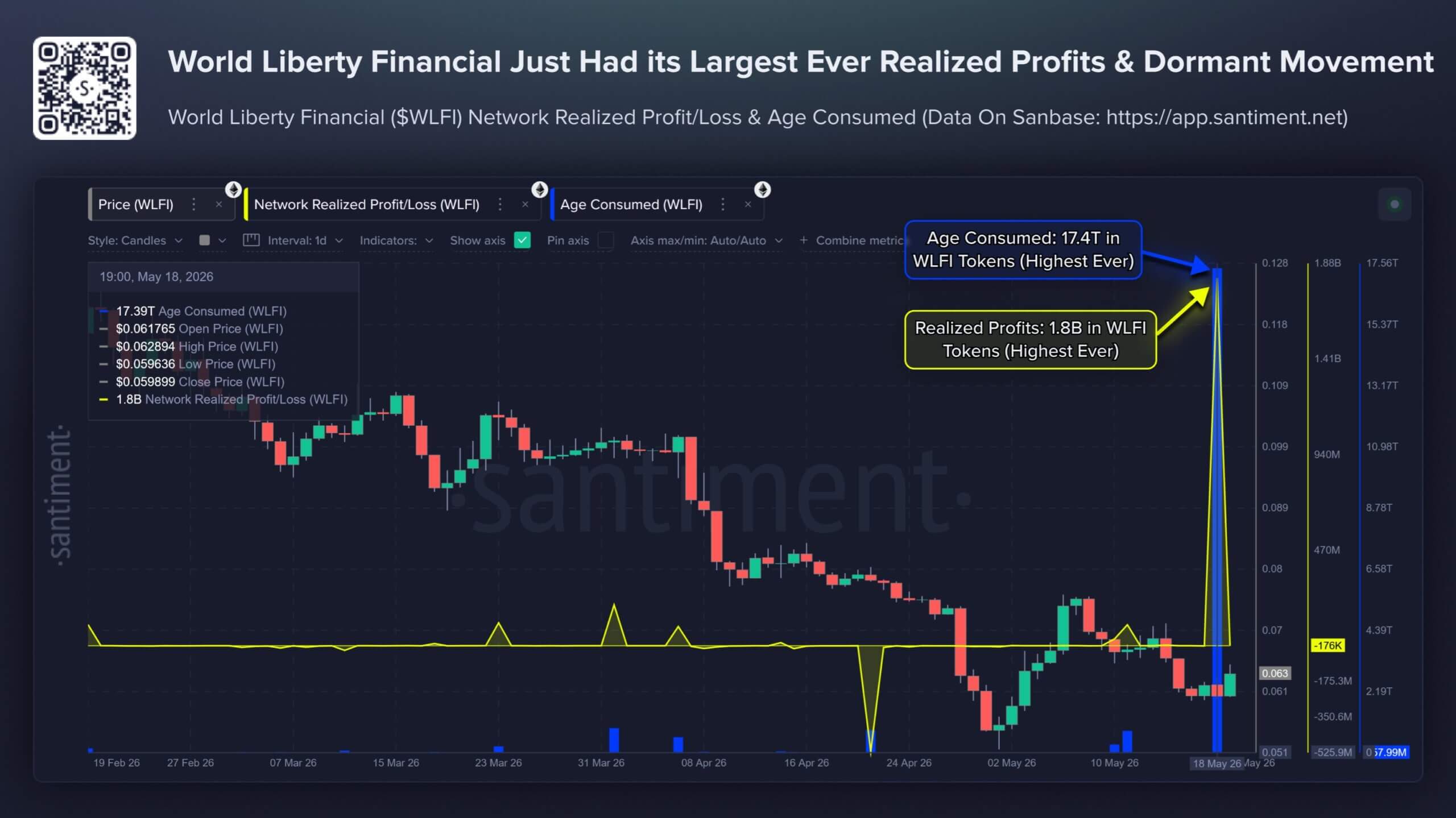
Santiment stated that the spike in transactions immediately followed the integration of Binance futures collateral.
The data shows that while the new exchange infrastructure has successfully revived declining market activity, it has primarily served as a mechanism for old, dormant holders to liquidate their positions and exit the ecosystem.
According to the blockchain analytics firm, the market has absorbed a significant portion of this selling pressure. WLFI rose 5.5% after the double metric peaks, showing that immediate currency demand softened the impact of profit taking.
However, the magnitude of the dormant token movement indicates that any sustainable price recovery must continue to consume excess supply from early participants waiting for deeper market liquidity.
AI Financial shows that the financial stress of World Freedom is spreading to the public markets
Financial pressures within the World Liberty Financial network have gone beyond decentralized token markets and are now impacting the balance sheets of public companies.
The first quarter regulatory filing from AI Financial (formerly ALT5 Sigma Corporation) shows how the volatility of digital assets can disrupt traditional corporate treasury structures.
AI Financial built its corporate treasury model entirely around the World Liberty ecosystem. In August 2025, the company conducted a massive $1.5 billion capital raise, evenly split between a registered direct offering and a private placement settled in tokens, to acquire 7.28 billion WLFI tokens at a cost basis of $0.20 per token.
According to the latest filing for the quarter ended March 28, the market decline forced the company to post an unrealized mark-to-market loss of $348.3 million on its token treasury. This adjustment reduced the book value of the digital assets to $706.4 million, less than half the original purchase price.
The writedown jeopardized the company’s bottom line, resulting in a net loss of $271.3 million from continuing operations for the quarter, compared to a net loss of $2.4 million in the year-ago period.
More importantly, contractual lockups make AI Financial’s $706 million asset base useless for day-to-day survival.
Under a Token Purchase Agreement, 3.53 billion tokens remain contractually non-transferable for 12 months.
The remaining 3.75 billion tokens, held under a Securities Purchase Agreement, cannot be sold until the company obtains shareholder approval, executes a formal amendment to its corporate charter and files an effective resale registration statement with regulators.
As a result, AI Financial ended the quarter with $10.5 million in cash, $32.2 million in total assets and $39.1 million in total liabilities, leaving the company with a working capital deficit of $5.5 million.
The financial pressure led management to declare that there is “substantial doubt” about the company’s ability to continue as a going concern within a year.
To support its operations, AI Financial has added a layer of related party debt. In January, the company borrowed nearly $15 million under a loan agreement directly from World Liberty Financial.
The company’s management announced that it could use the funds to implement a share buyback program and purchase additional WLFI tokens, using project debt to support both the public equity and the underlying ecosystem.
World freedom The struggle for financial governance puts the ecosystem under scrutiny
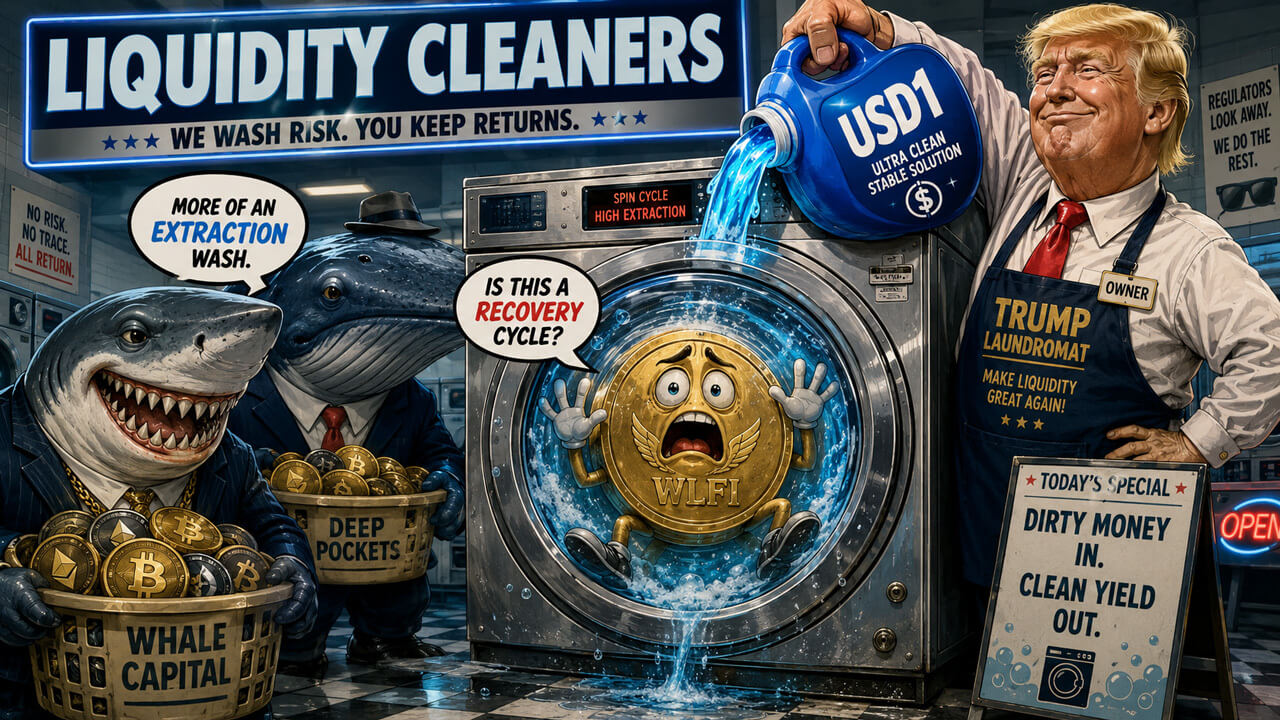
World Liberty’s ecosystem challenges extend beyond asset price fluctuations, cash shortages and corporate accounting policies.
The project is currently pursuing a defamation lawsuit against prominent crypto entrepreneur Justin Sun, a prominent backer of the project.
Sun had claimed that World Liberty’s developers had quietly embedded secret blacklisting features directly into the project’s smart contracts.
According to its legal documents, these features provide the core team with administrative loopholes to unilaterally freeze user wallets and limit individual participation in protocol management.
World Liberty has dismissed Sun’s claims as defamatory. The project also went against Sun, claiming that Tron’s founder made a coordinated effort to suppress the token’s market price during its public launch in September.
The lawsuit alleges that Sun actively short-circuited the asset and improperly transferred governance-bearing WLFI tokens to Binance to manipulate the direction of the project.
In addition to the legal dispute, on-chain data shows that the project previously used 5 billion WLFI tokens as collateral to borrow more than $75 million in USDC.
This move has drawn widespread criticism from crypto observers and US lawmakers alike. For context, Senator Elizabeth Warren has led an aggressive, ongoing effort to investigate this World Liberty Financial action and its ties to the Trump family.
The lawmaker urged the SEC to investigate the project. proverb:
“WLF’s activities appear to have benefited the Trump family at the expense of investors, who faced unexpected challenges in accessing their tokens. Early investors remain locked out of 80% of their token holdings and unable to sell into a market that has already moved strongly against them.”