
Crypto charts can look clean until one tiny candle ruins your confidence. Price pumps, dumps, then closes almost where it started. Is this a reversal, a pause, or just market noise? That’s the problem with the doji candlestick pattern crypto traders keep seeing. It looks simple, but it only helps when you read the full setup.
What Is a Doji Candlestick Pattern in Crypto?
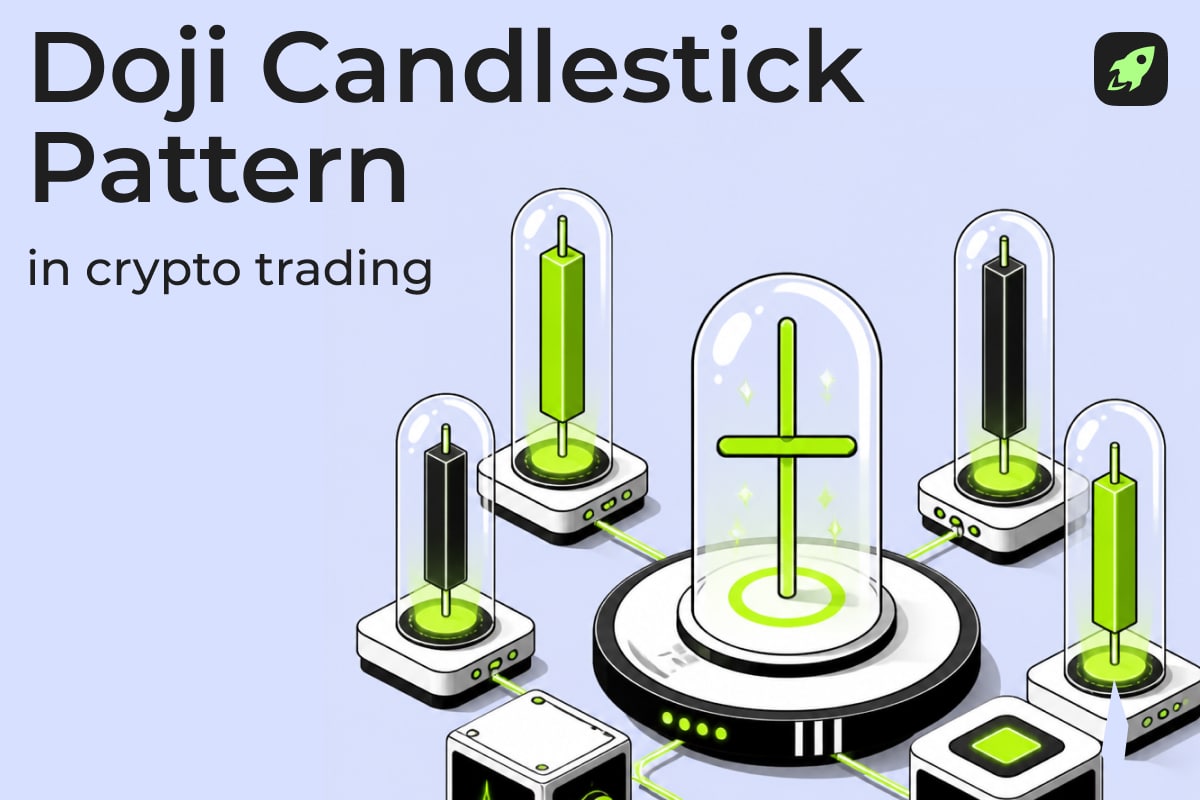
A doji candlestick pattern forms when an asset’s opening and closing prices are equal or so close that the candle has little to no visible real body. On a candlestick chart, this structure usually signals market indecision because neither bulls nor bears controlled the full trading period.
In crypto, a doji candle can appear on a 1-minute ETH price chart, a daily Bitcoin chart, or a weekly altcoin chart. The basic doji candlestick meaning stays the same, but the signal’s strength depends on price action, the market trend, support and resistance, volume, and what happens next.
There are several types of doji, including standard doji, dragonfly doji, gravestone doji, long-legged doji, four-price doji, Rickshaw Man doji, and doji star pattern setups. Most doji patterns point to indecision in the market, but they don’t predict future price movements by themselves.
How Does a Doji Candlestick Work?
A doji reflects uncertainty, but its meaning depends on context. To read a doji candle pattern well, you need to understand its structure, the trading session behind it, and the surrounding price movement.
OHLC Data Behind Every Candle
Open, high, low, and close prices—known as OHLC—form the basis of candlestick analysis. Each candlestick represents one selected time interval and summarizes what happened during that period.
• Open: The price at the beginning of the selected time frame.
• High: The highest price reached during that time frame.
• Low: The lowest price traded during that time frame.
• Close: The final price at the end of the trading period.
How to Get Free Crypto
Simple tricks to build a profitable portfolio at zero cost

Real Body, Upper Shadow, and Lower Shadow
A candlestick has a real body, an upper shadow, and a lower shadow. The real body shows the difference between the opening and closing prices. In a classic doji formation, that body is extremely small because the close finishes near the open.
The upper shadow marks the highest price reached, while the lower shadow marks the lowest price reached during the session. The position and length of the wicks reveal how strongly buyers and sellers fought before price stabilized.
Buyer Pressure and Seller Pressure Inside One Candle
A doji represents indecision because buyers and sellers both push price but neither side keeps control by the close. Price may move sharply higher or lower during the trading session, yet the doji candlestick forms when the final close lands near the open.
That doesn’t make the candle bullish or bearish on its own. It only shows that market participants tested both directions and ended in a near stalemate.
Why the Close Near the Open Matters
A doji indicates market indecision because the market moved during the session but made little net progress by the close. This neutral doji structure can be useful when it appears after a strong move, near support and resistance levels, or inside a larger reversal pattern.
Still, the candle doesn’t provide a standalone signal. It adds context to market sentiment and helps you judge whether momentum is fading, pausing, or waiting for a breakout.
Time Interval and Candle Formation
A doji can form on any time frame, from intraday trading charts to weekly or monthly charts. The time interval matters because it changes how much activity the candle captures.
A doji on a weekly chart reflects more market participation than one on a 5-minute chart. That’s why higher-timeframe doji signals often carry more weight, while low-timeframe signals are easier to misread.
What Does a Doji Tell Crypto Traders?
A doji can signal several things at once. It may reflect equilibrium, hesitation, fading momentum, or a pause before a larger move. The key is where the pattern appears and how price reacts afterward.
- Market indecision as the core signal: The main doji meaning is uncertainty. A doji represents a point where neither buyers nor sellers have clear control.
- Buyer-seller equilibrium: A doji shows balance between buying pressure and selling pressure. That balance can break in either direction.
- Momentum pause after strong price movement: A doji appears after strong trends when bullish momentum or bearish momentum starts to slow, but that pause doesn’t guarantee a reversal.
- Reversal, continuation, or consolidation outcomes: A doji may precede a trend reversal, trend continuation, price reversal attempt, or sideways consolidation. The next candles decide the stronger read.
Is a Doji Candlestick Bullish or Bearish?
A doji candlestick isn’t inherently bullish or bearish. Its baseline interpretation is neutral, and its signal changes with trend context, support and resistance, and confirmation.
- Neutral baseline interpretation: A doji is a neutral doji first. It signals hesitation, not direction.
- Bullish context after a downtrend: A doji after a bearish trend can suggest a potential bullish reversal, especially near support. A strong bullish candle after the doji can turn the setup into a more convincing bullish signal.
- Bearish context after an uptrend: A doji after an uptrend can warn that bullish momentum is fading. If the next candle is a bearish candle and closes lower, the setup may point to a bearish reversal.
- Sideways-market interpretation: In a range, doji patterns often confirm existing indecision rather than signal a fresh move.
So, is a doji candlestick bullish? Sometimes, but only in the right context. A bullish doji or doji bullish setup needs follow-through. The same rule applies to a bearish doji.
What Are the Main Types of Doji Candlestick Patterns?
Different doji candlestick types share the same core idea, but their wicks change the interpretation. Here are the main types of doji you’ll see in candlestick patterns.
Standard Doji

A standard doji has a very small or invisible real body with upper and lower shadows. It’s the baseline doji candlestick pattern and usually signals market indecision rather than a clear directional move.
Dragonfly Doji

A dragonfly doji has a long lower shadow, little or no upper shadow, and an open and close near the high. When a dragonfly doji forms after a downtrend or near support, it can act as a potential bullish reversal pattern if a bullish candle confirms it.
Gravestone Doji

A gravestone doji has a long upper shadow, little or no lower shadow, and an open, close, and low near the same price. After an uptrend or near resistance, it can signal a potential bearish reversal.
Long-Legged Doji

A long-legged doji has long upper and lower shadows, with opening and closing prices near each other. It shows strong intraperiod conflict and high indecision in the market.
Four-Price Doji

A four-price doji occurs when open, high, low, and close prices are identical. This price doji reflects almost no movement and often appears in illiquid or inactive conditions.
Rickshaw Man Doji

A Rickshaw Man doji is a subtype of the long-legged doji. It has long upper and lower shadows with the open and close near the middle of the candle range, showing strong buyer-seller equilibrium.
Doji Star Pattern

The doji star pattern is a broader multi-candle setup rather than a single candle type. It appears after a prior move and can support a potential reversal read when the surrounding candles confirm the shift.
How Is a Dragonfly Doji Used in Crypto Trading?
You usually read a dragonfly doji candle through structure, location, and confirmation. It can be useful, but only when the broader setup supports the signal.
Long Lower Shadow Structure
The long lower shadow shows that sellers pushed price down during the session, but buyers forced it back up by the close. That rejection of low prices is the key feature of the dragonfly doji.
Open, High, and Close Alignment
A dragonfly doji forms when the open, high, and close cluster near the top of the range. That structure shows that bearish pressure failed to hold through the close.
Downtrend Context
The pattern is most often discussed after a downtrend. In that context, it may suggest a potential bullish reversal, but it remains an early signal until price confirms it.
Support-Level Relevance
A dragonfly doji near support carries more weight than one floating in random price action. The level helps show where selling pressure may be weakening.
Bullish Reversal Potential
A dragonfly doji can become a bullish reversal signal when it appears after a decline and buyers follow through. Without confirmation, it’s only a warning that momentum may be changing.
Confirmation Candle Requirement
Many traders wait for the next candle to close above the dragonfly doji high before considering a long entry. Strong volume can add confidence to that signal.
How Is a Gravestone Doji Used in Crypto Trading?
A gravestone doji is often treated as the bearish counterpart to the dragonfly doji. You use it to assess possible exhaustion after upward moves.
Long Upper Shadow Structure
The long upper shadow shows that buyers pushed price higher but failed to keep it there. By the close, price returned near the session low.
Open, Low, and Close Alignment
In a gravestone doji, the open, low, and close cluster near the bottom of the range. That structure highlights failed upside pressure.
Uptrend Context
A gravestone doji becomes more meaningful after an uptrend, where it can signal fading bullish momentum. Even then, it still needs confirmation.
Resistance-Level Relevance
A gravestone doji near resistance often attracts attention because the level adds weight to the bearish interpretation.
Bearish Reversal Potential
If the pattern appears after a strong move up, it can suggest a bearish reversal. It remains conditional until later price action confirms the setup.
Confirmation Candle Requirement
Many traders wait for a bearish candle to close below the gravestone doji low before treating it as a valid signal. Volume and other indicators can help filter false signals.
How Is a Long-Legged Doji Interpreted?
The long-legged doji is one of the clearest visual signs of intraperiod conflict. It reflects both volatility and indecision.
Long Upper and Lower Shadows
Long upper and lower shadows show that buyers and sellers both pushed price sharply during the session. Neither side held control by the close.
High Intraperiod Volatility
A long-legged doji can close near its open while still reflecting major swings during the session. That makes it a sign of volatility as well as indecision.
Strong Buyer-Seller Conflict
This pattern shows a clear struggle between buyers and sellers. It doesn’t predict direction on its own, but it does show that the market was unstable during that period.
Consolidation Possibility
A long-legged doji can appear before consolidation. Price may move sideways while market participants wait for stronger direction.
Breakout Possibility
It can also appear before a breakout. You can watch for price to move above the high or below the low of the candle to resolve the indecision.
Higher-Timeframe Relevance
Long-legged dojis often carry more weight on higher time frames because they capture more market activity and filter out more noise.
How Do Support and Resistance Change Doji Meaning?
Support and resistance don’t change a doji’s structure, but they can change its importance. A doji at a key level usually matters more than one in the middle of a range.
Doji Near Support

A doji near support can suggest that selling pressure is weakening. In the right context, it may point to a potential bullish reversal or a short-term bounce.
Doji Near Resistance

A doji near resistance can signal hesitation after a climb. If price rejection appears there, you may read it as a possible bearish setup.
Doji Inside a Trading Range
A doji inside a tight range often adds little new information. It usually confirms existing indecision rather than signaling a fresh move.
Doji Near Breakout Zones
A doji near a breakout zone can show that the market is waiting for direction. The breakout direction often determines whether the pattern supports continuation or reversal.
How Can Traders Confirm a Doji Signal?
You shouldn’t build a trading strategy around a doji alone. Confirmation from price action, trading volume, and technical indicators helps reduce false signals.
- Confirmation candle: The next candle can confirm direction by closing above or below the doji range.
- Trading volume: Higher volume can show stronger buyer or seller commitment, while weak volume may reduce confidence.
- Relative Strength Index: RSI can add context when the market is overbought or oversold.
- MACD: MACD crossovers or divergence can help confirm or reject a momentum shift.
- Moving averages: Price position relative to major moving averages can add trend context.
- Bollinger Bands: A doji near a band edge can support a breakout or mean-reversion read when other evidence agrees.
Other candlestick patterns can also add context. For example, bullish engulfing after a doji can strengthen a bullish reversal read, while bearish engulfing can support a bearish reversal read. A three white soldiers candlestick pattern may also confirm strong follow-through after a pause.
How Do Timeframes Affect Doji Reliability in Crypto?
| Low-Timeframe Doji | High-Timeframe Doji | |
| Noise level | High, with rapid whipsaws and false intraday reads. | Lower, with more short-term noise filtered out. |
| False signal frequency | Frequent because many dojis reflect short-lived uncertainty. | Less frequent because each candle captures more activity. |
| Market participation captured | Mostly short-term traders, bots, and fast reactions. | Broader behavior from swing traders and larger market participants. |
| Typical use case | Scalping or reacting to short technical structures. | Spotting possible market structure shifts or larger pauses. |
| Signal weight | Lightweight and easily overridden by other signals. | More meaningful for broader candlestick analysis. |
Intraday doji patterns often reflect low-timeframe market noise, which makes them less reliable in fast conditions. Daily and weekly doji patterns usually carry more weight because they capture more market participation and reduce random chart noise.
That doesn’t make higher-timeframe dojis perfect. It only means you should treat them as more important reference points when building a trade plan or comparing multiple time frames.
Why Is Crypto Different for Doji Candlestick Patterns?
Crypto trades 24/7, unlike many traditional financial markets with fixed sessions. That affects when candlestick patterns form and how volume behaves across the day. A doji candlestick appears at any hour, and the same pattern can look different during active market hours, quiet weekends, or major news events.
Crypto is also highly volatile, so isolated doji signals can fail quickly. A single candle rarely tells the full story, especially on low time frames or illiquid tokens.
For that reason, trading doji candlesticks in crypto works best with confirmation, broader technical analysis, and strict risk management. Recognizing the shape is easy. Knowing when it deserves attention is the harder part.
How Can Beginners Read a Doji Step by Step?
Use this seven-step checklist to read doji formations in real time and understand what the candlestick is signaling within the broader setup.
Step 1: Identify the Candle Body
Open your chart and look for candles with a tiny or invisible body. A doji stands out because there is little distance between the open and close.
Step 2: Compare Open and Close
Check the candle’s exact opening and closing prices. In a valid doji, they should be equal or nearly equal.
Step 3: Check Upper and Lower Shadows
Look at the wicks above and below the body. Their size helps identify whether the pattern is a standard doji, gravestone doji, dragonfly doji, long-legged doji, or another variation.
Step 4: Locate the Trend Context
Zoom out and see where the doji appears. A doji after a strong trend can suggest exhaustion, while one in a sideways market may simply confirm ongoing indecision.
Step 5: Check Support or Resistance
Mark prior highs and lows to see whether the doji sits near a key level. A doji near support or resistance often matters more than one in the middle of a range.
Step 6: Wait for Confirmation
Don’t act on the doji alone. Watch the next candle to see whether price confirms a likely direction.
Step 7: Define Invalidation
Decide where the setup fails. Traders often use a break beyond the opposite wick of the doji as an invalidation point.
How Do Traders Build a Doji-Based Trade Plan?
A doji-based plan should rely on clear levels, logic, and risk control, not on the candle alone. Use the doji high and low as reference points, then decide whether the setup offers enough reward for the risk.
- Entry trigger: A break above or below the doji range can provide a directional cue.
- Doji high and doji low levels: These levels help define the trade structure.
- Stop-loss beyond the wick: Stops often sit beyond the opposite wick, but large wicks can make risk/reward unattractive.
- Risk-reward evaluation: The setup should offer a reasonable balance between possible loss and target area.
- Position sizing in volatile markets: Trade size should reflect volatility and your predefined risk limit.
- No built-in price target: A doji doesn’t provide a target, so you need other tools such as Fibonacci levels, trendlines, moving averages, or prior support and resistance.
How Does a Doji Compare With Similar Candlestick Patterns?
A doji can look similar to other candlestick patterns, but small structure differences change the interpretation. The main difference usually comes from body size, wick length, and trend context.
- Doji vs. spinning top: A doji has a tiny or nonexistent body, while a spinning top has a larger real body. Both show hesitation, but a spinning top can carry a slightly stronger directional tilt.
- Dragonfly doji vs. hammer: Both often appear after downtrends and have long lower shadows. A dragonfly doji has almost no body, while a hammer has a small real body and usually gives a stronger bullish reversal read.
- Gravestone doji vs. shooting star: Both often appear after uptrends and have long upper shadows. A gravestone doji has little to no body, while a shooting star has a small real body and usually gives a stronger bearish reversal read.
- Doji vs. high-wave candle: Both can show volatility and indecision. A doji has almost no body, while a high-wave candle has a larger body and emphasizes stronger intraperiod swings.
- In all cases, you still need context. Similar candle pattern structures can mean very different things depending on the market trend, support and resistance, and follow-through.
Final Thoughts
Doji candles are useful visual cues for hesitation in crypto markets. They can point to pauses, potential reversals, consolidation, or trend continuation, but they aren’t trade signals by themselves. Use them with support and resistance, confirmation candles, volume, indicators, and clear risk limits. The shape is easy to spot. The real skill is knowing when it actually deserves your attention.
Disclaimer: Please note that the contents of this article are not financial or investing advice. The information provided in this article is the author’s opinion only and should not be considered as offering trading or investing recommendations. We do not make any warranties about the completeness, reliability and accuracy of this information. The cryptocurrency market suffers from high volatility and occasional arbitrary movements. Any investor, trader, or regular crypto users should research multiple viewpoints and be familiar with all local regulations before committing to an investment.