

Close Menu
  • News
    • Bitcoin
    • Altcoins
    • DeFi
    • Market Cap
  • Blockchain
  • Web 3
    • NFT
    • Metaverse
  • Regulation
  • Analysis
  • Learn
  • Blog
What's Hot

OP Concise data confidentiality allows institutions to hide transaction data on Ethereum

2026-05-14

Crypto markets are vastly underestimating the passage of the Clarity Act

2026-05-14

Traders are faced with a vulnerable situation

2026-05-14
Facebook X (Twitter) Instagram
  • Contact
  • Terms & Conditions
  • Privacy Policy
  • DMCA
  • Advertise
Facebook X (Twitter) Instagram
Bitcoin Platform – Bitcoin | Altcoins | Blockchain | News Stories Updated Daily
  • News
    • Bitcoin
    • Altcoins
    • DeFi
    • Market Cap
  • Blockchain

    OP Concise data confidentiality allows institutions to hide transaction data on Ethereum

    2026-05-14

    Tether unveils developer grant program to fund on-device AI and open-source payment tools

    2026-05-14

    Google BigQuery adds support for ZeroG On-Chain data analytics

    2026-05-14

    Ondo brings tokenized US equities to Hyperliquid’s HyperEVM

    2026-05-13

    Ronin moves from independent sidechain to Ethereum layer 2

    2026-05-13
  • Web 3
    • NFT
    • Metaverse
  • Regulation

    Crypto markets are vastly underestimating the passage of the Clarity Act

    2026-05-14

    CLARITY Act faces more than 100 changes as bankers send 8,000 demand letters against stablecoin rewards

    2026-05-13

    Bank lobbyists battle Clarity Act, saying bill would risk ‘flight from bank deposits’ to payment stability

    2026-05-12

    Het Witte Huis onthult dat Amerikaanse banken ‘weigerden’ bijeenkomsten bij te wonen om het probleem met stablecoin-beloningen in de CLARITY Act op te lossen

    2026-05-11

    Progress on the CLARITY Act markup now depends on these Democratic lawmakers

    2026-05-11
  • Analysis

    Wells Fargo Executive Gives Details on ‘Number One’ Stock Picks, Says Company Is Going Through a Generational Restructuring

    2026-05-14

    Ethereum Price Flashes Weakness Signals, Pullback Fears Start to Rise

    2026-05-14

    Ethereum Price Flashes Weakness Signals, Pullback Fears Start to Rise

    2026-05-14

    XRP price remains lower as buyers remain on the sidelines

    2026-05-14

    Dogecoin (DOGE) breaks away from the pack as momentum turns aggressive

    2026-05-14
  • Learn

    AI Agent by Changelly: automated crypto swaps and no-code API integration

    2026-05-13

    Parabolic SAR Crypto Guide: Signals, Settings, and Risks

    2026-05-13

    What Is the Average Directional Index (ADX) in Crypto?

    2026-05-12

    Mean Reversion Trading in Crypto: Strategies, Signals, and Risks

    2026-05-12

    Moving Averages in Crypto Explained: SMA, EMA & Crossovers

    2026-05-12
  • Blog
Bitcoin Platform – Bitcoin | Altcoins | Blockchain | News Stories Updated Daily
Home»Blockchain»The 20th anniversary of reusable proofs of work
Blockchain

The 20th anniversary of reusable proofs of work

2024-08-19No Comments3 Mins Read
Share
Facebook Twitter LinkedIn Pinterest Email

Twenty years ago this week, Hal Finney introduced Reusable Proofs of Work (RPOW), a groundbreaking concept that paved the way for today’s digital currency. Finney’s visionary work continues to echo throughout the cryptocurrency community, underscoring his deep insight into the development of digital monetary systems.

From RPOW to Bitcoin

Hal Finney was a highly respected computer scientist and cryptographer, celebrated for his early and influential contributions to digital currencies. He was one of the first to get into Bitcoin and famously received the first BTC transaction from Satoshi Nakamoto.

Finney’s influence on the crypto asset world is undeniable and extends beyond Bitcoin with his creation of Reusable Proofs of Work (RPOW) in 2004 – a concept that foreshadowed many elements that were later essential to Bitcoin.

At its core, Finney’s RPOW system was a groundbreaking attempt to tackle the problem of double-spending in digital currencies. Building on the proof-of-work (PoW) concept introduced by Adam Back’s Hashcash, RPOW enabled the reuse of PoW tokens, acting as a precursor to Bitcoin’s secure transaction methodology.
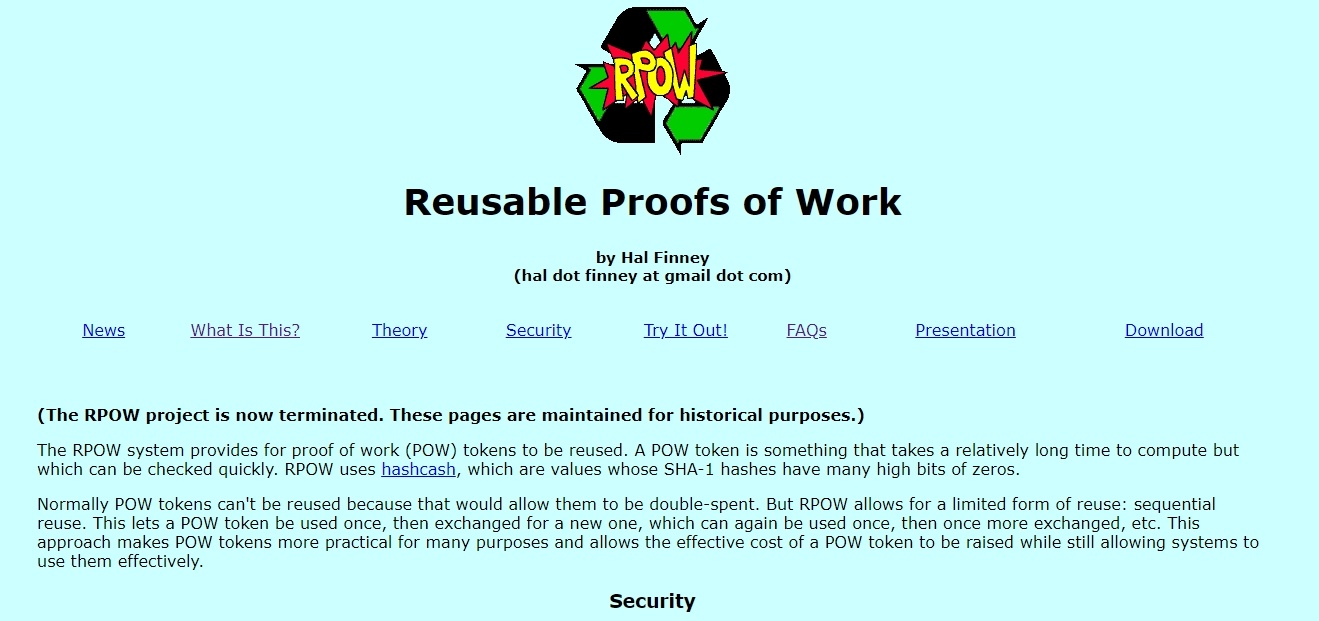
Archived snapshot from Hal Finney’s RPOW website.

The system allowed for a PoW token to be exchanged for a new token, which could then be reused, preserving the value of the original token and allowing its continued use. This was a major leap forward in digital currency technology, addressing the crucial challenge of preventing the same user from issuing tokens multiple times.

The RPOW server, hosted on a secure IBM 4758 cryptographic coprocessor, was another innovative feature of Finney’s system. This hardware guaranteed the security and integrity of the tokens by allowing users to remotely verify that the server was running the correct software, free of backdoors.

See also  HyperGPT and ChimpX AI work together to simplify Web3 through intelligent onchain automation

Finney’s rigorous approach to security and transparency in the RPOW system was groundbreaking, providing a level of trust and assurance that was critical to the adoption of digital monetary systems. On August 15, 2004, Finney shared his vision with the cypherpunk community via a detailed message (with double spaces) on the mailing list.

“I’d like to invite members of this list to try out my new hashcash-based server, rpow.net,” Finney wrote at the time. “This system receives hashcash as a Proof of Work (POW) token and in return creates RSA signed tokens that I call reusable Proof of Work (RPOW) tokens. RPOWs can then be transferred from person to person and exchanged for new RPOWs at each step. Each RPOW or POW token can only be used once, but because it produces a new token, it is as if the same token can be transferred from person to person.”

At the time, he invited members to experiment with the RPOW system, explaining its operation and possible applications. Finney was open about the system’s beta status and solicited community feedback to refine the technology. His message, sent exactly twenty years ago, emphasizes the collaborative and open-source ethos that has defined the cryptocurrency community.

Although RPOW has not achieved widespread use, its significance is undeniable. The principles and technologies that Finney introduced laid the foundation for Bitcoin and the other cryptocurrencies that followed. Afterwards, Satoshi unveiled the Bitcoin White Paper on October 31, 2008 and officially launched Bitcoin on January 3, 2009. Always curious and forward-thinking, Finney quickly became interested in the software and began running the program just days afterward. Satoshi activated the main net.

See also  What Are ERC-20 Tokens and How Do They Work?

Source link

20th anniversary proofs reusable Work
Share. Facebook Twitter Pinterest LinkedIn Tumblr Email

Related Posts

OP Concise data confidentiality allows institutions to hide transaction data on Ethereum

2026-05-14

Tether unveils developer grant program to fund on-device AI and open-source payment tools

2026-05-14

Google BigQuery adds support for ZeroG On-Chain data analytics

2026-05-14

Ondo brings tokenized US equities to Hyperliquid’s HyperEVM

2026-05-13
Add A Comment

Comments are closed.

Top Posts

Cardano (ADA) Struggles to Build Bullish Momentum: Will This Turn Around?

2024-10-24

Ethereum: Despite Low Investor Interest, Why ETH Could Rise to $5k

2025-01-27

Pharos launches public test network for its layer 1 blockchain

2025-03-26
Editors Picks

1) What 2-9) HAPPENED? We know now.

2023-10-13

Can decentralized social media really guarantee freedom of expression?

2024-11-29

Bitcoin demands $95,000 back as short liquidations trigger a two-month breakout

2026-01-13

Here’s where the next 100x opportunity in crypto is, according to DeFi veteran Arthur Cheong

2023-08-21

Our mission is to develop a community of people who try to make financially sound decisions. The website strives to educate individuals in making wise choices about Cryptocurrencies, Defi, NFT, Metaverse and more.

We're social. Connect with us:

Facebook X (Twitter) Instagram Pinterest YouTube
Top Insights

OP Concise data confidentiality allows institutions to hide transaction data on Ethereum

Crypto markets are vastly underestimating the passage of the Clarity Act

Traders are faced with a vulnerable situation

Get Informed

Subscribe to Updates

Get the latest news and Update from Bitcoin Platform about Crypto, Metaverse, NFT and more.

  • Contact
  • Terms & Conditions
  • Privacy Policy
  • DMCA
  • Advertise
© 2026 Bitcoinplatform.com - All rights reserved.

Type above and press Enter to search. Press Esc to cancel.