
Close Menu
  • News
    • Bitcoin
    • Altcoins
    • DeFi
    • Market Cap
  • Blockchain
  • Web 3
    • NFT
    • Metaverse
  • Regulation
  • Analysis
  • Learn
  • Blog
What's Hot

Cardano founder Charles Hoskinson is taking “a break”

2026-06-04

Cardano fuels Brazil’s Olympic technology push with blockchain and AI

2026-06-04

Drip.Trade NFT Exchange on Hyperliquid will close on June 15

2026-06-04
Facebook X (Twitter) Instagram
  • Contact
  • Terms & Conditions
  • Privacy Policy
  • DMCA
  • Advertise
Facebook X (Twitter) Instagram
Bitcoin Platform – Bitcoin | Altcoins | Blockchain | News Stories Updated Daily
  • News
    • Bitcoin
    • Altcoins
    • DeFi
    • Market Cap
  • Blockchain

    Cardano fuels Brazil’s Olympic technology push with blockchain and AI

    2026-06-04

    The movement centers on stablecoin payments as the layer 2 boom loses momentum

    2026-06-04

    Cardano partners with Token Terminal to improve access to on-chain data

    2026-06-03

    France intercepts sanctioned tanker Tagor linked to Russian oil trade

    2026-06-03

    XRP to be included in Bitwise’s first-ever $259 million tokenized fund, CEO speaks out

    2026-06-03
  • Web 3
    • NFT
    • Metaverse
  • Regulation

    Bank of England stablecoin caps may choke the UK’s pound-token market before launch

    2026-06-03

    Europe is actively trying to stop the takeover of the dollar stablecoin

    2026-06-01

    How a disputed $1 billion claim became a powerful weapon against prediction markets

    2026-05-31

    The US says it has captured Iran’s cryptocurrency with a $1 billion seizure

    2026-05-31

    Hyperliquid’s HYPE rally is bigger than a new all-time high

    2026-05-31
  • Analysis

    Rumor had it that Zcash stopped working

    2026-06-04

    Rumor had it that Zcash stopped working

    2026-06-04

    XRP Price Takes Another Hit as Bitcoin-Led Weakness Spreads Across Crypto

    2026-06-04

    Bitcoin’s Plunge to $65,000 Leaves Traders Paying to Protect Against a Drop to $50,000

    2026-06-04

    Bitcoin price bursts lower, opening the door to more pain

    2026-06-03
  • Learn

    Williams %R Indicator in Crypto: How to Use %R in Crypto Trading

    2026-06-03

    What Is a Semi-Fungible Token? SFT Crypto Explained

    2026-06-02

    Pennant Chart Pattern in Crypto: How Bullish and Bearish Pennants Work

    2026-06-02

    Head and Shoulders Crypto Pattern: How It Works and How to Read It

    2026-06-01

    Crypto Triangle Patterns: How to Spot and Read Them

    2026-06-01
  • Blog
Bitcoin Platform – Bitcoin | Altcoins | Blockchain | News Stories Updated Daily
Home»Blockchain»Ethereum and Solana clash over what blockchain resilience really means
Blockchain

Ethereum and Solana clash over what blockchain resilience really means

2026-01-08No Comments4 Mins Read
Share
Facebook Twitter LinkedIn Pinterest Email

Ethereum and Solana are not only separated by questions of scalability, they are also increasingly divided by competing visions of what blockchain networks should be able to withstand in the future.

Recent comments from the co-founders of each network revealed two competing definitions of “resilience,” rooted in different assumptions about risk, infrastructure, and the future shape of blockchain adoption.

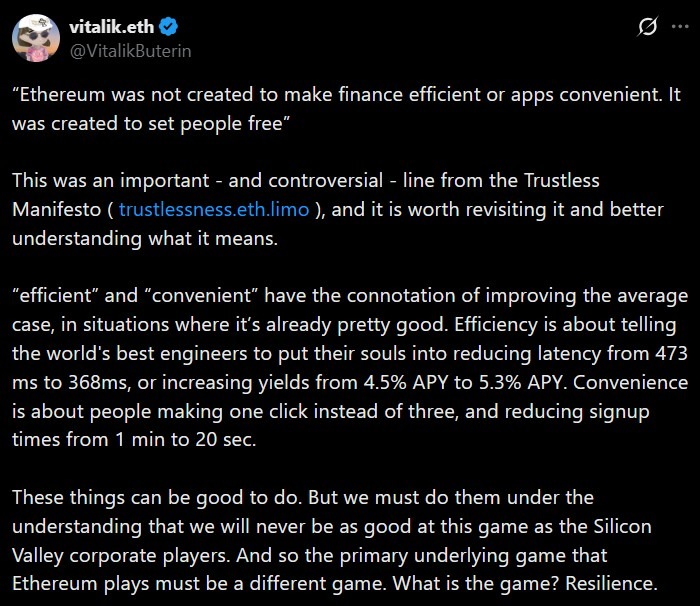
In an

Buterin argued that Ethereum is not designed to optimize for efficiency or convenience, but to ensure that users remain sovereign even under hostile conditions.

“Resilience is the game where anyone, anywhere in the world, can access the network and be a first-class participant,” Buterin wrote, adding: “Resilience is sovereignty.”
Source: Vitalik Buterine

Co-founder of Solana signals a different approach

Anatoly Yakovenko, co-founder of Solana, responded to Buterin’s X-post, calling it a “cool vision” and offering a contrasting definition of resilience.

For Yakovenko, resilience comes from the ability to synchronize massive amounts of information globally at high throughput and low latency, without relying on trusted intermediaries. In his view, reliability is inextricably linked to performance, and not to a philosophical consideration.

“If the world can benefit from 1 Gbps and 10 simultaneous 10ms batch auctions, then that is the floor we need to achieve reliably around the world.”

“If it’s 10gbps and 100 1ms auctions, then that’s what we’ll deliver,” he added.

Source: Anatoly Yakovenko

The exchange follows Buterin’s claims on Sunday that Ethereum has effectively solved the blockchain trilemma of decentralization, security and scalability via PeerDAS and zero-knowledge Ethereum Virtual Machines (zkEVMs), as reported by Cointelegraph.

See also  Nansen brings validator muscles to Caldera in modular blockchain shakeup

This claim sharpened scrutiny of Ethereum’s roadmap and raised questions about whether resilience should be measured by redundancy and sovereignty or by speed and economic competitiveness.

“The path ETH has chosen is a lost one: objectively unable to compete on capacity within competitive timelines and also completely unable to compete on speed,” Cyber ​​Capital founder Justin Bons wrote in response, arguing that performance and economic reality cannot be treated as secondary concerns.

Resilience as redundancy versus resilience as performance

Ethereum’s resilience thesis is based on architectural prudence and redundancy. The network manages independent execution and consensus clients, encouraging diversity to reduce risks that could halt block production.

This extends to Ethereum’s approach to scaling. On Wednesday, developers increased Ethereum’s blob limit for a second time, incrementally increasing data throughput while prioritizing cost stability and node security. Rather than aggressively increasing execution speed, the network opted for gradual capacity increases to minimize systemic risk.

Economic signals also support the network’s resilience approach. Ethereum’s exit queue dropped to near zero in early January, indicating a renewed willingness among validators to hold capital for the long term. This was seen as a sign of confidence in Ethereum’s long-term security and roadmap.

Solana’s approach prioritizes resilience through performance. Yakovenko’s comments suggest that the blockchain will focus on reliably handling real-time markets, auctions and payments.

Solana’s history reflects this perspective. While the network has previously suffered significant outages in previous cycles, it has steadily strengthened its infrastructure through protocol upgrades, reimbursement markets and network improvements.

Related: Grayscale announces first Ethereum payout for a US-listed ETF

Infrastructure tradeoffs and institutional signals

Both models have their own tradeoffs. Ethereum’s ambitious claims for resilience depend on future deployments of zkEVMs and the separation between proposer and builder, which remains untested at mainnet scale.

See also  How are Telegram mini apps useful for e-commerce, media and automation?

Bons argued that these designs could introduce new centralization pressures by shifting power to specialized, capital-intensive builders, potentially creating life risks if that layer fails.

Institutional behavior offers a different view of resilience. Ethereum remains the dominant settlement layer for stablecoins and tokenized treasuries, reflecting a preference for predictability and conservative risk profiles.

On the other hand, Solana has accelerated institutional adoption in performance-sensitive use cases. Tokenized real-world assets (RWAs) on Solana reached record levels in late 2025, while spot Solana ETFs and experiments with corporate payments gained popularity.

Taken together, the difference suggests that Ethereum and Solana take different approaches to resilience. Ethereum prioritizes survivability, even at the expense of speed.

On the other hand, Solana prioritizes economic viability under real-time demand, even if it requires closer coordination.

Magazine: ‘China’s Ethereum’ in Civil War, Japan Embraces Bitcoin ETFs: Asia Express

Source link

Blockchain Clash Ethereum means Resilience Solana
Share. Facebook Twitter Pinterest LinkedIn Tumblr Email

Related Posts

Cardano fuels Brazil’s Olympic technology push with blockchain and AI

2026-06-04

The movement centers on stablecoin payments as the layer 2 boom loses momentum

2026-06-04

Cardano partners with Token Terminal to improve access to on-chain data

2026-06-03

France intercepts sanctioned tanker Tagor linked to Russian oil trade

2026-06-03
Add A Comment

Comments are closed.

Top Posts

XRP Price Takes a 5% Hit: Is More Downside Ahead?

2024-12-27

ZettaBlock announces the addition of blockchain data

2024-05-03

Ethereum gains ground on Bitcoin as the bear market continues

2023-08-14
Editors Picks

Polygon recaptures 10th position while MATIC is up nearly 30% in the past week

2023-07-15

What Is the Average Directional Index (ADX) in Crypto?

2026-05-12

Ethereum experiences an ‘insatiable black hole of question’, according to Crypto Trader – here is his prospects

2025-08-08

Bitcoin faces a huge, long liquidation imbalance as $15 billion is underpriced

2026-05-07

Our mission is to develop a community of people who try to make financially sound decisions. The website strives to educate individuals in making wise choices about Cryptocurrencies, Defi, NFT, Metaverse and more.

We're social. Connect with us:

Facebook X (Twitter) Instagram Pinterest YouTube
Top Insights

Cardano founder Charles Hoskinson is taking “a break”

Cardano fuels Brazil’s Olympic technology push with blockchain and AI

Drip.Trade NFT Exchange on Hyperliquid will close on June 15

Get Informed

Subscribe to Updates

Get the latest news and Update from Bitcoin Platform about Crypto, Metaverse, NFT and more.

  • Contact
  • Terms & Conditions
  • Privacy Policy
  • DMCA
  • Advertise
© 2026 Bitcoinplatform.com - All rights reserved.

Type above and press Enter to search. Press Esc to cancel.