
Arthur Hayes said NEAR and Zcash are at the heart of his privacy business, arguing that crypto markets are starting to reprice assets associated with private value transfer, AI-era sovereignty and true protocol economics. In an interview with The Rollup, Maelstrom’s CIO said NEAR could offer “20x potential” while Zcash could have “5x potential” in the coming year, framing both assets as part of a broader response to “big tech, big government” and AI-driven surveillance.
Hayes’ thesis begins with a macro shift. Earlier this year, he said he had been cautious because Bitcoin appeared to be pricing in an “AI deflationary credit event,” with monetary authorities unlikely to print aggressively until a crisis forced them to do so. That changed, he argued, after the conflict with Iran created a liquidity-positive situation for the markets.
“Governments print money to win wars. AI is part of war. AI investments will be endorsed by governments in both the United States and China,” Hayes said. He added that governments in the US, China and Europe would likely finance a war economy and AI infrastructure through monetary expansion, with some of that liquidity leaking into Bitcoin and select crypto assets.
Why NEAR and Zcash?
Hayes’ strongest comments were reserved for privacy. He reaffirmed that Zcash is his “second largest bag” and said the asset had become investable again after earlier concerns about its familiar setup, issuance profile and developer subsidy faded into the background. In his opinion, the old Zcash trade was too early and too messy. The new one is cleaner, more fluid and more relevant to the current political and technological moment.
Related reading
“There’s nothing wrong with wanting to get private money over the internet,” Hayes said. “And that’s what Zcash represents, that’s what Monero represents. And as we learn the ability for big tech, big government and AI to know essentially everything about us and track everything that happens in our lives, having pure, just cryptographically proven privacy with money is going to be super necessary.”
Hayes said his renewed interest in Zcash accelerated after a conversation with Naval Ravikant during Tokyo 2049. According to Hayes, Ravikant argued that Monero’s signatures were weaker than commonly believed and referenced a Japanese law enforcement case involving deanonymization. Hayes said he bought $1 million worth of Zcash “at that point,” and then continued collecting while he further researched the thesis.
The price target came as Hayes linked Zcash to NEAR’s role in making private value transfer between assets and chains more useful. He argued that only shielded Zcash is important, but the bigger opportunity comes when users can move from shielded ZEC to other assets, including stablecoins, via NEAR Intents.
“Within the ZODL app, I can now send any crypto item I want anonymously to anyone across the internet. From Shielded Zcash, using Near Intents. Now I like, you know, USDT on Tron and I’ve sent it anonymously to whoever I’m going to send it to. That’s huge,” Hayes said.
That’s where his upside estimates diverge. Hayes said Zcash remains the main manifestation of the privacy trade, but NEAR can offer the more asymmetric setup because it is connected to the execution layer behind confidential transfers. “I think Near has a 20x potential, while Zcash could have a 5x potential or something like that in the next year,” he said. “So you scale the capital you allocate accordingly to the risk.”
Related reading
NEAR co-founder Illia Polosukhin reinforced the economics of that argument, saying that NEAR Intents is approaching $20 billion in total volume, with $18.9 billion mentioned during the interview, and has generated $33 million in fees. He said NEAR charges a fee from each transaction and uses it to buy back NEAR, while the ecosystem has already cut inflation in half and can push for further reductions as revenues grow.
Hayes also linked the trade to the token structure. He said NEAR would benefit from being “completely diluted,” avoiding the large amount of risk allocations that still weigh on many L1 assets. For a token expected to move higher, he argued, the clean supply profile matters.
The risk is, in Hayes’ own view, macro. He said he plans to stay until the broader liquidity backdrop changes, but warned that reduced government support for AI investments or a worsening war scenario would change the setup. For now, he sees privacy, AI-linked sovereignty and stock market revenue as the trades with the clearest market validation.
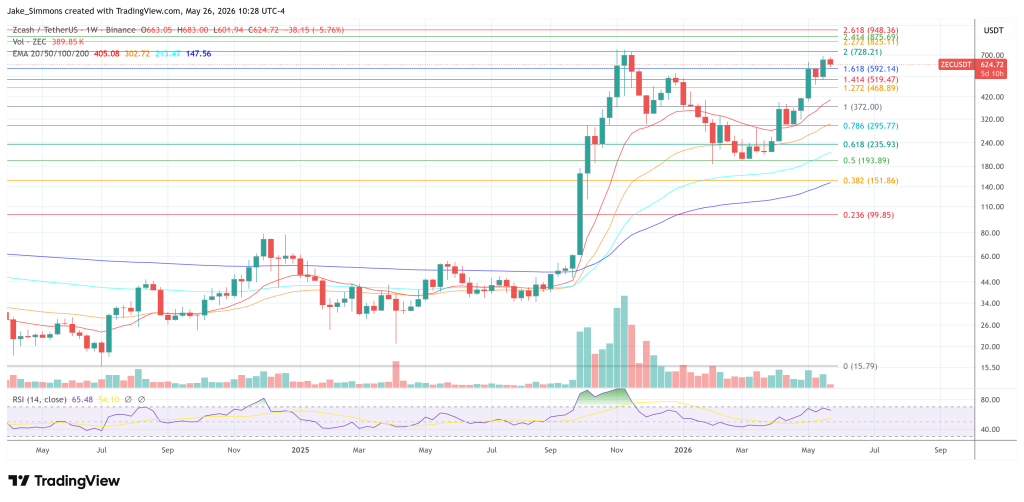
At the time of writing, Zcash was trading at $624.
Featured image created with DALL.E, chart from TradingView.com