
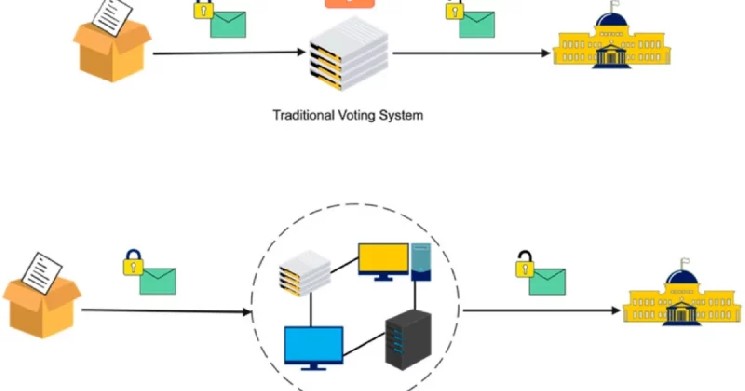
Voting in crypto governance has a dirty secret: it’s not really secret. Most DAO votes are cast from pseudonymous wallets on public blockchains, meaning anyone with a block explorer can see exactly how you voted. This creates a problem that goes beyond mere privacy inconvenience. It opens the door to coercion, vote buying and social pressure that undermines the whole point of democratic decision-making.
CRISP, short for Coercion-Resistant Impartial Selection Protocol, is a new attempt to solve this. Launched in May 2026 by the Interfold project, which grew out of Gnosis Guild’s Enclave, the protocol brings together three heavy-duty cryptographic techniques to create what amounts to a digital secret ballot.
How CRISP actually works
The protocol rests on three cryptographic pillars: fully homomorphic encryption (FHE), zero-knowledge proofs (ZKPs) and distributed threshold cryptography (DTC). Each solves a different piece of the private voting puzzle.
Fully homomorphic encryption is the star of the show. In English: Allows you to perform calculations on encrypted data without ever decrypting it. Think of it as a sealed ballot box that can count its own contents without anyone opening it. Votes arrive encrypted, are counted while still encrypted, and only the final result is revealed.
Zero-knowledge proofs take care of the verification side. They let the system confirm that a vote is valid, that the voter is eligible, and that the final count is correct, all without revealing any individual vote.
Distributed threshold cryptography is the decentralization layer. Rather than relying on one party to hold the decryption key, CRISP distributes that responsibility across a network of economically incentivized node operators called Ciphernodes. No Ciphernode can decrypt anything on its own. A threshold number of them must work together to announce the end result.
The combination addresses several known failure modes in existing digital voting. Commit-reveal schemes, in which voters are asked to cast a hidden vote and later make it public, are vulnerable to manipulation during the revelation phase. Familiar operator models put too much power in one pair of hands. And as mentioned, simply voting via the chain is about as private as a glass house.
Which makes it force-resistant
CRISP is designed to be receiptless, meaning voters cannot generate proof of how they voted even if they wanted to. This completely breaks the chain of coercion. You can promise someone that you will vote the way they want, take their money, and vote the way you want. There is no receipt to check.
The protocol also supports censorship-resistant submission, meaning votes cannot be selectively blocked or filtered by any intermediary. Combined with anonymous participant participation, the system aims to make voting both private and unstoppable.
A live proof-of-concept demo is currently available at crisp.enclave.gg for anyone who wants to see the mechanic in action rather than taking it on faith.
Open source, no token, broader ambitions
A notable feature of the project is what it doesn’t have: a token. There is no native cryptocurrency, no market listing, no liquidity pool. The entire codebase is open source and hosted on GitHub under gnosisguild/enclave.
The Interfold project, which has been rebranded from the Enclave framework, positions itself as infrastructure rather than a financial product. The team frames their work around encrypted execution environments, or E3s, a broader concept that goes beyond voting and addresses any scenario where computation needs to occur based on sensitive data.
Gnosis Guild applied for a Zcash Community Grant in March 2026 to develop what they call “Zecret Ballots,” an integration that would bring CRISP’s coercion-resistant voting capabilities specifically to the Zcash community.