

Bitcoin’s break below the $60,000 area has pushed digital asset markets into a more defensive phase, ending months of restricted trading and exposing a market structure that traders say could fuel the next big move.
Crypto Slates Data shows the largest cryptocurrency has been moving sideways since February, when it first tested the $60,000 area.
That long consolidation made the level a hotly debated indicator for traders, even as macro risks, exchange-traded fund outflows and concerns around corporate Bitcoin holders weighed on sentiment.
As a result, the latest decline points to a more fragile setup in which large amounts of Bitcoin have moved to major exchanges, open interest is rising while spot prices remain weak, and professional traders are paying more to protect themselves from another leg lower.
Bitcoin’s break turns exchange flows into a supply test
The clearest sign of stress can be seen in the exchange flows.
Data from CryptoQuant shows that more than 550,000 BTC were moved to deposit addresses associated with Binance and OKX after Bitcoin fell below the $60,000 area. Binance-linked deposit addresses received over 220,000 BTC, while OKX-linked addresses received over 330,000 BTC.
These figures are well above this year’s normal figures. According to CryptoQuant data, Binance has averaged around 60,000 BTC in comparable inflows, while OKX has averaged around 95,000 BTC.
The latest transfers are the largest of the year and resemble levels last seen during the 2023 bear market.
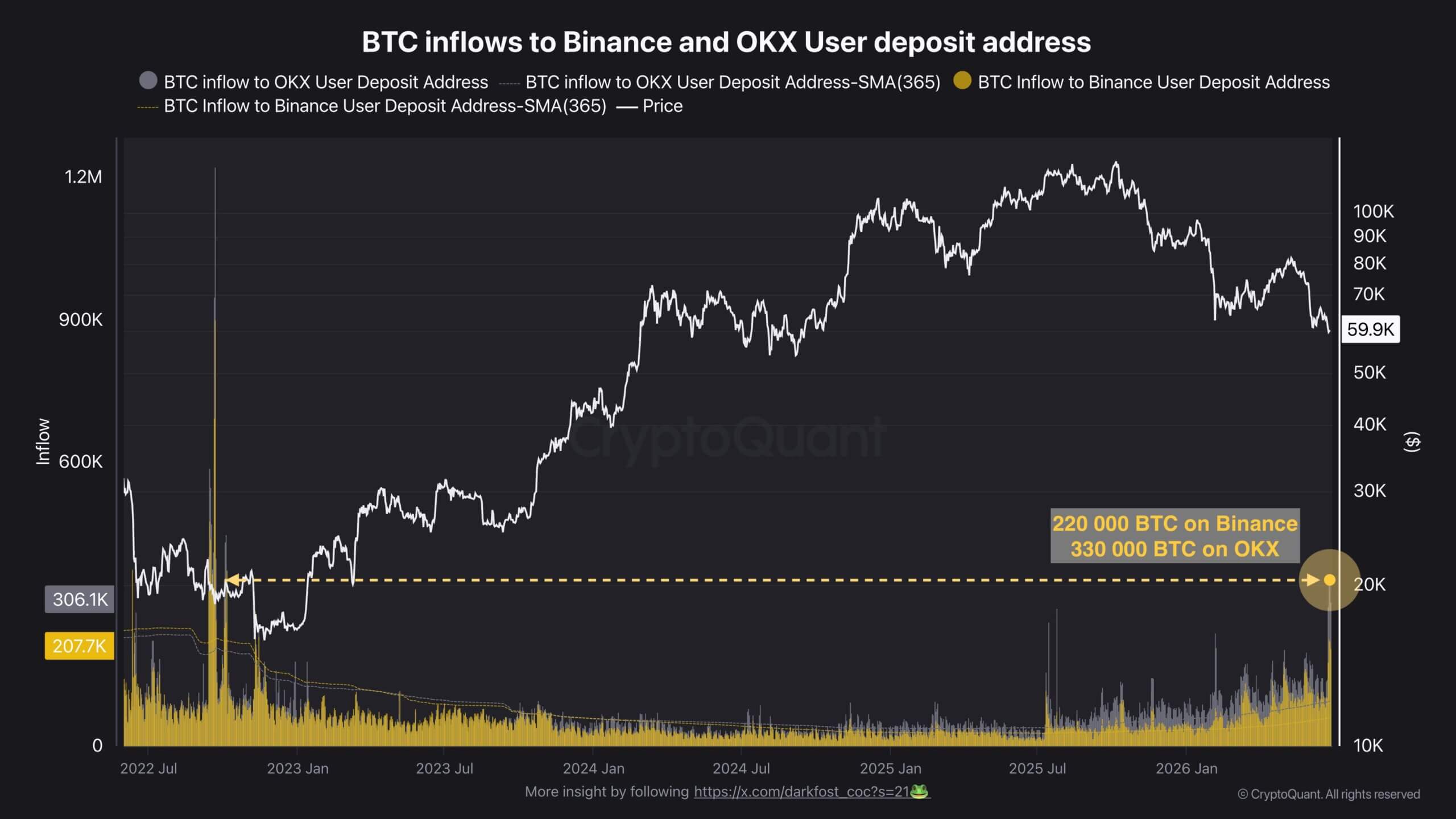
In cryptocurrency market architecture, a sudden transfer of coins to exchange deposit addresses acts as an initial operational indicator of intent. Users typically route assets to these specific points before pooling funds into a platform’s central hot wallets for execution, lending, or collateral allocation.
Still, the timing gives the data more weight. Large transfers to exchanges during a price decline often raise concerns that more supply could become available if the market weakens further.
In a market already trading below levels many investors have been eyeing for months, the potential excess supply could make the recovery more difficult to sustain.
The flow also reflects how range-bound markets can become unstable once a known level is breached. When traders respond to the same zone for months, risk controls, hedging and stop-loss decisions can cluster around it. Once the level drops, many participants simultaneously reassess exposure.
Therefore, the exchange data is central to the current setup. The market is not just dealing with a lower Bitcoin price. It also takes into account the possibility that more coins have moved closer to locations where holders can trade quickly.
A valuation reset reduces excess risk, but not volatility risk
The exchange flows are coming as Bitcoin’s on-chain valuation metrics show that much of the previous cycle’s surplus has already been compressed.
CryptoQuant’s MVRV Z-Score shows Bitcoin’s valuation premium has fallen sharply and is moving closer to historically low valuation areas.
The MVRV framework compares Bitcoin’s market value to its realized value. Market value reflects the current price of circulating coins, while realized value estimates the total cost base of the network by valuing each coin at the price where it last moved in the chain.
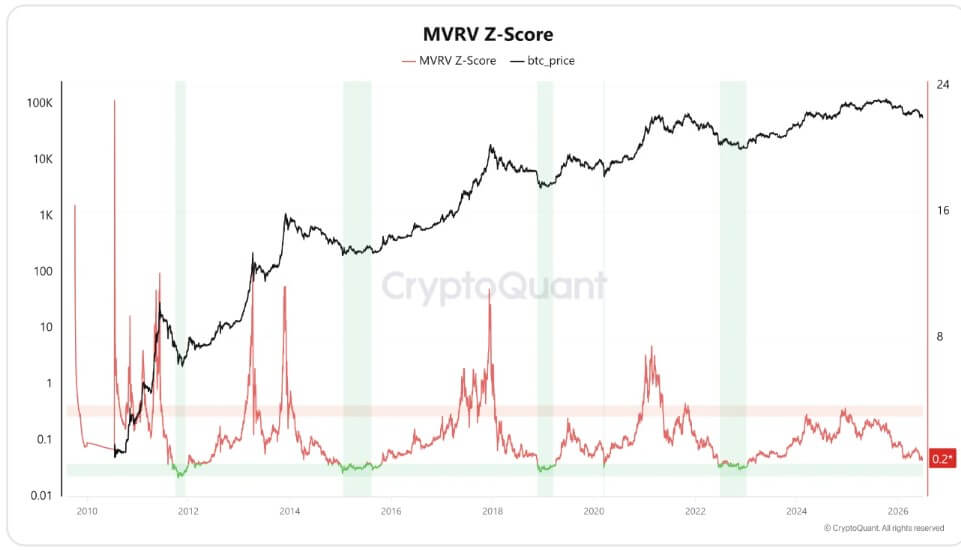
When the market value trades well above the realized value, unrealized gains tend to be high and cyclical risk tends to increase. As the gap narrows, profitability declines and speculative pressure diminishes.
The Z-Score adjusts that relationship by measuring the distance between market value and realized value relative to Bitcoin’s historical market capitalization deviation. That helps traders assess whether Bitcoin is trading at unusually high or compressed valuation levels compared to its own history.
The current reading suggests that the market has moved closer to reset territory.
However, the indicator does not indicate a precise bottom. Bitcoin has previously traded near cheaper valuation zones as prices continued to weaken, especially during periods of poor liquidity, forced selling or macro stress.
That distinction is important now because valuation and positioning send different messages. Data about the chain shows that the market is less tense than earlier in the cycle. Market structure data shows that traders are still preparing for a disorderly move.
Data from CryptoQuant shows that funding rates on the major exchanges have turned positive again, while Bitcoin remains weak around $59,000 to $60,000. Positive financing generally means traders who take long positions are paying shorts, a sign that demand for bullish exposure has returned after a more negative period.
At the same time, open interest is rising, while spot prices remain soft. That means building new positions into the downturn, rather than risking exit from the system.
The combination can make price action more sensitive. If Bitcoin falls further, newly opened long positions could come under pressure. If the market rebounds sharply, traders on more downsides may be forced to take cover.
Both outcomes could make the next step bigger than the spot market alone would suggest.
Downside hedges are built up as institutional interest weakens
To counter this heightened structural uncertainty, institutional traders are aggressively building defensive positions in the options markets.
Singapore-based digital asset trading firm QCP Capital reports that implied volatility rates are systematically rising as market participants pay a premium for downside protection.
According to the company, demand focused on Bitcoin put options expiring in July with strike prices between $55,000 and $58,000.
Data from digital asset derivatives exchange Deribit reinforces this story, showing that approximately $1.2 billion in open interest is clustered specifically in the $55,000 and $50,000 strike zones.
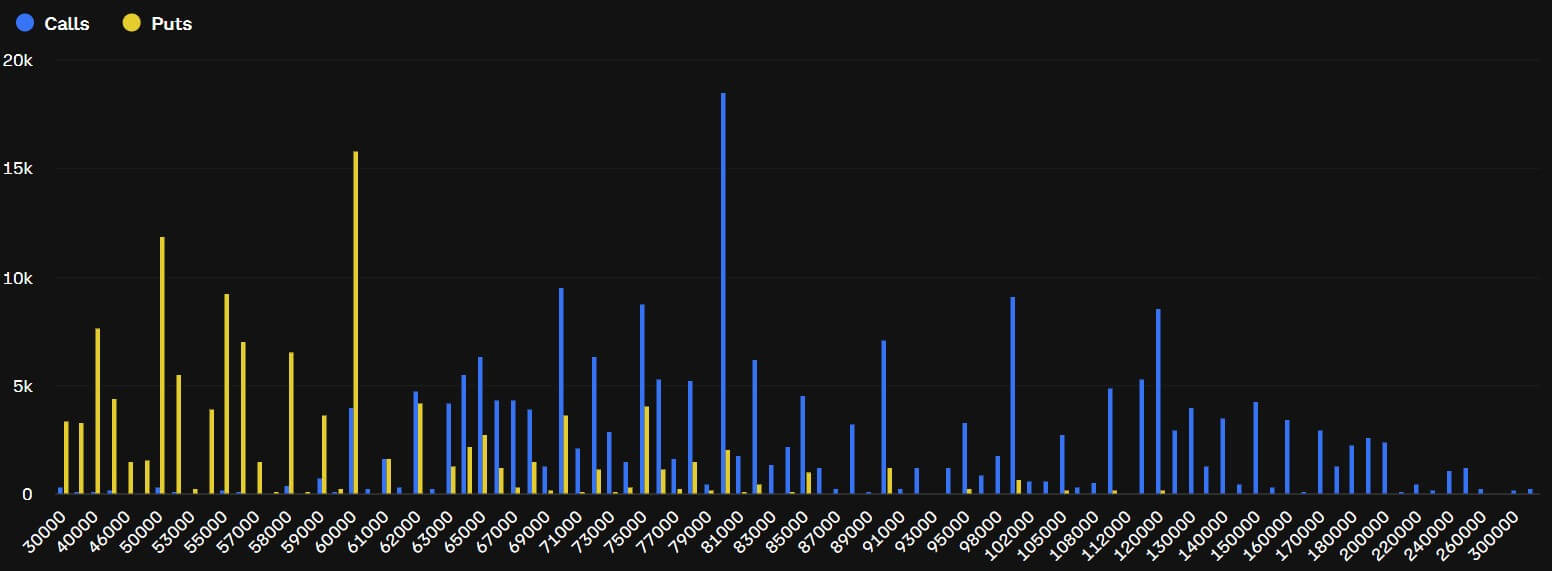
This defensive positioning is complemented by a structural shift in institutional capital flows.
Data from blockchain analytics firm Glassnode shows that institutional demand is no longer acting as a reliable sponge for circulating supply. Over the past month, Bitcoin exchange-traded funds (ETFs) lost approximately 71,600 BTC, while digital asset trusts added only a marginal 7,500 BTC.
Adjusted for network issuance, the combined net institutional capital flow is -77,000 BTC.
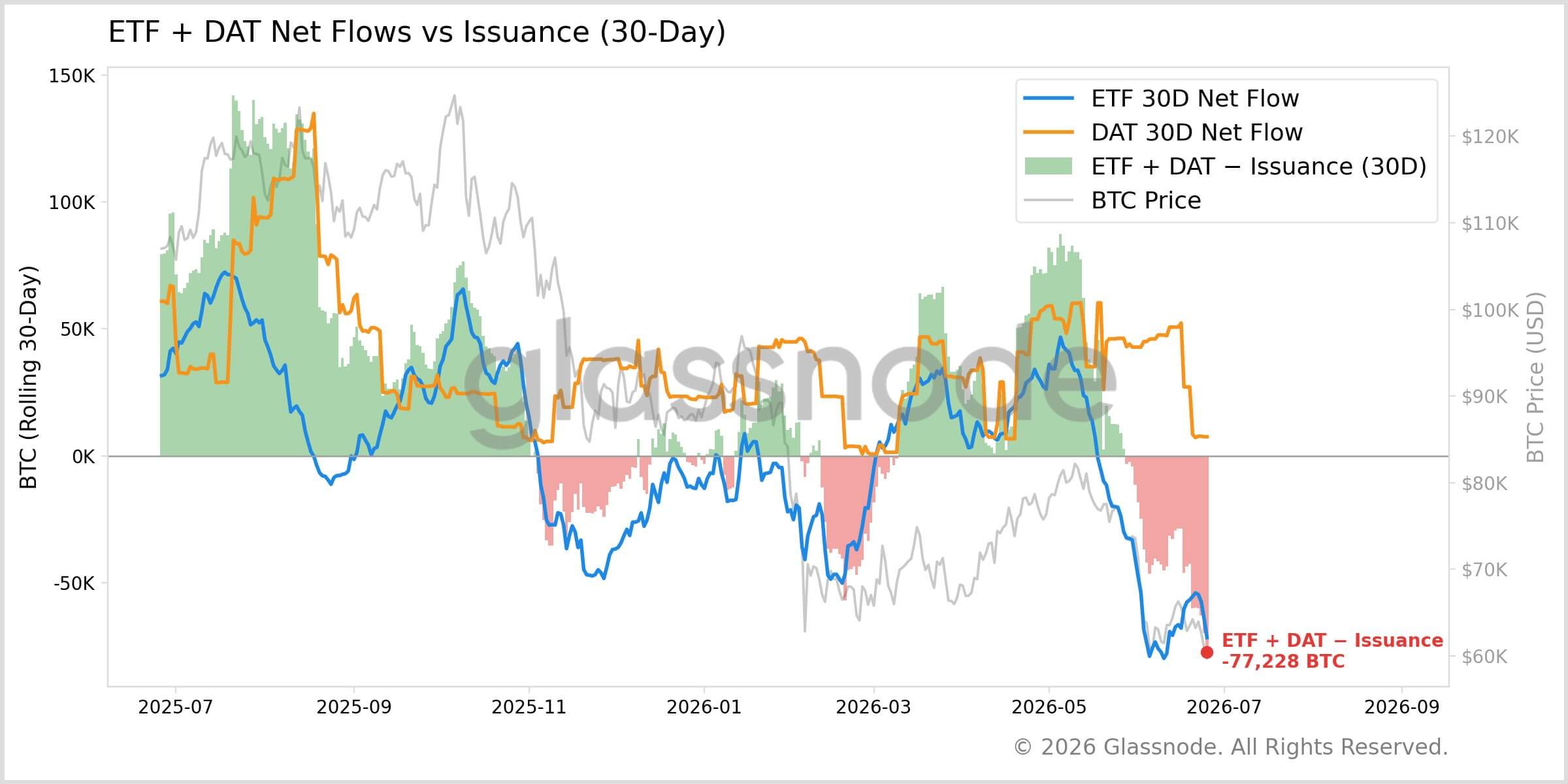
According to Glassnode’s analysis, any near-term recovery in the spot market will face immediate friction from the continued glut of wrapper supply until net flows reverse.
This institutional deleveraging trend is explicitly quantified by BlockScholes, whose own Bitcoin risk indices have remained below the -1.0 threshold for more than 23 consecutive days.
BlockScholes notes that the longevity of this trend marks a departure from typical cyclical dips, indicating ongoing, structural risk reduction by institutional allocators that will likely require a fundamental macroeconomic or sector-specific catalyst to drive change.
That puts Bitcoin in a vulnerable position after breaking below the $60,000 mark. On-chain valuation metrics indicate that the market has already lost much of its previous surplus, but currency flows, options positioning and institutional demand all indicate that the market is still preparing for stress.
The immediate test is whether spot demand can absorb the supply that is now closer to the exchanges. If demand improves, defensive positioning could contribute to a recovery.
If not, the same structure could turn the $60,000 breakout into a broader shock to volatility.