
A rally can look strongest just before it fails. If you enter late, ignore weakening momentum, or assume every green candle means more upside, a sudden reversal can erase gains quickly. The evening star candlestick pattern helps you recognize that shift—but only when its three candles form in the right context and receive bearish confirmation.
What Is the Evening Star Candlestick Pattern in Crypto?
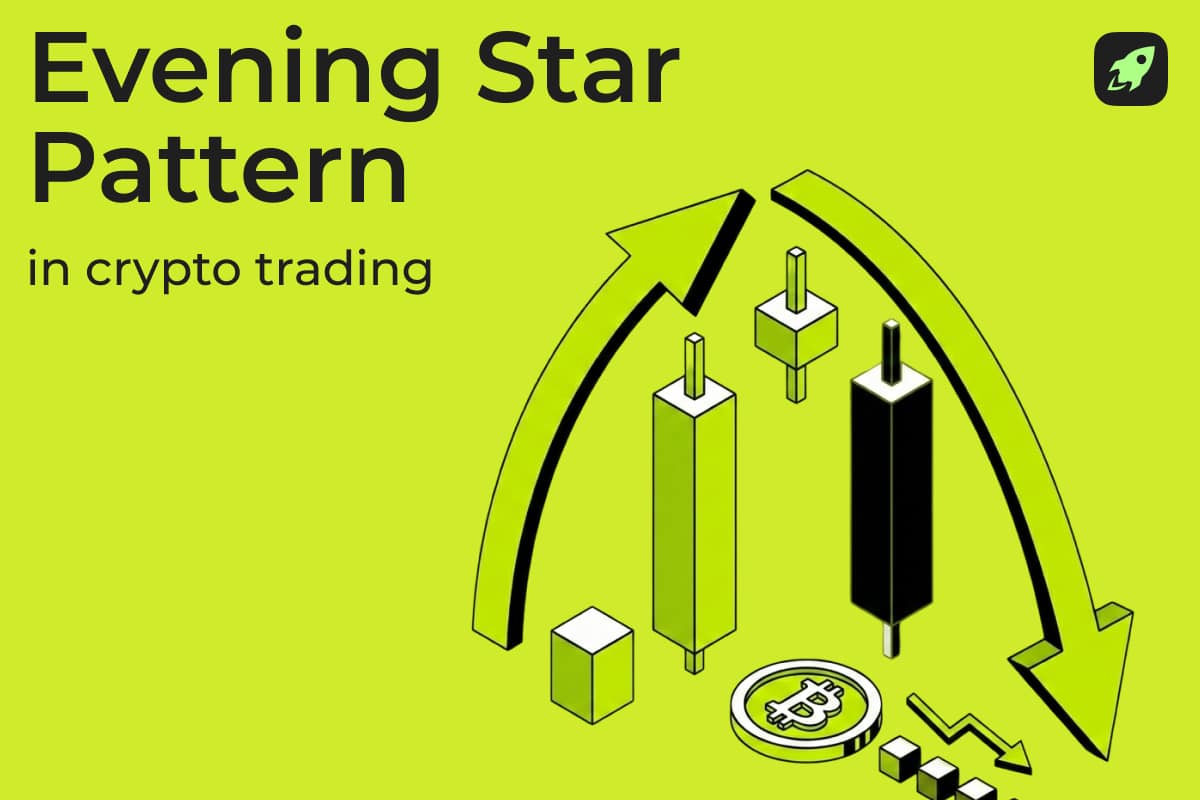
The evening star candlestick pattern is a three-candle bearish reversal pattern that appears after an established uptrend. It signals that strong buying pressure may be fading while selling pressure begins to take control, creating the possibility of a trend reversal or downward movement.
The evening star pattern consists of:
- A large bullish candle that extends the upward trend
- A small-bodied star candle that shows indecision
- A large bearish candle that confirms the potential bearish reversal
In a textbook evening star, the final bearish candle closes below the midpoint of the first candle’s real body. Traditional versions may also include gaps between the candles, but gaps are less important in spot crypto because the market trades around the clock. You should focus on the prior rally, the loss of bullish momentum, and the strength of the third bearish candle.
How Do Crypto Candlesticks Work?
Each candlestick represents price movements during a selected period. It uses open, high, low, and close data to show how buyers and sellers moved the market, giving you a quick view of momentum, volatility, and possible reversal patterns.
Candlestick Chart Basics
A candlestick chart divides price action into fixed time intervals. Depending on your settings, one candle might represent one minute, four hours, one day, or one week, and every candle summarizes what happened during that period.
You can use the chart to compare momentum, identify support and resistance, and spot patterns such as the evening star. A chart pattern doesn’t predict the future on its own, so read it alongside the surrounding trend and other technical analysis tools.
OHLC Data: Open, High, Low, and Close
Each candlestick is built from four values known as OHLC data:
- Open: The first recorded price in the selected period
- High: The highest price reached during the period
- Low: The lowest price reached during the period
- Close: The final recorded price when the period ends
Because crypto trades 24/7, the closing price reflects the end of your chosen candle interval rather than the closing bell of a traditional stock market. Two exchanges can also produce slightly different candles because their prices, liquidity, and interval boundaries may differ.
Real Body and Wick Anatomy
The real body shows the distance between the opening and closing prices. A bullish candle closes above its open, while a bearish candle closes below it. The wicks, also called shadows, show how far the price moved above or below the body during the same period.
A small body often reflects uncertainty because the open and close are close together. A long upper wick can indicate rejection at higher prices, while a long lower wick can show that buyers defended a lower level. In an evening star candlestick, the middle candle’s small body signals that the previous upward momentum is stalling.
Timeframe and Candle Duration
The timeframe defines how long each candle takes to form. A five-minute evening star may reflect a brief intraday reaction, while a daily or weekly evening star includes more price activity and can provide broader trend context.
Higher timeframes often filter out short-term noise, but they don’t make the pattern reliable in every case. Choose a timeframe that matches your strategy, and don’t confirm the setup before the third candle closes.
Price Action as the Source Signal
The evening star comes from price action, so the candles themselves should remain your main reference. Indicators can support the setup, but they shouldn’t replace the actual structure of the pattern or the trend that came before it.
A clean formation can still produce a false signal in a volatile crypto market. Treat it as evidence of a possible shift—not a guarantee that a bearish trend will follow.
Why Does the Evening Star Need an Uptrend First?
A bearish reversal pattern needs an upward trend to reverse. If the three candles appear during sideways or directionless price action, the formation has little reversal value because there isn’t a clear bullish trend losing strength.
Look for sustained buying pressure, higher highs, higher lows, or a strong rally before the pattern forms. It doesn’t cause the decline. It shows that bullish momentum may be weakening, so you shouldn’t automatically expect the rally to continue.
What Are the Three Candles in an Evening Star Pattern?
The evening star pattern consists of three consecutive candles that show strength, hesitation, and bearish confirmation. You need the complete sequence because one isolated candle can’t communicate the same change in market behavior.
First Bullish Candle
The first candle is a long bullish candle that continues the existing upward trend. It usually closes well above its opening price, showing strong buying pressure and confidence that the rally can continue.
After an extended rise, this large bullish candle can also show that the move is becoming stretched. It isn’t bearish by itself, but it creates the context for a possible peak if the next two candles show weaker demand.
Star Candle
The middle candle is the star candlestick. It has a small real body and may close slightly higher, slightly lower, or near its opening price, which shows that neither buyers nor sellers maintained clear control.
The star candle can be a doji or a spinning top, but it doesn’t have to match either shape perfectly. Its main role is to show that upward momentum has slowed after the strong bullish candle.
Third Bearish Candle
The third candle is a large bearish candle that provides bearish confirmation. It shows that selling pressure has increased and that the market has reversed a meaningful part of the first candle’s upward move.
Under the stricter textbook definition, the third bearish candle closes below the midpoint of the first bullish candle’s body. A shallow close or a small final candle weakens the setup because sellers haven’t taken back enough ground to confirm a decisive shift.
What Does Each Candle Reveal About Market Psychology?
The evening star shows a transition from confidence to uncertainty and then bearish sentiment. The sequence carries more information than the three candles do separately.
Buying Pressure in the First Candle
The first candle shows that buyers remain in control and are willing to push the closing price higher. The strong move can attract late entries and increase the assumption that the bullish trend will continue. That confidence can become a vulnerability near resistance or after a rapid rise. If demand weakens, fewer buyers may be available to sustain the move.
Market Indecision in the Star Candle
The middle candle shows a loss of upward momentum. Price may still test a new high, but the small body indicates that the market can’t extend the rally with the same conviction. This candle doesn’t confirm a bearish reversal on its own. It only shows that the balance between buyers and sellers has become less favorable to the bullish side.
Selling Pressure in the Third Candle
The final bearish candle shows that sellers have taken control. A close below the first candle’s midpoint erases much of the previous gain and strengthens the bearish signal. A weak bearish candle doesn’t provide the same confirmation. You should compare its body, closing price, and volume with the previous candles before treating the pattern as complete.
How Can You Identify an Evening Star on a Crypto Chart?
To identify an evening star candlestick pattern in crypto, check the broader trend before examining the individual candles. The formation should appear after a recognizable rally, and the third candle should clearly confirm that bullish momentum has weakened.

Clear Prior Rally
The pattern should form after an upward trend with visible buying pressure. Higher highs and higher lows, a breakout, or a sharp rally can provide the necessary background. If price has been moving sideways, the same three candle shapes may simply reflect ordinary consolidation. Without a prior bullish trend, you don’t have a meaningful bearish reversal setup.
Large Bullish First Candle
The first candle should be bullish and relatively large compared with nearby candles. Its closing price should sit well above its open, showing that buyers controlled most of the period. You don’t need an exact body-size threshold, but the candle should stand out on the price chart. A small or weak first candle makes the pattern’s initial bullish phase less convincing.
Small-Bodied Middle Candle
The middle candle should have a noticeably smaller body than the first. It may be bullish, bearish, a spinning top, or a doji candlestick pattern, as long as it shows indecision and reduced upward momentum. Traditional star patterns often contain a bullish gap before the middle candle. Since spot crypto trading continues 24/7, you shouldn’t reject an otherwise valid setup simply because that gap doesn’t appear.
Bearish Third Candle Close
The third candle should be decisively bearish and close well below its open. A long body offers stronger evidence that selling pressure has replaced hesitation. Wait until the candle closes before confirming the pattern. An unfinished bearish candle can recover before the interval ends and leave you with a very different chart pattern.
Close Into the First Candle’s Body
The third candle should close deep inside the first bullish candle’s body. In the textbook version, it closes below the midpoint, showing that sellers have reversed more than half of the advance. The deeper the close, the stronger the bearish confirmation appears. However, even a textbook formation can fail, so you still need a stop-loss plan and a clear invalidation level.

How to Get Free Crypto
Simple tricks to build a profitable portfolio at zero cost

Does the Star Candle Have to Be a Doji?
No, the star candle doesn’t have to be a doji. A doji has nearly identical opening and closing prices, but the evening star only requires a small-bodied candle that reflects hesitation after the first strong bullish candle.
A spinning top or another short candle can fill the same role. The candle’s exact color is less important than the visible loss of upward momentum and the bearish confirmation that follows.
Do Gaps Matter for the Evening Star in Crypto?
Classic descriptions often include a bullish gap before the star and a bearish gap before the third candle. The gaps separate the middle candle in markets with fixed trading sessions.
Spot crypto markets operate continuously, so clean bullish and bearish gaps appear less often than they do in session-based financial markets. You can still identify an evening star without them, but you should require a clear slowdown in the middle candle and a strong bearish close in the third.
How Is the Evening Star Confirmed?
The third candle provides the main confirmation, while volume, resistance, RSI, and nearby support can help you evaluate the setup. No indicator guarantees a downward trend, but independent signals can help filter weak formations.
Bearish Third Candle Confirmation
The final bearish candle should close deep inside the first candle’s body, preferably below its midpoint. Its size and closing position should show that sellers didn’t merely interrupt the rally—they reversed a meaningful part of it.
You can also wait for the next candle to move below the pattern’s low. This may reduce premature entries, although it produces a later entry point.
Volume Confirmation
Higher trading volume during the third bearish candle can support the reversal hypothesis by showing increased market participation. Compare it with recent average volume rather than relying on the raw number alone.
Volume confirmation isn’t mandatory, and volume quality can vary across exchanges. Still, a strong bearish candle on thin volume may deserve more caution than the same price move with clear participation.
Resistance Level Confirmation
An evening star can carry more weight near resistance, a previous swing high, or the top of a trading range. The location shows that buyers are approaching an area where selling pressure appeared before.
Resistance doesn’t validate the pattern by itself. You should still require the three-candle structure and bearish confirmation instead of assuming that every rejection near resistance will become a trend reversal.
RSI and Overbought Conditions
The Relative Strength Index, or RSI, is a momentum oscillator that ranges from 0 to 100. A reading above 70 is traditionally considered overbought, but an asset can remain overbought during a strong bullish trend, so the reading isn’t an automatic bearish signal.
An evening star with elevated RSI may add context for a slowdown. Read the indicator with price action instead of using the 70 level alone to enter a short position.
RSI Divergence and Momentum Weakness
Bearish RSI divergence occurs when price reaches a higher high while RSI forms a lower high. That difference can suggest that upward momentum isn’t keeping pace with the latest price increase.
When bearish divergence appears alongside an evening star, the two signals point to the same type of weakness. Neither signal guarantees a reversal, but the combination can make the setup more selective.
Support Level as a Downside Reference
Nearby support can help you plan targets, manage a long position, or judge whether a short setup has enough room. You can compare it with Fibonacci retracements, although price structure should remain the main reference.
For risk management, one common approach is to place a stop-loss above the star candle’s high or above the highest point of the full pattern. That placement isn’t suitable for every strategy, so your position size and maximum acceptable loss should determine the final level.
How Reliable Is the Evening Star Pattern in Crypto?
The evening star is a recognized bearish reversal signal, but it doesn’t have one universal win rate. Results depend on the asset, timeframe, trend definition, confirmation rules, entry method, fees, and testing period, so claims such as a fixed 55%–65% success rate can be misleading without a specific dataset.
You can improve signal quality by requiring a clear rally, a third candle that closes below the first candle’s midpoint, and confirmation from volume or resistance. Crypto volatility can still produce false signals, so the pattern should remain one part of your strategy.
How Can You Use the Evening Star Pattern?
You can use the evening star pattern as a warning, timing reference, or risk-management signal. It shouldn’t function as an automatic instruction to sell or open a short position because the market can invalidate the setup immediately after it forms.
Long Position Warning
If you already hold a long position, an evening star can warn that the bullish trend may be losing strength. You might review your stop-loss, reduce exposure, or avoid adding to the position until the price confirms whether the rally has ended.
The pattern doesn’t mean the asset will collapse. It gives you a reason to reassess continued upward momentum.
Profit-Taking Signal
The pattern can provide a structured point for reviewing unrealized gains after a strong rally. If it forms near resistance and receives bearish confirmation, taking partial profits may fit a plan designed to protect gains without closing the entire position.
Your decision should depend on your target, timeframe, and risk tolerance. Don’t exit solely because three candles resemble an evening star when the broader setup is unclear.
Read more: Crypto Profit-Taking Strategies for Beginners
Short Setup Planning
If your strategy allows short selling, you can use the evening star to define a potential bearish setup. Wait for the third candle to close, identify the invalidation point above the pattern, and check whether the next support level leaves enough room for an acceptable risk-to-reward ratio.
Short positions carry substantial risk because losses can accelerate when price rises. Avoid entering without a predetermined stop-loss and position size.
Entry Point After Confirmation
A possible entry comes after the third bearish candle closes or price breaks below the pattern’s low. Waiting helps you avoid acting while the final candle is still forming.
A later entry may reduce the available profit distance, so you need to compare confirmation quality with the remaining room before support. There isn’t one correct entry method for every evening star trade.
Exit Point Planning
You can use prior support, recent swing lows, or a chosen risk-to-reward ratio to plan an exit point. If price rises above the pattern’s high or quickly recovers the third candle’s decline, the bearish setup may be invalidated.
Define these conditions before entering the trade. Changing them after price moves against you can turn a controlled loss into a much larger one.
Alert-Based Monitoring
Chart alerts and screeners can find possible evening star candles across many assets and timeframes. They save time but may flag formations without a real uptrend or strong bearish confirmation.
Review every alert manually before using it in a trading decision. The pattern’s context remains more important than the screener label.
How Is the Evening Star Different From Similar Patterns?
Several bearish candlestick patterns appear after upward price movements, but their structure and confirmation differ. Comparing them can help you avoid confusing one-candle warnings with multi-candle reversal patterns.
Learn more: Crypto Chart Patterns Cheat Sheet
Evening Star vs. Morning Star

The morning star candlestick pattern is the bullish opposite of the evening star. Both patterns consist of three candles, but the morning star signals that selling pressure may e fading while the evening star signals that buying pressure may be fading.
| Feature | Evening Star | Morning Star |
| Trend context | Appears after an uptrend | Appears after a downtrend |
| First candle | Large bullish candle | Large bearish candle |
| Middle candle | Small-bodied indecision candle | Small-bodied indecision candle |
| Third candle | Large bearish candle | Large bullish candle |
| Signal | Potential bearish reversal | Potential bullish reversal |
Evening Star vs. Shooting Star
A shooting star gives you a compact warning that higher prices were rejected. The evening star provides a fuller three-stage shift from bullish momentum to indecision and then bearish confirmation.
| Feature | Evening Star | Shooting Star |
| Core structure | Three-candle pattern | One key reversal candle |
| Main shape | Bullish, small-bodied, bearish | Small body with a long upper wick |
| Context | Established upward trend | Upward price move or uptrend |
| Confirmation | Built into the third candle | Usually requires a later bearish candle |
Evening Star vs. Bearish Engulfing
Both are bearish reversal patterns that appear after upward movement. The bearish engulfing pattern shows a faster shift, while the evening star includes a middle candle that highlights the loss of bullish momentum before the final bearish move.
| Feature | Evening Star | Bearish Engulfing |
| Structure | Three candles | Two candles |
| Transition | Bullish strength, pause, bearish control | Bearish body engulfs the prior bullish body |
| Confirmation | Third bearish candle | Second bearish candle |
| Main clue | Momentum stalls before reversing | Selling pressure takes control abruptly |
Evening Star vs. Dark Cloud Cover
Dark cloud cover is a two-candle bearish pattern that moves directly from a long bullish candle to a bearish reversal candle. The evening star adds a small-bodied middle candle, making the loss of upward momentum visible before sellers take control.
| Feature | Evening Star | Dark Cloud Cover |
| Structure | Three candles | Two candles |
| Middle pause | Yes | No |
| Final close | Below the midpoint of the first bullish candle | Second candle closes in the lower half of the first candle’s body |
| Traditional gap | Around the star | Second candle opens above the first candle’s high |
Final Thoughts
The evening star pattern can warn you that a strong crypto rally is losing momentum, but the candle shapes aren’t enough by themselves. Look for a real uptrend, a small-bodied star, and a final bearish candle that closes deep into the first candle’s body. Then check volume, resistance, RSI, and support while keeping your stop-loss and exit plan clear. No pattern is certain, but disciplined confirmation can help you avoid impulsive decisions.
Disclaimer: Please note that the contents of this article are not financial or investing advice. The information provided in this article is the author’s opinion only and should not be considered as offering trading or investing recommendations. We do not make any warranties about the completeness, reliability and accuracy of this information. The cryptocurrency market suffers from high volatility and occasional arbitrary movements. Any investor, trader, or regular crypto users should research multiple viewpoints and be familiar with all local regulations before committing to an investment.