

XRP’s pullback toward $1 tests whether one of the cryptocurrency market’s biggest tokens can hold a level that has become increasingly important after months of falling prices.
Data from CryptoSlate shows digital assets fell to $1.02 on Friday, the weakest price since February, after a market-wide sell-off prompted traders to reduce their exposure to digital assets.
XRP subsequently recovered somewhat, but the recovery did little to allay concerns that the decline may be entering a more damaging phase.
However, these types are emerging in different parts of the market. Leveraged positions are disappearing, derivatives activity has shrunk and investors who were once waiting for a recovery are increasingly moving their investments at a loss.
The shift puts XRP between two possible outcomes. Clearing speculative positions could reduce the risk of another liquidation-induced decline.
But without stronger demand from spot buyers, traders’ withdrawal could leave the token with little support if it falls below $1.
Liquidations accelerate the retreat
The latest selloff gained momentum after XRP fell to $1.07 on Wednesday, triggering about $9 million in long liquidations, CryptoQuant data shows. It was the biggest daily loss for bullish leveraged traders since February 5.
Binance accounted for about half of the total, with about $4.5 million in XRP long positions closed on the exchange.

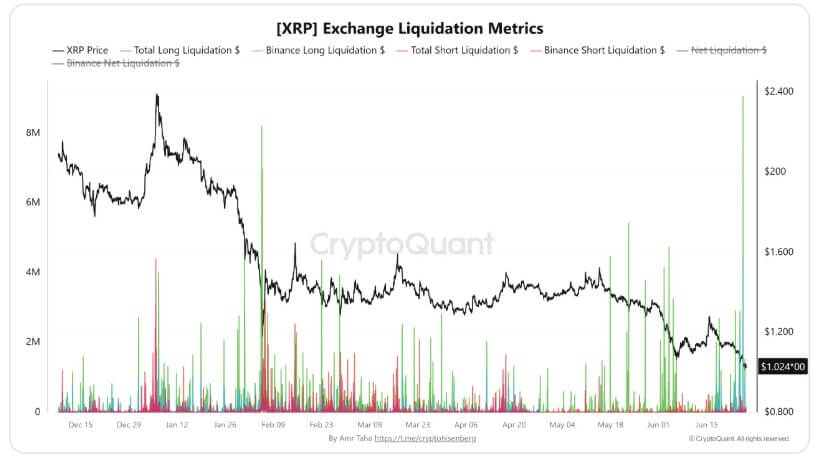
Long liquidations occur when falling prices reduce the value of the collateral supporting a bullish leveraged position. Exchanges then automatically close the trade, adding a new sell order to an already falling market. When several positions are concentrated around similar price levels, that process can accelerate a downturn.
The liquidations contributed to a broader reduction in outstanding positions in XRP derivatives. Open interest on Binance fell to around $205 million, the lowest level since March 22. The measure tracks contracts that remain active rather than contracts that have already been settled or closed.
Bybit recorded a similar decline. XRP’s open interest on the exchange fell to around $185 million, returning to levels last seen on June 6.
The parallel declines on two of the largest platforms suggest traders were reducing their exposure to the derivatives market rather than reacting to conditions on a single exchange.
The contraction also suggests that some investors voluntarily closed positions as prices weakened, while others were forced out of positions due to liquidations.
On the exchanges tracked, total open interest on XRP has fallen to approximately $2.34 billion. Futures revenue has fallen even sharper, from more than $30 billion during the comparable period last year to roughly $2.84 billion.
That represents a more than 90% drop in trading volume, reflecting how much speculative activity has disappeared since XRP attracted greater participation in 2025.
Open interest and futures volume measure separate aspects of derivatives activity. Open interest represents the value of positions that are outstanding, while volume measures the contracts traded over a period of time.
The simultaneous weakness of both measures shows that fewer traders are holding their positions and less capital is circulating through the market.
The cut could make XRP less vulnerable to large chains of forced liquidations. It could also be a signal that traders have lost confidence in the prospect of a near-term recovery.
Investors are accepting losses at the fastest pace since 2022
The pullback is no longer limited to leveraged traders.
A growing portion of XRP investors are moving their tokens below their purchase price, pushing a key measure of realized profitability to the lowest level in almost four years.
Data from Glassnode shows that XRP’s 90-day moving average profit-loss ratio fell to 0.33, its weakest reading since August 2022. The metric compares the value of gains recorded when tokens move on-chain with the value of realized losses.
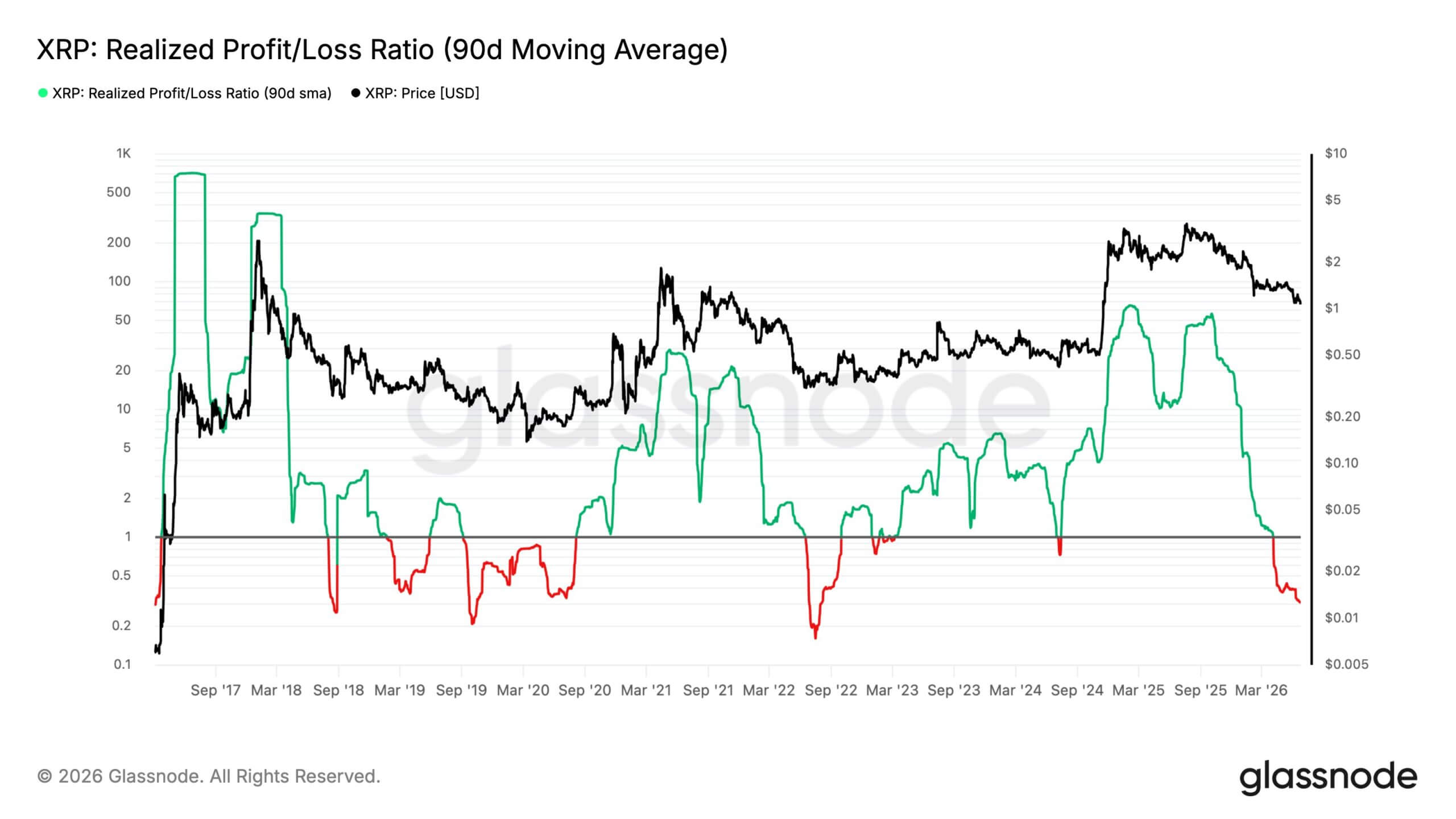
A reading of 0.33 means that investors realize roughly one unit of profit for every three units of loss. Ratios above 1 indicate that profitable trades dominate, while numbers below that threshold show that investors who accept losses account for most of the activity.
The latest figures indicate an intensification of capitulation, a term used to describe periods when holders exit their positions after a prolonged decline.
Such episodes can help markets reach a bottom by transferring assets from investors eager to sell to buyers willing to hold on due to further volatility. They can also last for a long time if demand remains weak, meaning the indicator alone cannot determine that XRP has bottomed out.
The deterioration reflects how quickly market conditions have turned against investors who have been accumulating XRP at higher prices. Any move downward places more of the token’s supply in unrealized loss, increasing the risk that holders will sell during temporary rebounds to limit further damage.
That creates an additional obstacle to a sustainable recovery. Even if the latest liquidations eliminate vulnerable leveraged positions, XRP could face selling from investors looking to exit close to their entry prices as the token tries to recover.
Risk-adjusted momentum remains negative
The returns generated by XRP have also failed to compensate traders for the volatility required to obtain them.
CryptoQuant’s risk-adjusted trend indicator for XRP on Binance shows that the token’s 30-day Sharpe ratio has fallen to minus 0.29. The measure compares an asset’s return to the level of risk assumed by investors over the period.
A negative Sharpe ratio indicates that XRP has suffered a loss after taking into account the price fluctuations. Investors were exposed to volatility without receiving a positive return.
The token’s Sharpe Z-score has fallen to around minus 1.57, showing that its recent risk-adjusted performance is significantly weaker than its historical average. The seven-day Sharpe momentum also remains negative at around minus 0.09.
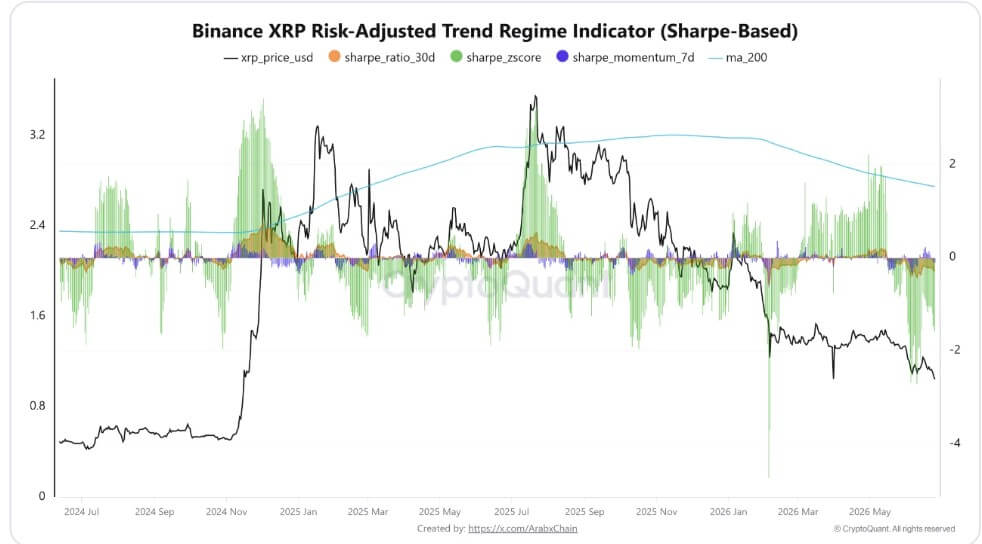
The results suggest that recent recovery efforts have not had sufficient strength to change the prevailing trend. They also help explain why traders may be reluctant to rebuild positions after liquidating or closing contracts.
Investors considering a new position are faced with an asset that has delivered weak returns while retaining the possibility of wide price swings. Until that relationship improves, the decline in open interest may continue to reflect a decline in appetite rather than a temporary reset before another surge.
One derivatives indicator provides a more neutral signal.
Binance’s XRP perpetual-to-spot volume imbalance was almost 0.51, while its 30-day Z-score was around 0.17. The figures show that perpetual futures still account for a large portion of trading activity, but the imbalance remains close to last month’s average.
The result suggests that derivatives positioning is no longer unusually stressed compared to recent conditions. During XRP’s April and May rallies, perpetual activity rose faster than spot trading, widening the gap between the two markets. That difference narrowed as prices fell and speculative activity waned.
The near-neutral value could reduce the chance that an extreme imbalance alone will result in another sudden liquidation. This does not show that spot market demand has increased enough to support a recovery.
Broader market decline removes support
XRP’s capitulation is unfolding as investors withdraw from cryptocurrencies across the market.
Bitcoin briefly fell to around $58,100 on Thursday, its lowest level since September 2024, before recovering towards $60,000. Ethereum continued to underperform, falling towards $1,550 and continuing its decline for the third day in a row.
The total value of the cryptocurrency market also fell below $2 trillion after Bitcoin’s fall to $58,000, wiping billions of dollars from digital assets and leaving many tokens at their weakest levels of the year.
The market breadth has deteriorated sharply. Of the 85 non-stablecoin assets surveyed by CryptoRank, 87% fell in June, while only 13% advanced. The average asset lost 8.6% and the average return was minus 12.3%, indicating that the weakness extended well beyond a handful of major tokens.
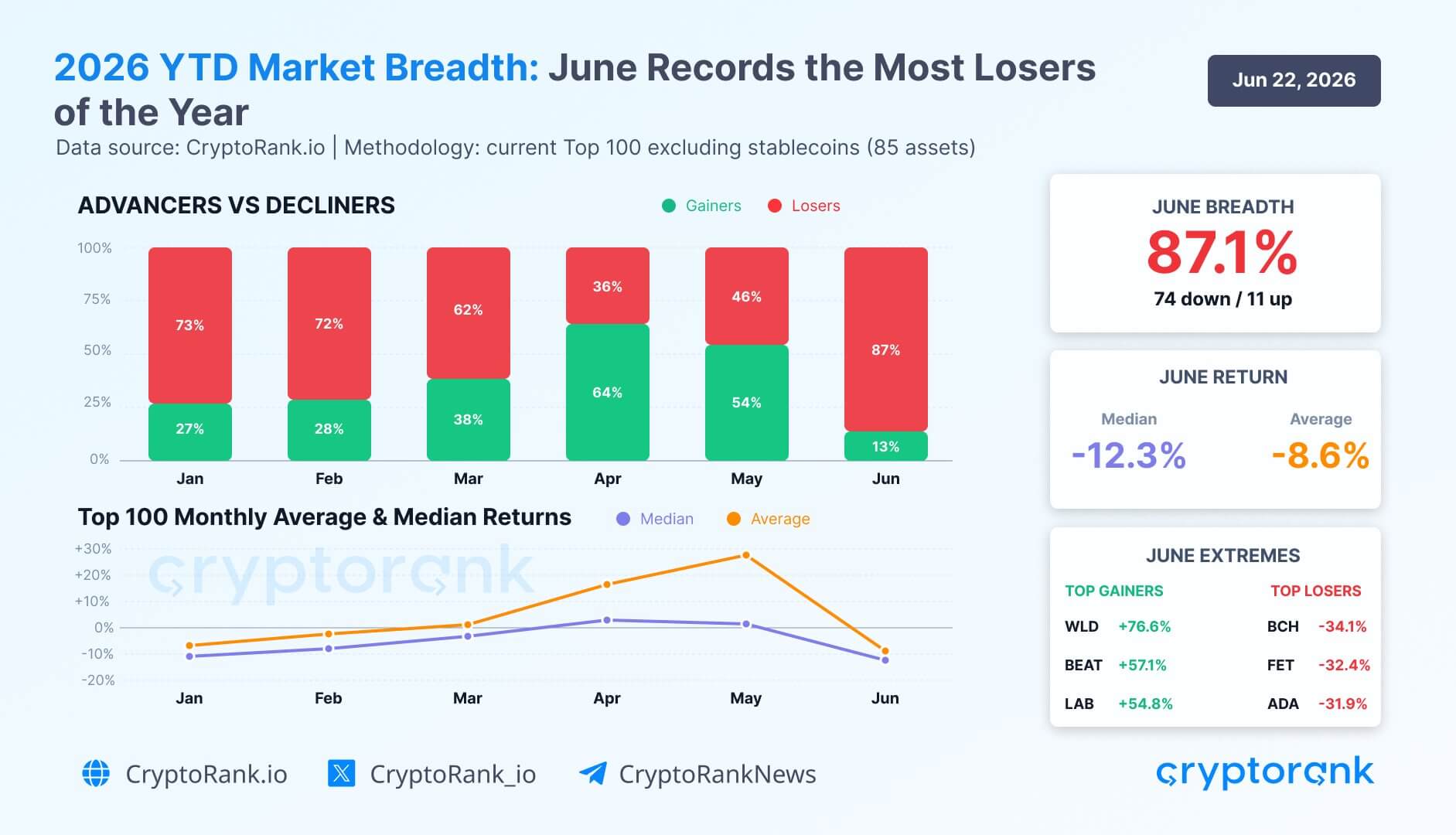
Only two of the ten largest non-stablecoin assets remained positive during the second quarter. Hyperliquid’s HYPE led with a 72.6% gain, largely driven by a rally in June that briefly pushed quarterly returns above 100%. Tron’s TRX followed with a 4.1% advance.
The rest remained in negative territory.
This broad decline reduces the possibility that investors will rotate capital from other cryptocurrencies into XRP.
During stronger markets, traders can view a sharp decline in a major token as an opportunity to buy at a discount. In a market where most assets are declining, preserving cash often takes precedence over seeking recovery.