

Close Menu
  • News
    • Bitcoin
    • Altcoins
    • DeFi
    • Market Cap
  • Blockchain
  • Web 3
    • NFT
    • Metaverse
  • Regulation
  • Analysis
  • Learn
  • Blog
What's Hot

Animoca-backed NUVA connects Figure’s $19 billion in tokenized assets to Ethereum

2026-05-14

Cardano’s most accurate indicator just turned bullish

2026-05-14

Jane Street Cuts Exposure to Bitcoin ETFs by 71% – Analyst Sees Bullish Upside

2026-05-14
Facebook X (Twitter) Instagram
  • Contact
  • Terms & Conditions
  • Privacy Policy
  • DMCA
  • Advertise
Facebook X (Twitter) Instagram
Bitcoin Platform – Bitcoin | Altcoins | Blockchain | News Stories Updated Daily
  • News
    • Bitcoin
    • Altcoins
    • DeFi
    • Market Cap
  • Blockchain

    Animoca-backed NUVA connects Figure’s $19 billion in tokenized assets to Ethereum

    2026-05-14

    Upbit will launch its own wallet and blockchain chain, signaling the shift to an on-chain platform

    2026-05-14

    OP Concise data confidentiality allows institutions to hide transaction data on Ethereum

    2026-05-14

    Tether unveils developer grant program to fund on-device AI and open-source payment tools

    2026-05-14

    Google BigQuery adds support for ZeroG On-Chain data analytics

    2026-05-14
  • Web 3
    • NFT
    • Metaverse
  • Regulation

    Bitcoin Rips as CLARITY Act Clears Major Senate Committee Hurdle, Advances to Full Senate Floor

    2026-05-14

    Crypto markets are vastly underestimating the passage of the Clarity Act

    2026-05-14

    CLARITY Act faces more than 100 changes as bankers send 8,000 demand letters against stablecoin rewards

    2026-05-13

    Bank lobbyists battle Clarity Act, saying bill would risk ‘flight from bank deposits’ to payment stability

    2026-05-12

    Het Witte Huis onthult dat Amerikaanse banken ‘weigerden’ bijeenkomsten bij te wonen om het probleem met stablecoin-beloningen in de CLARITY Act op te lossen

    2026-05-11
  • Analysis

    A strong XRP position above $1.38 could open the door for another move higher

    2026-05-14

    Ripple Insider Warns XRP Holders as Fake XRPL Airdrop Scams Increase

    2026-05-14

    Wells Fargo Executive Gives Details on ‘Number One’ Stock Picks, Says Company Is Going Through a Generational Restructuring

    2026-05-14

    Ethereum Price Flashes Weakness Signals, Pullback Fears Start to Rise

    2026-05-14

    Ethereum Price Flashes Weakness Signals, Pullback Fears Start to Rise

    2026-05-14
  • Learn

    Invite a Friend, Earn up to 200 USDT: Changelly’s first referral program is live

    2026-05-14

    AI Agent by Changelly: automated crypto swaps and no-code API integration

    2026-05-13

    Parabolic SAR Crypto Guide: Signals, Settings, and Risks

    2026-05-13

    What Is the Average Directional Index (ADX) in Crypto?

    2026-05-12

    Mean Reversion Trading in Crypto: Strategies, Signals, and Risks

    2026-05-12
  • Blog
Bitcoin Platform – Bitcoin | Altcoins | Blockchain | News Stories Updated Daily
Home»Bitcoin»Bitcoin Bull Run Linked to Economic Echoes of the 1930s and 1970s: Hayes
Bitcoin

Bitcoin Bull Run Linked to Economic Echoes of the 1930s and 1970s: Hayes

2024-07-02No Comments4 Mins Read
Share
Facebook Twitter LinkedIn Pinterest Email

Arthur Hayes, the co-founder of crypto exchange BitMEX, recently offered an in-depth analysis in its latest release essay, “Zoom Out,” drawing compelling parallels between the economic upheavals of the 1930s and 1970s and the current financial landscape, focusing primarily on the implications for Bitcoin and crypto’s bull run. His in-depth research suggests that historical economic patterns, when properly understood, can provide a blueprint for understanding the potential revival of the Bitcoin and crypto bull run.

Understanding financial cycles

Hayes begins his analysis by exploring the major economic cycles, starting with the Great Depression, through the economic boom of the mid-20th century, and into the stagnant 1970s. He categorizes these transformations into what he calls ‘local’ and ‘global’ cycles, which are crucial for understanding the broader macroeconomic forces at play.

Local cycles are characterized by an intense national focus where economic protectionism and financial repression prevail. These cycles often arise from government responses to severe economic crises that prioritize national recovery over global cooperation, typically leading to inflationary outcomes due to the devaluation of fiat currencies and increased government spending.

Related reading

In contrast, global cycles are characterized by periods of economic liberalization, during which global trade and investment are encouraged, often leading to deflationary pressures due to increased competition and efficiency in global markets.

Hayes carefully examines the impact of each cycle on asset classes, noting that non-fiat assets such as gold have historically performed well during local cycles due to their nature as a hedge against inflation and currency devaluation.

See also  2023 sets the stage for a monumental 2024

Hayes draws a direct parallel between the creation of Bitcoin in 2009 and the economic climate of the 1930s. Just as the economic crises of the early 20th century led to transformative monetary policy, the financial crash of 2008 and subsequent quantitative easing paved the way for the introduction of Bitcoin.

Why the Bitcoin Bull Run Will Resume

Hayes argues that Bitcoin’s rise during what he identifies as a renewed local cycle, marked by the global recession and significant central bank interventions, reflects past periods when traditional financial systems were under pressure and alternative assets such as gold became increasingly important.

Hayes builds on the analogy between gold in the 1930s and Bitcoin today, explaining how gold served as a safe haven in times of economic uncertainty and rampant inflation. He argues that Bitcoin, with its decentralized and state-independent nature, is well suited to serve a similar purpose in today’s volatile economic climate.

Related reading

“Bitcoin operates outside traditional state systems, and its value proposition becomes especially apparent in times of inflation and financial repression,” Hayes notes. This characteristic of Bitcoin, he argues, makes it an indispensable asset for those looking to preserve wealth amid currency devaluation and fiscal instability.

Hayes points to the significant increase in the U.S. budget deficit, which is expected to reach $1.915 trillion in fiscal year 2024, as a modern indicator that parallels the fiscal expansions of previous local cycles. This deficit, which is significantly higher than in previous years and marks the highest level outside the COVID-19 era, is attributed to higher government spending, similar to historical periods of government-induced economic stimulus.

See also  Why Bitcoin's 30% Drop Is a 'Healthy Thing', Michael Saylor Reveals

Hayes uses these fiscal indicators to suggest that, just as previous local cycles have led to higher valuations of non-sovereign assets, current fiscal and monetary policies are likely to increase Bitcoin’s appeal and value.

“Why am I confident that Bitcoin will regain its mojo? Why am I confident that we are in the midst of a new mega-local, nation-state-first inflationary cycle?” Hayes asks rhetorically in his essay. He believes that the same dynamics that drove the value of assets like gold during previous economic upheavals are now adapting to strengthen Bitcoin’s value.

He concludes: “I believe that fiscal and monetary conditions are and will remain loose, and therefore hodling crypto is the best way to preserve wealth. I am convinced that today will rhyme with the 1930s to 1970s, and that means that since I can still move freely from fiat to crypto, I must do so because a humiliation is coming due to the expansion and centralization of credit allocation through the banking system.”

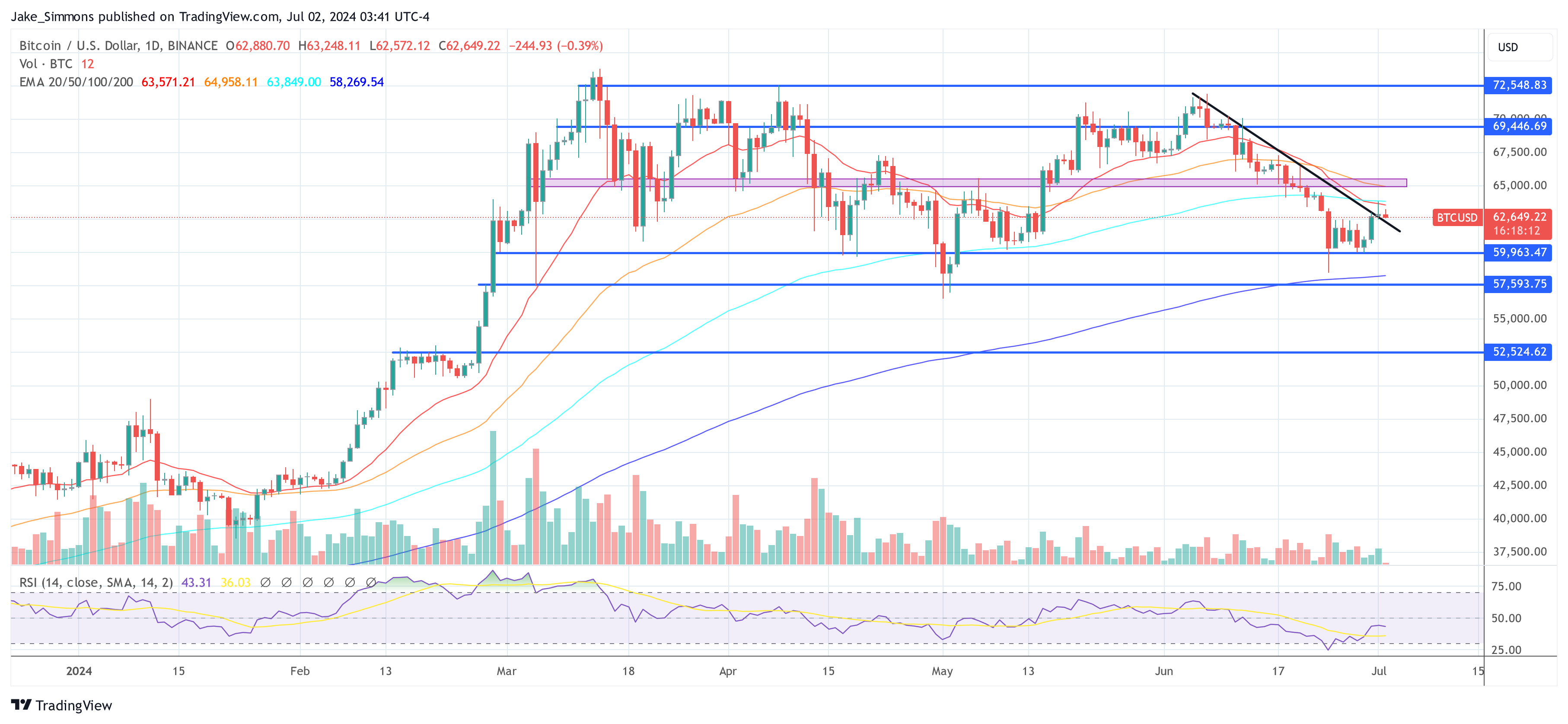
At the time of writing, BTC was trading at $62,649.
Bitcoin price
BTC falls below $63,000, 1-day chart | Source: BTCUSD on TradingView.com

Featured image from YouTube / What Bitcoin Did, chart from TradingView.com

Source link

1930s 1970s Bitcoin Bull Echoes economic Hayes linked run
Share. Facebook Twitter Pinterest LinkedIn Tumblr Email

Related Posts

Jane Street Cuts Exposure to Bitcoin ETFs by 71% – Analyst Sees Bullish Upside

2026-05-14

Why Bitcoin Still Needs Massive Capital Inflows to Spark a Real Bull Run

2026-05-14

Bitcoin Rips as CLARITY Act Clears Major Senate Committee Hurdle, Advances to Full Senate Floor

2026-05-14

Analyst Says Bitcoin Should Be Avoided at All Costs; Here’s what you can do instead as a 50% crash looms

2026-05-14
Add A Comment

Comments are closed.

Top Posts

Kima Network integrates with ECB to shape the future of programmable finance

2025-11-21

Brave Browser teams up with Inspect to bring a new look to Web3 browsing

2023-11-15

Time to Convert Bitcoin to Ethereum? ETH/BTC Charts Gear Up for a 180% Rise

2024-09-13
Editors Picks

CLARITY Act gets a deadlock break that also opens the door for more demand for Bitcoin

2026-03-21

Bitcoin’s Open Interest Increases: Will BTC Surge Higher This Week?

2024-03-04

Tether burns crypto -ecosystem with new USDT -Mint of $ 2 billion

2025-07-16

BTC is down 7.99% over the past 7 days.

2024-09-01

Our mission is to develop a community of people who try to make financially sound decisions. The website strives to educate individuals in making wise choices about Cryptocurrencies, Defi, NFT, Metaverse and more.

We're social. Connect with us:

Facebook X (Twitter) Instagram Pinterest YouTube
Top Insights

Animoca-backed NUVA connects Figure’s $19 billion in tokenized assets to Ethereum

Cardano’s most accurate indicator just turned bullish

Jane Street Cuts Exposure to Bitcoin ETFs by 71% – Analyst Sees Bullish Upside

Get Informed

Subscribe to Updates

Get the latest news and Update from Bitcoin Platform about Crypto, Metaverse, NFT and more.

  • Contact
  • Terms & Conditions
  • Privacy Policy
  • DMCA
  • Advertise
© 2026 Bitcoinplatform.com - All rights reserved.

Type above and press Enter to search. Press Esc to cancel.