
Crypto moves fast, and your emotions often move even faster. One red candle can make you doubt everything. And then, one green rally can make you chase entries you’d normally avoid.
The crypto Fear and Greed Index can help with that. It won’t predict the next move, and it won’t tell you what to buy. But it can show whether the crypto market feels fearful, greedy, or somewhere in between.
What Is the Crypto Fear and Greed Index?
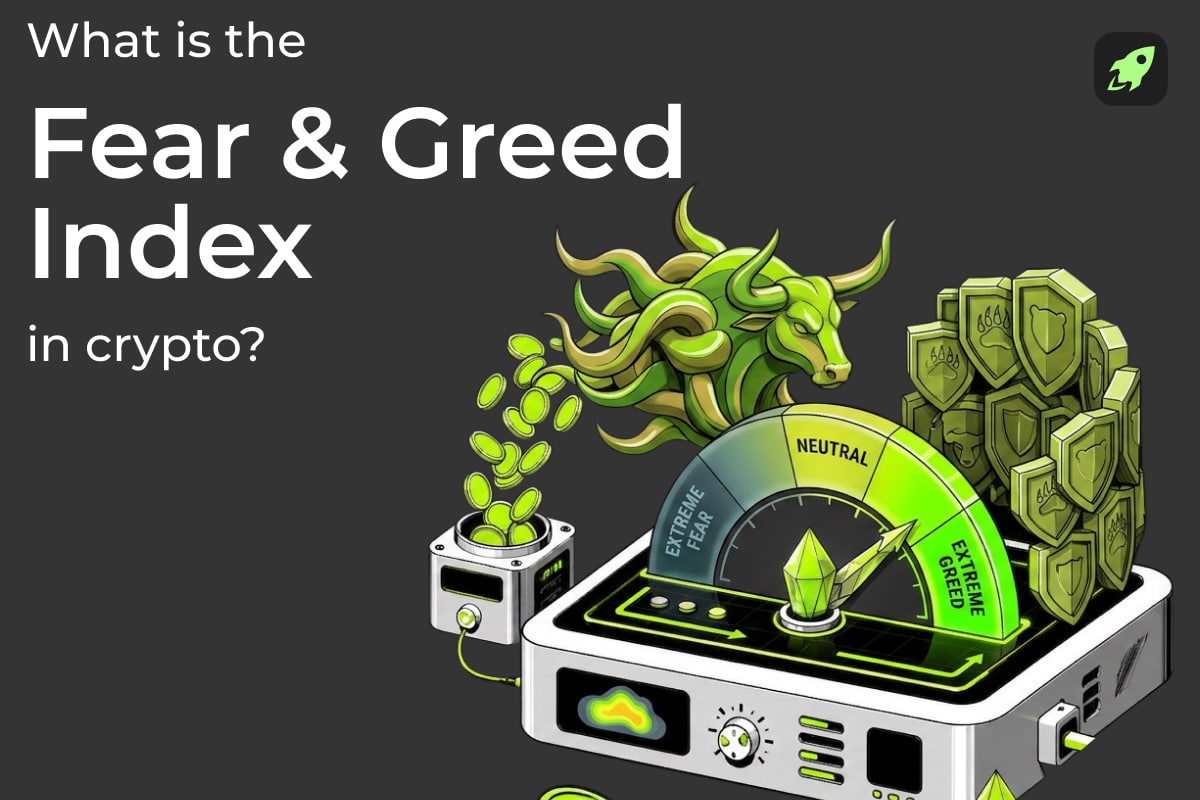
The crypto Fear and Greed Index is a sentiment indicator that tracks crypto market sentiment on a 0–100 scale. Lower values point to fear, while higher values point to greed. In simple terms, the Fear and Greed Index measures how optimistic or anxious crypto investors appear to be at a given time.
The index combines market and attention signals such as trading volume, market volatility, market momentum, social media activity, Bitcoin dominance, and Google Trends data. These inputs are then compressed into one score that helps you gauge market sentiment quickly.
The index doesn’t measure intrinsic value. It doesn’t show whether Bitcoin, Ethereum, or any other asset is fairly priced. It reflects market sentiment, not fundamentals. That’s why you should treat any Fear and Greed Index reading as context, not as investment advice.
If you’re wondering exactly what the Fear and Greed Index in crypto is, the short answer is this: It’s a crypto market indicator that helps you measure fear and greed across the market. It can show whether investor sentiment looks cautious, neutral, optimistic, or overheated.
Why Does the Crypto Fear and Greed Index Matter?
The crypto market often moves on emotion. During turbulent markets, fear can push investors into panic selling. Greed can push them into FOMO buying after prices have already moved sharply.
The Fear and Greed Index gives you a structured way to look at these emotional swings. Instead of guessing whether the market feels nervous or euphoric, you can use the index as one data point in your broader research.
Fear and greed can shape crypto market behavior in several ways:
- Fear can increase selling pressure, reduce risk appetite, and push investors toward defensive assets.
- Extreme fear can appear during corrections, liquidations, or negative news cycles.
- Greed can appear during rallies, strong market momentum, and periods of high buying volumes.
- Extreme greed can suggest excessive optimism, a crowded trade, or a market that may need a cooldown.
This doesn’t mean that fear is always bullish or greed is always bearish. A fearful market can keep falling, and a greedy market can keep rising. The index simply helps you assess market sentiment before your own emotions take over.
How Does the Crypto Fear and Greed Index Work?
The crypto Fear and Greed Index works by combining several sentiment indicators into one daily market sentiment snapshot. Different providers use different models, but most versions look at market data, attention signals, and investor behavior.
A typical Fear and Greed Index calculated from multiple inputs may include:
- Volatility, which tracks how sharply prices move compared with corresponding average values.
- Market momentum and trading volume, which show whether buyers or sellers appear more active.
- Social media interactions, which can measure how much engagement crypto-related posts receive.
- Bitcoin dominance, which tracks Bitcoin’s market cap share compared with the total cryptocurrency market.
- Google Trends and Bitcoin-related search queries, which show changes in search volume and public interest.
- Surveys or weekly polls, although some providers have paused this input.
These inputs are weighted, processed, and turned into a single 0–100 score. The result is one number that summarizes the crypto market’s current mood.
The index usually updates once per day. That means it gives you a broad sentiment snapshot, not real-time trading data. Importantly, if the market moves sharply intraday, the next index update may not reflect that move immediately.
How Do You Read the 0–100 Fear and Greed Score?
The Fear and Greed Index ranges from 0 to 100. A score near 0 means maximum fear. A score near 100 means maximum greed. Values near the middle suggest a more balanced market mood.
The common index ranges are:
- 0–24: Extreme fear
- 25–44: Fear
- 45–55: Neutral
- 56–74: Greed
- 75–100: Extreme greed
Low scores suggest a fearful market. Investors may feel anxious, defensive, or unwilling to take risk. High scores suggest a positive market mood, stronger risk appetite, or possible overconfidence.
These labels help you read the market’s emotional backdrop. They don’t guarantee what prices will do next. A score of 20 doesn’t mean a bottom is in, and a score of 80 doesn’t mean a top has formed.
What Does Extreme Fear Mean in Crypto?

Extreme fear usually means crypto investors are nervous. It can appear during sharp selloffs, negative news cycles, liquidation cascades, or periods of weak demand.
A fearful market may show:
- Lower risk appetite
- Panic selling
- Defensive behavior
- Rising market volatility
- Weak market momentum
- Lower confidence in short-term market trends
Many investors treat extreme fear as a possible contrarian signal. The idea is simple: When fear dominates, prices may already reflect a lot of negative expectations. In some cases, that can create a buying opportunity.
But extreme fear doesn’t guarantee a bottom. Oversold conditions can stay oversold, and bad news can keep pushing prices lower. Use extreme fear as a reason to research deeper, not as a command to buy.
What Does Extreme Greed Mean in Crypto?

Extreme greed means optimism is running high. Investors may feel confident, social media activity may rise, and FOMO can spread quickly across the crypto market.
When greed dominates, you may see:
- Strong market momentum
- High buying volumes
- More speculative behavior
- Rising search trends
- More aggressive risk-taking
- Claims about “easy gains” or guaranteed upside
Extreme greed can suggest overheated market conditions. It may also appear when narratives become too emotional, including claims about Bitcoin price manipulation, coordinated pumps, or unstoppable rallies.
Still, extreme greed doesn’t guarantee a top. Strong trends can continue longer than expected. The better approach is to treat extreme greed as a caution flag. Review your risk management, check whether your plan still makes sense, and avoid decisions driven only by your own emotions.

How to Get Free Crypto
Simple tricks to build a profitable portfolio at zero cost

Who Publishes the Crypto Fear and Greed Index?
There isn’t one universal crypto Fear and Greed Index. Several platforms publish their own versions, and their daily readings may differ because they use different data sources and methodologies.
The two most referenced versions are Alternative.me and CoinMarketCap. Alternative.me publishes a widely used Bitcoin-focused index that many investors treat as a broad crypto sentiment proxy. CoinMarketCap publishes its own proprietary CMC crypto Fear and Greed Index for overall market sentiment.
Other crypto platforms, exchanges, and education sites may also show fear and greed tools, explainers, or dashboards. That’s why you should always check which provider you’re using before comparing historical values or making conclusions from a single score.
How Is the Alternative.me Fear and Greed Index Calculated?
The Alternative.me Fear and Greed Index is the best-known version. It focuses mainly on Bitcoin market sentiment, although many investors use it as a general crypto fear indicator.
Alternative.me’s published methodology includes the following components:
- Volatility (25%): Compares current Bitcoin volatility and maximum drawdowns with average values from the previous 30 and 90 days. Higher volatility can signal a fearful market.
- Market Momentum/Volume (25%): Compares current trading volume and market momentum with prior average values. Strong buying activity in a positive market can increase the greed score.
- Social Media Interactions (15%): Tracks Bitcoin-related hashtags and engagement. A high interaction rate can signal rising greed.
- Bitcoin Dominance (10%): Measures Bitcoin’s market cap share of the total crypto market. Rising dominance can suggest caution, while falling dominance can suggest higher altcoin risk appetite.
- Google Trends (10%): Uses Bitcoin-related search queries, Google trends data, and search volume changes to measure public interest.
- Surveys/Weekly Polls (15%): Listed in the methodology, but currently paused.
This model uses a text processing algorithm for some social and search-related signals, then combines the weighted inputs into one daily score.
How Is the CoinMarketCap Fear and Greed Index Different?
CoinMarketCap’s Fear and Greed Index is also scored from 0 to 100, but it uses a proprietary methodology. That means the full formula and exact weightings aren’t public.
CoinMarketCap says its index combines several components, including price momentum, market volatility, derivatives market data, market composition, and proprietary CMC data such as social trend searches and user engagement.
Here’s the simple difference:
| Feature | Alternative.me | CoinMarketCap |
| Methodology | Publicly documented with stated weightings | Proprietary |
| Main focus | Bitcoin-focused sentiment proxy | Broader crypto market sentiment |
| Derivatives data | Not listed as a core input | Included |
| Search data | Google Trends and Bitcoin search queries | Proprietary search and engagement data |
| Market composition | Bitcoin dominance | Broader market composition signals |
| Output | 0–100 sentiment score | 0–100 sentiment score |
Because the models differ, their scores may not match on the same day. That doesn’t mean one is “wrong.” It means they measure sentiment through different data sources.
Why Is Bitcoin Dominance Part of the Index?
Bitcoin dominance measures Bitcoin’s market capitalization as a share of the total cryptocurrency market capitalization. In other words, it shows how much of the total crypto market cap belongs to Bitcoin.
Some index models use Bitcoin dominance because it can reflect risk appetite. When Bitcoin dominance rises, investors may be moving away from riskier altcoins and into Bitcoin. That can signal caution or fear. When dominance falls, investors may be rotating into altcoins, which can signal stronger appetite for risk.
This interpretation is useful, but it definitely isn’t a universal law. Bitcoin dominance can move for many reasons, including ETF flows, Bitcoin-specific news, altcoin weakness, stablecoin supply changes, or broad market cycles. So treat it as one supporting input, not a standalone signal.
How Can Traders and Investors Use the Fear and Greed Index?
You can use the Fear and Greed Index as a quick sentiment check before deeper research. It helps you see whether the market looks fearful, neutral, greedy, or overheated.
Here are practical ways to use it:
- Check the daily score before reviewing charts or news.
- Compare today’s score with historical values.
- Use extreme fear as a prompt to look for oversold conditions, not as an automatic buy signal.
- Use extreme greed as a reminder to review exposure, not as an automatic sell signal.
- Track the index in a market journal to see how sentiment changes over time.
- Compare the score with price action, support levels, liquidity, and trading volume.
- Use it as emotional discipline when your own emotions start driving investment decisions.
For beginners, the index helps explain the mood of the crypto market in simple terms. For active investors, it can support a contrarian strategy. For long-term investors, it can add context to dollar-cost averaging and portfolio risk awareness.
The key is balance. The index can inform your thinking, but it shouldn’t override your plan.
What Should You Check Alongside the Fear and Greed Index?
The Fear and Greed Index works best when you combine it with other data sources. A single score can’t explain the entire market.
Check these signals alongside it:
- Price trend and support levels: See whether price action confirms or contradicts the sentiment reading.
- Trading volume and liquidity: Strong moves with weak volume may be less reliable than moves backed by deep market activity.
- Bitcoin dominance trend: Watch whether capital is rotating into Bitcoin or into altcoins.
- Market volatility: Check whether the index reflects a short spike or a broader volatility regime.
- On-chain data and exchange flows: Look for wallet activity, inflows, outflows, and network usage.
- News and macro conditions: Regulatory news, interest rate changes, ETF flows, and exchange events can shift sentiment quickly.
- Token fundamentals: For individual assets, review adoption, utility, revenue, development, tokenomics, and project-specific risks.
This cross-check helps you avoid overreacting to one score and makes your research more grounded.
What Does the Fear and Greed Index Not Tell You?
The Fear and Greed Index is useful, but it has limits.
- It doesn’t give exact price targets. A score of 20 doesn’t tell you where Bitcoin or any altcoin will trade next.
- It doesn’t confirm market tops or bottoms. Extreme fear can appear before more downside, and extreme greed can appear before more upside.
- It doesn’t cover every token equally. A broad crypto market sentiment score may not reflect what’s happening inside a smaller altcoin, memecoin, or DeFi token.
- It doesn’t show the full leverage picture. Liquidations, funding rates, open interest, and derivatives positioning need separate analysis.
- It doesn’t replace fundamentals. You still need to check whether a project has real demand, healthy liquidity, credible development, and sustainable tokenomics.
- It doesn’t protect you from sudden news shocks. Hacks, lawsuits, exchange failures, macro events, and regulatory updates can change sentiment fast.
- Most importantly, it doesn’t constitute investment advice. Any serious financial decision should be based on your own comprehensive due diligence, risk management, and, when needed, guidance from a qualified financial advisor.
Is the Crypto Fear and Greed Index a Lagging Indicator?
Yes, the crypto Fear and Greed Index can lag behind live market moves. It usually updates once per day, so it doesn’t capture every intraday price swing, liquidation event, or news reaction in real time.
The index also uses data that often reacts after price action has already moved. For example, volatility, trading volume, social media interactions, and Google Trends can all rise after a major rally or crash starts.
That doesn’t make the indicator useless, though. It just means you should use it for historical context and confirmation, not as a real-time trigger. It can help you understand whether sentiment has shifted across days or weeks, but it can’t replace live market data.
Some Reddit and community discussions criticize the index for being too simple or too reactive. That skepticism is fair. The best use is not as “score says buy” or “score says sell.” The best use is “score shows sentiment is stretched, so I should cross-check with other data and consider acting.”
How Reliable Is the Crypto Fear and Greed Index?
The crypto Fear and Greed Index is moderately reliable as a sentiment tool. It can show whether the market feels fearful, neutral, or greedy. It can also help you compare current sentiment with historical values. But it isn’t reliable as a standalone prediction tool. Sentiment can stay extreme for longer than expected, and price doesn’t always reverse when the index hits extreme fear or extreme greed.
The index is most useful when it confirms what you already see elsewhere. If extreme greed appears alongside parabolic price action, weak fundamentals, and rising leverage, that’s a strong warning sign. If extreme fear appears alongside capitulation, improving fundamentals, and strong support, that may deserve deeper research.
Use it to frame your thinking. Don’t use it to outsource your judgment.
Should You Use the Crypto Fear and Greed Index?
You can definitely use the crypto Fear and Greed Index, but only as one part of your research.
- For beginners, it’s a simple way to understand crypto market sentiment without reading dozens of charts. It can show whether the market mood looks fearful, greedy, or neutral.
- For active investors, it can support contrarian thinking. Extreme fear may point to areas worth researching, while extreme greed may help you avoid chasing hype.
- For long-term investors, it can add emotional context to portfolio decisions. If your plan is dollar-cost averaging, the index can help you understand market mood without changing your whole strategy every time sentiment shifts.
Still, the index should never be your only signal. Combine it with technical analysis, fundamentals, on-chain data, liquidity, news context, and risk management. Then make decisions based on evidence, not emotion.
Final Thoughts
The crypto Fear and Greed Index turns market emotion into one readable score. That makes it useful, especially when crypto feels loud, fast, and messy.
But it’s still just a sentiment indicator. Extreme fear doesn’t guarantee a buying opportunity, and extreme greed doesn’t guarantee a correction. Use the index to check the mood, question your assumptions, and support your research—not to replace it.
Disclaimer: Please note that the contents of this article are not financial or investing advice. The information provided in this article is the author’s opinion only and should not be considered as offering trading or investing recommendations. We do not make any warranties about the completeness, reliability and accuracy of this information. The cryptocurrency market suffers from high volatility and occasional arbitrary movements. Any investor, trader, or regular crypto users should research multiple viewpoints and be familiar with all local regulations before committing to an investment.