

South Korean police on June 5 opened the country’s first illegal gambling investigation into domestic Polymarket users, targeting residents who had placed bets on the June 3 local election results.
Gangwon Provincial Police are leading the investigation at the request of the national police, tracking cryptocurrency transaction data to identify users across the country.
The identified individuals face possible fines of up to 10 million won ($6,500) under Article 246 of the Criminal Code. Polymarket’s resolved 2026 Seoul Mayor Election Market alone showed a total volume of US$52.2 million, driving activity in Korea’s election markets well into the tens of billions.
South Korea ranks 15th in the Chainalysis 2025 Global Crypto Adoption Index, the latest addition to a list that already includes India (#1), Brazil (#5), Indonesia (#7) and Thailand (#17).
Six of the top 20 crypto adoption markets have now pushed back against prediction platforms through gambling laws, derivatives restrictions, ISP blocks, user enforcement, or a combination of all four.
Crypto adoption and regulatory clearance for crypto-native financial products have diverged, and prediction markets are caught in that divide.
| Country | Chain analysis rank | Enforcement process | Goal |
|---|---|---|---|
| India | #1 | Online gambling laws, blocking orders, VPN pressure | Polymarket, Kalshi |
| US | #2 | CFTC vs. State Gambling Conflict, Congressional Investigation | Kalshi, Polymarkt |
| Brazil | #5 | Platform blocks, derivatives restrictions | 27 platforms |
| Indonesia | #7 | Online gambling block | Polymarkt |
| South Korea | #15 | Research into illegal gambling at user level | Domestic Polymarket users |
| Thailand | #17 | Classification of online gambling | Polymarkt |
The volume that attracted attention
The combined monthly trading volume on Kalshi and Polymarket increased from less than $5 billion in September 2025 to more than $10 billion in May 2026.
For context, legal U.S. sportsbooks averaged about $14 billion in monthly wagers in 2025. Sports, politics and crypto accounted for 91% of Kalshi’s global volume and 90% of Polymarket’s as of July 2024.
Sports alone accounted for 80% of Kalshi’s volume, while politics accounted for 32% of Polymarket’s, and these product concentrations are right where regulators draw the toughest line.
Since the start of 2026, Kalshi has spotted more than 400 suspicious transactions, more than double the total for all of 2025. Platforms built market integrity mechanisms faster than legal frameworks emerged to govern them.
How the classification breaks down
On April 24, Brazilian Finance Minister Dario Durigan announced that National Monetary Council Resolution No. 5,298 blocked 27 platforms, including Polymarket, Kalshi, PredictIt and Robinhood’s prediction feature. It also banned derivatives related to sports, online gaming, political, electoral, cultural and social outcomes.
Only contracts tied to economic benchmarks, such as exchange rates or interest rates, survived the cut. Durigan said the government wanted to prevent an unregulated gambling market from encroaching on household finances at a time when Brazil was already reducing consumer debt.
Kalshi’s timing was particularly bad: the platform had announced a Brazilian distribution partnership with brokerage XP International in March 2026, a month before the lockdown took effect.
India dealt with the same product through a different legal pipe and arrived at the same outcome. Both Houses of Parliament passed the Promotion and Regulation of Online Gaming Act 2025 in August 2025, received presidential assent the same month and came into effect on May 1, 2026.
By law, prediction markets fall under prohibited online money gambling, the classification of which includes event contracts regardless of how operators frame them as derivatives or prediction tools.
MeitY has issued a blocking order against Polymarket and is preparing a similar order for Kalshi. On April 25, the ministry sent a letter specifically to VPN providers, warning them not to allow access to blocked platforms.
Targeting VPN providers in addition to platforms extends enforcement one layer deeper in the access stack.
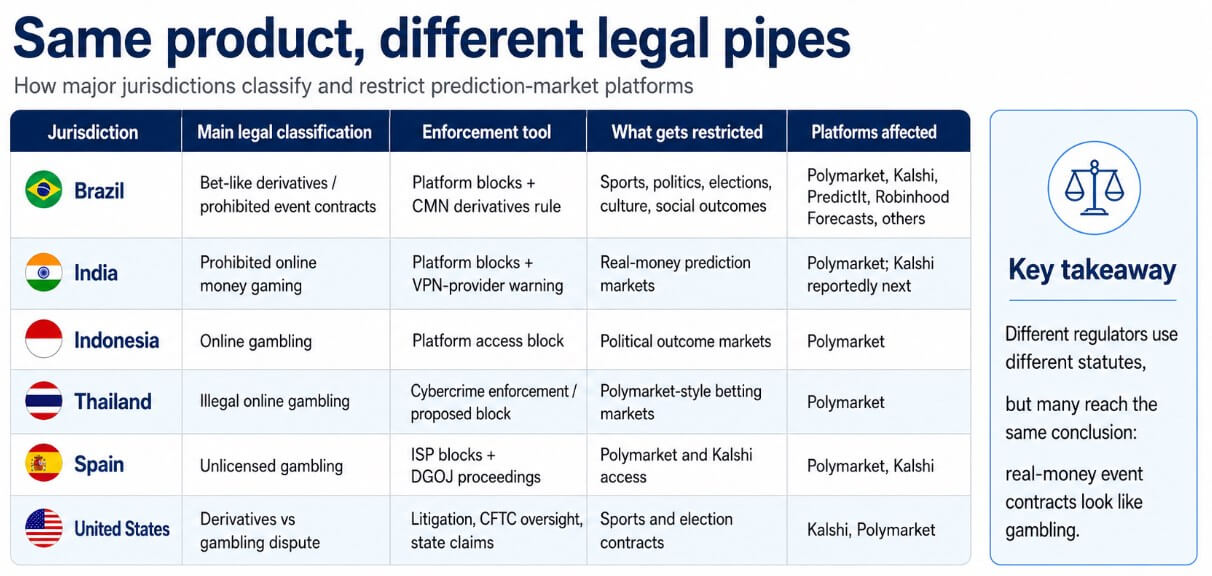
Indonesia blocked Polymarket after markets about the possible early end of President Prabowo Subianto’s term circulated on the platform. Thailand’s cybercrime authorities previously classified Polymarket as illegal online gambling.
Spain ordered ISPs to block Polymarket and Kalshi on May 26, pending a disciplinary procedure by the gambling watchdog DGOJ, which is expected to last three to four months.
Spain is outside Chainalysis’s top 20, but its enforcement relies on consumer protection mechanisms, providing regulators with a framework that applies regardless of whether the product is classified as a derivative.
The American version
The United States is in a jurisdictional battle as federal CFTC regulations coexist with state-level gambling claims over the same contracts, and that tension remains unresolved.
Kalshi has a designated contract market license and Polymarket relaunched a US exchange in late 2025 after acquiring a regulated derivatives firm.
Several states claim that sports and election contracts are entering gambling territory regardless of CFTC oversight, resulting in lawsuits that are carving up the domestic market.
In April 2026, Polymarket International recorded a trading volume of $9 billion, compared to $1.3 billion on Polymarket US.
The US House Oversight Committee opened an investigation into Kalshi and Polymarket in May 2026 over whether government employees acted on classified information, with Chairman James Comer flagging potential legislation to ban members of Congress and government officials from participating.
This market integrity argument adds legislative pressure independent of the CFTC-versus-state issue.
How far the collateral wedge travels
In the bull case, regulators in major financial centers accept event contracts as legitimate derivatives when used for economic, financial or hedging purposes, and require platforms to exclude sports, politics and elections in order to operate legally.
Kalshi’s CFTC-regulated model serves as a template, with platforms splitting into a compliant financial contract layer and a separate offshore, crypto-native layer.
The offshore layer will continue to attract retail demand until payment issues, app store enforcement, or a crackdown on VPNs gradually limit access.
In the bear case scenario, Brazil’s derivatives ban and India’s online money gaming classification spread to other top markets for crypto adoption.
Sports, politics and elections are the products that users actually want, and those are exactly the contracts that regulators focus on. Platforms that rely on these categories for 90% of their volume cannot exclude them without becoming structurally different companies.
A market integrity incident, such as a documented case of insider trading about a geopolitical event or election, accelerates the cascade. In the first five months of 2026 alone, Kalshi flagged more than 400 suspicious transactions. The raw material for a triggering event already exists.
Regulated financial contracts will serve jurisdictions willing to treat limited categories of events as CFTC-style derivatives. Licensed gambling products will be offered on platforms that classify outcome contracts as betting and comply with local consumer protection regimes.
| Future model | Where it fits | What survives | What is being pressed? |
|---|---|---|---|
| Regulated financial contracts | US CFTC or financial market regimes | Economic data, inflation, rates, weather, crypto benchmarks | Sports, politics, elections |
| Licensed gambling products | Countries that consider event contracts as betting | Consumer-protected gambling markets | Derivatives branding, offshore access |
| Geofenced crypto-native markets | Offshore or lightly regulated locations | Stablecoin-funded global liquidity | App Store access, payments, VPN routes, user protection |
Geofenced crypto-native markets will continue to reach users through stablecoins, wallets and VPNs until access, payment processing or enforcement pressure catches up.
The South Korean investigation shows that enforcement logic is shifting from platform blocking to user liability, with authorities tracking crypto transaction data to identify individuals and summon them for questioning.