
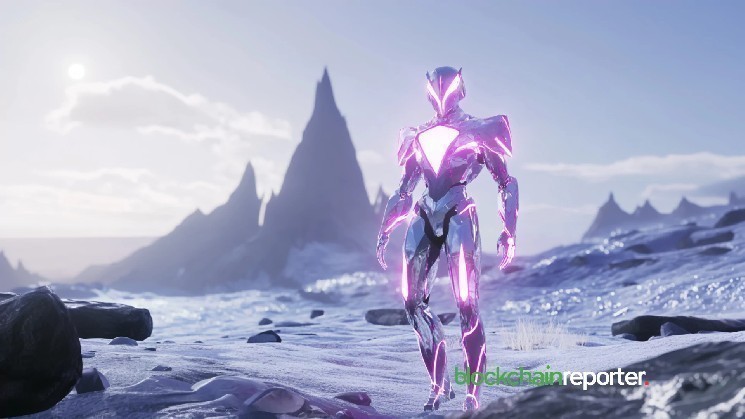
MetaMars has taken a significant step with its groundbreaking partnership with XDGAI, the move to create a decentralized AI ecosystem, combining intelligence, blockchain and creating the metaverse. The partnership unites MetaMars’ immersive Web3 metaverse and XDGAI’s token-based Neuronal Economic System, which aims to transform the way AI functions within the decentralized environment.
🚀 Partnership alert! MetaMars + @xdgainet = the future of decentralized AI! 🌐💡
XDGAI’s token-driven Neuronal Economic System powers a global intelligent computing network that combines AI and blockchain. 🧠💎
Together we shape the future of AI! #MetaMars #XDGAI pic.twitter.com/JaHxXvDnI4
— MetaMars (@MetaMars_global) November 5, 2025
This project is an attempt to integrate AI computing power and blockchain-based economies in a way that creates a self-sustaining network that performs more advanced data processing, virtual interactions, and AI-generated experiences.
Within XDGAI’s Neural Economic System
The foundation of this collaboration is XDGAI’s Neuronal Economic System, inspired by a token-based decentralized web to deploy distributed AI intelligence across the global nodes. Unlike classic AI systems, where the data center is centralized, the XDGAI model promotes peer-to-peer computation and machine learning with a decentralized system of incentives.
By doing this, developers, researchers, and makers can get involved in AI model training and be compensated with XDGAI tokens. The system not only democratizes access to AI resources, but also promotes transparency, scalability and ownership, which are essential for the development of the Web4 infrastructure.
MetaMars: Expanding the Web3 Frontier
MetaMars is a Mars-themed metaverse focused on interplanetary exploration, whose ecosystem has gradually expanded to include blockchain-based experiences. The platform’s vision is a self-sustaining virtual reality, where people have the opportunity to own land, create digital economies and interact with others, who also have AI-enhanced experiences.
The technical approach of applying XDGAI to bring in decentralized AI services would see MetaMars enhance its artificial world with autonomous artificial intelligence interactions, predictive systems, and intelligent world-building tools. Such synergy holds the promise of creating immersive spaces where AI not only serves humans, but evolves with them and continues to learn as a result of real-time interactions.
AI meets the metaverse: a decentralized revolution
The collaboration between MetaMars and XDGAI represents a combination of two disruptive trends, the democratization of AI and the growth of the metaverse.
While the centralized AI systems are usually associated with issues of data control and scalability, the decentralized AI networks like XDGAI are expected to enable users to directly own their contribution to digital intelligence.
In the case of MetaMars, it is about the construction of AI-oriented digital societies that are independent, flexible and maintain economic relationships. It won’t be long before users notice AI-powered NPCs (non-player characters) capable of controlling cities, creating virtual architecture, or even interacting with players in realistic and human-like ways.
The similarity between the two projects is the focus on sustainability and inclusivity, where AI will be made accessible to everyone, not just a large company or a developer with a well-developed infrastructure. They both want to develop an outline of a new digital civilization governed by blockchain and decentralized intelligence.
Impact on the sector and roadmap for the future
The collaboration would accelerate adoption in both the Web3 and AI sectors and bridge the gap between machine learning, metaverse ecosystems and crypto-driven economies, according to the analysts. The two partners have already mentioned future integrations such as the use of AI tokens in the MetaMars ecosystem and cross-platform interoperability between XDGAI’s compute nodes and the metaverse assets.
MetaMars is a Mars-themed metaverse focused on interplanetary exploration, which has been gradually growing its ecosystem with blockchain-based experiences.