
The thesis is that ordinary people can deliver the storage, bandwidth and computing power that modern apps need, at the edge, via peer-to-peer networks.
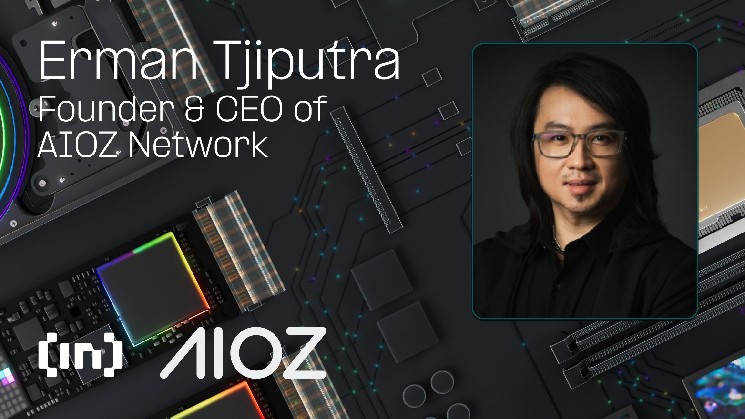
In an exclusive conversation with BeInCrypto, Erman Tjiputra, Founder and CEO of AIOZ Network, explains the idea, why it matters to regular users and how AIOZ Network aims to be the application-first DePIN stack for AI, streaming and storage.
The project bills itself as a community-powered internet infrastructure for the AI age, unifying distributed storage, AI computing and media streaming under one network.
“Call it like it is,” Tjiputra tells BeInCrypto.
“Neighbors help neighbors run the internet. If you have WiFi at home, a gaming PC with a GPU or a spare hard drive, you can contribute resources and unlock the potential for token rewards. There is no bottleneck and the services are closer to users at the edge, so it’s faster and fairer.”
What “human-powered internet” means
The simplest example of Tjiputra starts at home.
“You install our lightweight app. Your home Wi-Fi becomes a ramp. Your gaming PC can transcode video, perform AI inference tasks, or pin files. Your SSD/HDD stores content shards. When someone nearby watches a stream or calls an AI model, the network routes it peer-to-peer from the nearest contributors. You unlock potential token rewards. They get speed.”
AIOZ Network says it’s not about emulating a tokenized data center; it aims to make participation useful from day one, as users can instantly stream, store or run AI, application-first by design.
AIOZ Network positions itself as blockchain-agnostic (Cosmos/EVM), purpose-built DePIN for AI + media + storage, and already has a global contributor base that counts AIOZ Network on hundreds of thousands of devices.
AIOZ Network is a unified stack, AI compute (AIOZ AI), storage (AIOZ Storage, S3 compatible), streaming (AIOZ Stream), and IPFS pinning (AIOZ Pin), all powered by DePIN. Presented as composable primitives, these services enable Web3 apps to leverage the edge, peer-to-peer infrastructure from day one.
Why this strengthens today’s internet for everyday people
For makers, Tjiputra says:
“Retain ownership and receive transparent, on-chain payouts. Sell subscriptions, pay-per-view, tips, or manage ad-supported channels where revenue sharing happens on-chain.”
AIOZ Stream’s model explicitly supports SVOD, TVOD, AVOD, and tipping, with an optional watch-to-earn incentive that can credit ad auction viewers.
On the viewer side, he emphasizes a frictionless experience: “Watch with great quality and privacy, even without a wallet,” he adds, pointing to AIOZ Stream’s wallet-free onboarding for casual users, while still maintaining transparency behind the scenes.
And for builders, the field is zero gatekeepers: “Open SDKs and APIs for storage, streaming, and AI so developers can deliver quickly,” he says.
The simple flywheel
Devices contribute resources → contributors unlock the potential for token rewards → creators publish and get paid → viewers watch and can directly support → developers deploy AI tools and apps → all usage feeds the network.
In practice, anyone can have a home PC or NAS on board to provide storage, bandwidth or GPU cycles. The network measures uptime, proximity and quality and allocates work accordingly, so contributors unlock the potential for token rewards tied to verified delivery and computing power.
These tokens come from real uses: SVOD/TVOD, AVOD with on-chain splits, tips and developer releases for inference and datasets. As activity grows, more devices are added, latency decreases, and costs decrease, attracting more creators and apps and widening the circle.
“It is one network in which AI, streaming and storage reinforce each other. Every viewer session, every model call and every read and write file strengthens the DePIN layer underneath,” says Tjiputra.
No tokenized data center: what makes the AIOZ network different
In a field where many DePIN projects resemble “tokenized data centers,” AIOZ Network insists it is human-powered and application-centric.
“We built the apps that make participation useful from day one,” says Tjiputra. “Creators can go live, viewers can click play, and builders can deploy models, all with a peer-to-peer edge that users themselves provide.”
AIOZ’s Stream Vision Paper describes a decentralized content delivery stack that routes video/audio through contributors and pays everyone, creators, contributors, and even viewers (if enabled) through the same token rails, including ad auctions (AVOD), subscriptions (SVOD), and transactional (TVOD). UX principles emphasize speed and wallet-free onboarding for regular users.
“Place a Mini CDN in every home”
Tjiputra’s long-term vision is blunt:
“Put a mini CDN in every home. If millions of everyday devices quietly power the Internet, it will be faster, cheaper and more resilient for everyone,” he says. AIOZ Network aims to provide the people cloud that serves media, AI and storage from the edge, is user-owned and interoperable across chains that people already use.
Power the next ChatGPT from your living room
“Control the next ChatGPT from your home, as a contributor and as a consumer,” adds Tjiputra. “If you have a GPU, inference tasks can be run on your box. You are rewarded via DePIN; a neighbor calls the model with sub-second latency because it is served at the edge, and not on the other side of the world.”
AIOZ AI is described as a distributed compute and marketplace layer where models/datasets can be deployed, licensed and monetized on-chain, bridging AI workloads with DePIN incentives.
DePIN makes Web3 possible
AIOZ Network views participation as more than a perk for passive viewers; it is a path from watch-to-earn to a true build-to-earn economy. “Watch-to-earn is a tactic.
The bigger step is building to earn,” says Tjiputra.
“Host a DePIN app, moderate a channel, transcode a stream, pin content, perform model inference, contribute useful work, and unlock the potential for token rewards. That’s the broader participation economy we’re looking for.”
When asked about the endgame, Tjiputra returns to the basic principles:
“It’s an internet infrastructure for Web3, a mainstream people cloud for media, AI and storage. Peer-to-peer at the edge; open, verifiable and owned by the users who power it.”
AIOZ Network enables a merit-based contribution model across a multi-chain stack, with the goal of making AI computing, storage, and streaming community-powered and interoperable.
The post Erman Tjiputra, CEO of AIOZ Network, on the human-powered DePIN future of Web3 infrastructure appeared first on BeInCrypto.