
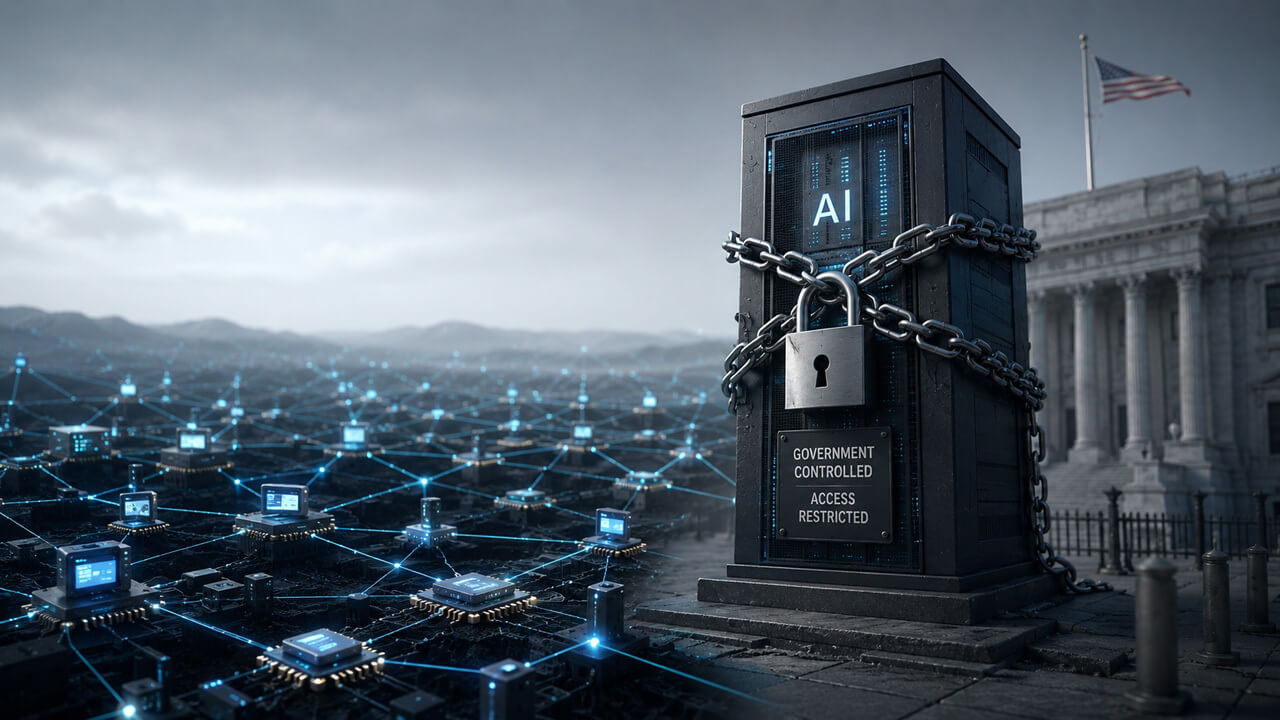
The US government has issued an emergency export control directive forcing artificial intelligence pioneer Anthropic to abruptly suspend global access to its border models, Fable 5 and Mythos 5.
The sweeping mandate, which cites national security authorities, applies to all foreign nationals both inside and outside the United States, including Anthropic’s own international staff.
The enforcement action marks the first time Washington has effectively recalled a widespread, cross-border commercial AI model.
Although Anthropic complied by disabling the models for its entire global user base, the unprecedented intervention has created an immediate ideological and capital shift in the technology landscape.
Within hours of the announcement, digital asset markets reacted aggressively, sending decentralized AI tokens into double digits and refocusing the cryptocurrency industry around an explicit infrastructure mission: building censorship-resistant, verifiable layers of intelligence, independent of centralized state control.

Anthropic defends Fable and Mythos
CryptoSlate previously reported that Anthropic’s Mythos model could expose exploitable flaws within the emerging industry, leading to billions in losses.
As a result, the AI model has become a valued tool for cybersecurity teams using this capability defensively, giving engineers a way to discover and fix flaws before attackers can exploit them.
Against that backdrop, the US government’s order stemmed from a perceived vulnerability that allows users to bypass the model’s core security rails.
However, the anthropic leadership has openly broken ranks with federal regulators over the proportionality of the response.
The company confirmed that it had reviewed a technical demonstration of the limited exploit and determined that the model could only analyze specific codebases and identify minor, previously known software bugs.
Anthropic noted that the demonstrated level of capability is already widely available on competing commercial platforms, including OpenAI’s GPT-5.5, and represents a standard tool used every day by cybersecurity professionals defending corporate infrastructure.
In a statement about the recall, Anthropic defended its technical framework, arguing that absolute immunity from exploitation is a mathematical and practical impossibility for any boundary model developer:
“We suspect that perfect resistance to jailbreaks is not currently possible for any model provider. Every security used in the industry is vulnerable to non-universal jailbreaks. We have strived to make jailbreaks narrow or very expensive to produce, and to combine this with thorough monitoring. We do not agree that the discovery of a limited potential jailbreak should be reason to recall a commercial model that has been deployed to hundreds of millions of people.”
Before Fable 5’s commercial launch, Anthropic spent thousands of hours developing the model, working with the US government, the UK Artificial Intelligence Safety Institute (AISI) and independent defense companies.
The company warned that if Washington applies a standard of zero-exploit tolerance in the private sector, it will essentially freeze all development and implementation of frontier models in the domestic technology industry.
The company further criticized the government’s opaque enforcement measures and reiterated that state intervention must remain transparent, fair, clear and strictly based on empirical, technical facts.
AI’s centralized bottlenecks give crypto a concrete mandate
For the digital asset industry, which has spent much of the first part of the decade navigating changing regulatory frameworks and speculative asset cycles, the unilateral shutdown of a major commercial AI model has acted as an unprecedented institutional catalyst.
Industry analysts and venture capitalists see the intervention as definitive proof that centralized computational intelligence remains vulnerable to sudden, random political bottlenecks.
Ansem, a widely followed crypto trader, said the move was the strongest marketing argument yet for open-source AI models that can be used without providing personal data to centralized platforms.
Chris Barret, an executive at Chainlink, said:
“When intelligence runs through centralized chokepoints, access can change overnight. The future will need decentralized AI models and the verifiable infrastructure to connect, secure and coordinate them.”
The sentiment was echoed across the venture capital landscape, where the enforcement action is being interpreted as a turning point for decentralized infrastructure networks (DePIN).
Jake Brukhman, founder of venture capital firm CoinFund, noted that the friction between Anthropic and the U.S. government is “laying the rails for decentralized AI in real time.”
Prominent figures from Silicon Valley also weighed in on the growing philosophical divide between state-aligned security regimes and open source networks.
Venture capitalist Marc Andreessen sharply criticized the growing compliance framework, characterizing heavy-handed AI regulations as an institutional burden that risks crippling early-stage startups, draining capital in endless audits, and turning frontier systems into limited corporate gatekeepers.
However, he also argued that the risk of out-of-control systems disrupting critical public infrastructure remains unacceptably high without strong federal oversight.
Pumping Decentralized AI Tokens
The market reaction showed how quickly traders linked the anthropic order to crypto’s decentralized AI thesis.
CryptoSlate Data showed new demand for tokens related to decentralized computing, open-source AI infrastructure, and model coordination. Bittensor’s TAO rose 13.4%, Venice Token rose 18% and Internet Computer rose 9.8%, making AI-linked assets one of the strongest parts of the market after the directive became public.
Tao.com, a non-custodial wallet and infrastructure provider in the Bittensor ecosystem, said the rally reflected broader concerns about who controls access to artificial intelligence.
The company stated:
“We’re not building decentralized AI because it sounds better. We’re building it because the off switch can’t be one-man. If AI is going to drive the economy, you can’t lock it behind one API, one vendor, one jurisdiction, or one policy vote.”
The move added momentum to a sector that had already shown relative strength this year.
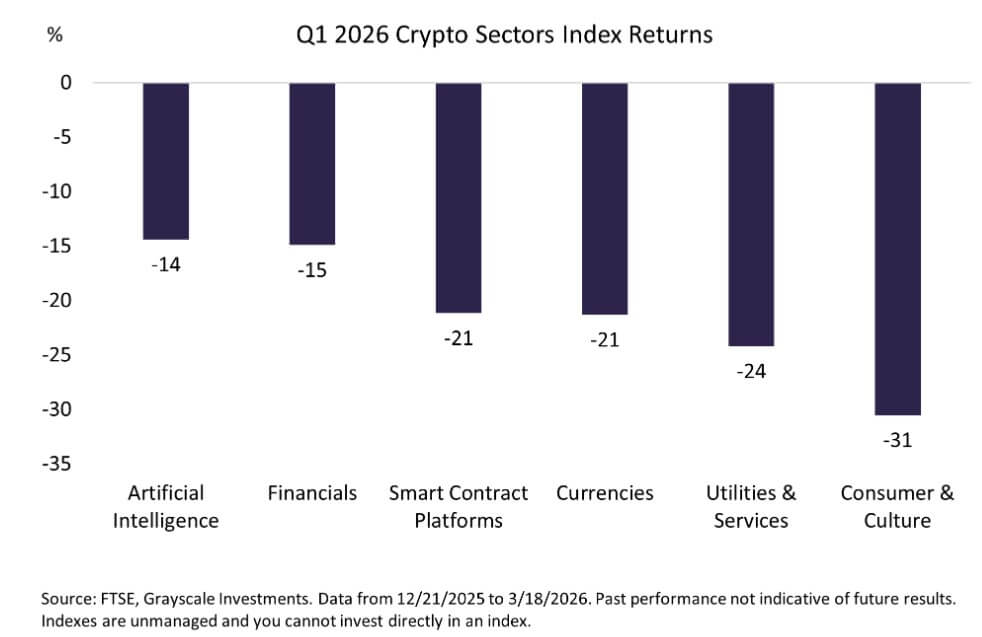
Earlier this year, Grayscale described AI-linked tokens as one of crypto’s most resilient themes during the first quarter. The category fell 14% during the March sell-off, while nearly 90% of digital assets posted double-digit losses.