

JPMorgan has warned that Congress could create new gaps in financial oversight if it moves too quickly to write new rules for the crypto industry.
The warning comes as Senate leaders attempt to advance the Digital Asset Market Clarity Act, a broad bill that would divide federal oversight of digital assets between the Securities and Exchange Commission (SEC) and the Commodity Futures Trading Commission (CFTC).
The measure has become one of the crypto industry’s top priorities after years of enforcement actions and regulatory disputes.
While JPMorgan did not mention the CLARITY Act or take a formal position on the bill, its warning was timely as the same issues it flagged, including market surveillance, stablecoin incentives, developer exemptions, and anti-money laundering tools, are poised to shape the Senate vote.
JPMorgan frames the battle around safeguard measures
JPMorgan’s intervention revolves around one central argument: as digital assets come to resemble traditional financial products, Congress should regulate them based on what they do, not the technology behind them.
In a Monday post, Umar Farooq, global co-head of payments at JPMorgan, and Peter Muriungi, CEO of Digital Assets and Blockchain Solutions, said digital assets delve deeper into payments, settlement, trading and products that increasingly overlap with well-known financial services.
They said tokenization and programmable money could reduce payment friction, shorten settlement cycles and make markets more efficient. But these profits, they argued, depend on rules that provide safeguards around the protection of investors, consumer balance sheets and illicit financing.
The bank said a tokenized product should not be exempt from existing obligations simply because it is issued or traded on a blockchain.
If a token behaves like a security, investors should expect disclosure, custody and market integrity standards to apply. If a decentralized platform performs brokerage or exchange-like functions, it should carry obligations that support fair and transparent markets.
They wrote:
“If the guardrails are weak or unclear, the risk doesn’t go away. It shifts and concentrates.”
That concern is greatest in payments, where stablecoins have become one of crypto’s most commercially important use cases.
JPMorgan said stablecoins and tokenized money can support faster settlement, especially across borders.
However, the bank warned that payment products could end up in shadow banking when issuers or platforms offer rewards, cashbackor return-like incentives for holding balances, without the capital, liquidity, supervision, and consumer protection rules applicable to traditional deposits.
That argument has become a central demand of banks as Congress writes crypto regulations. Traditional lenders say crypto companies should not compete with bank deposits while avoiding the fees and scrutiny associated with regulated banking.
JPMorgan Chief Executive Officer Jamie Dimon is one of the most visible critics of stablecoin returns. Although lawmakers rejected the banking industry’s push for a complete ban during previous negotiations, banks continue to push for stricter limits.
TD Cowen’s Jaret Seiberg reportedly said he doesn’t expect any major changes to the bill’s stablecoin yield provisions, a sign that crypto proponents believe they can pass the legislation despite opposition from banks.
Meanwhile, JPMorgan’s warning also extends beyond deposits. The bank said digital assets legislation should preserve anti-money laundering and law enforcement tools, arguing that exemptions for core parts of the crypto ecosystem could create blind spots around illicit financing, opaque ownership and market manipulation.
The company combined that caution with a reminder that it is already building in the sector. JPMorgan pointed to JP Morgan’s Kinexys, its blockchain company, and JPM Coin, a deposit token used for near-instant, 24/7 settlement between institutional clients.
That gives the bank’s warning a sharper edge. JPMorgan advocates for digital assets to expand within a framework that maintains the oversight that supports existing markets.
July’s push turns CLARITY into a test of crypto’s strength in Washington
The cautious approach advocated by JPMorgan clashes with a coordinated effort by congressional leaders, the White House and digital asset advocates to get the CLARITY Act through Congress before lawmakers leave for their August recess.
Senate Banking Committee Chairman Tim Scott is pushing for a vote in July, arguing that formal rules are needed to protect consumers while preserving digital asset development in the US. His urgency is echoed by Senate Majority Leader John Thune, who has urged the chamber to pass crypto market structure legislation before the August recess.
The executive branch has also reinforced the compressed timeline. Patrick Witt, who heads the president’s Digital Assets Council, cast the coming weeks as a key moment for U.S. crypto policy, calling the legislation part of a broader effort to strengthen U.S. leadership in global financial markets.
This push reflects how much the bill has come to represent for an industry exhausted by years of legal battles, enforcement actions, and recurring disputes over whether digital tokens should be treated as securities or commodities.
For many crypto companies, the CLARITY Act is the most realistic near-term path to a federal market structure framework.
Despite the momentum, advocates face a narrow legislative window to resolve difficult disagreements.
Although the Senate Banking Committee approved the bill in a 15-9 vote in May, that initial victory did not resolve the disputes the leadership now faces.
Negotiators must still determine whether the framework can survive floor amendments, attract enough Democratic support to overcome procedural hurdles and coordinate with the House of Representatives before the summer deadline.
As part of that broader initiative, the House Financial Services Committee has scheduled a field hearing on July 17 in New York to highlight the legislation’s potential to support financial innovation.
Still, market strategists say the calendar remains one of the biggest obstacles to the bill. Seiberg indicated that formal Senate deliberation could begin the week of July 13, setting up possible floor action the week of July 20. He cited July 24 as a key deadline as the House of Representatives is expected to leave Washington for its August recess.
Missing that window could complicate the bill’s trajectory, he said, because the fall session will likely be determined by midterm election campaigns. Lawmakers may be less willing to hold politically difficult votes on complex regulatory issues shortly before facing voters, making a post-recession revival uncertain.
That uncertainty is already changing expectations. Galaxy Digital recently lowered its estimate of the chances that the CLARITY Act will become law in 2026 to 50%, citing a a shrinking Senate calendar and unresolved policy disputes.
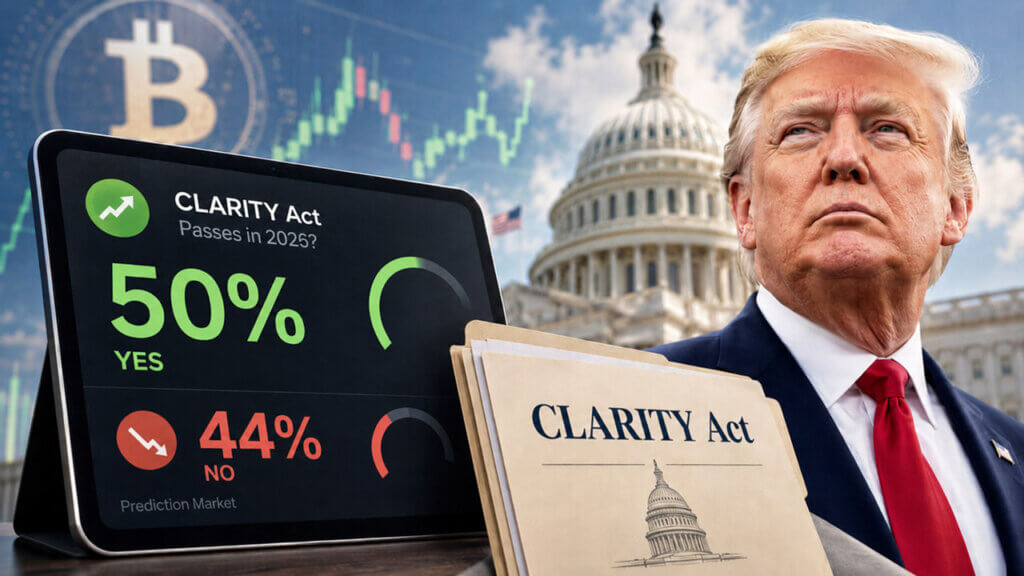
Those deadlines would be difficult, even for a settled account. They are more difficult now as the CLARITY Act fades into the background and the most politically sensitive dispute remains unresolved.
Ethical struggle threatens the path of 60 votes
The biggest hurdle to securing the required 60 votes in the Senate is a growing clash over the ethics of government.
Democrats are seeking restrictions on cryptocurrency business activities by government officials and their families, including the president.
The requirement has become one of the bill’s main obstacles, as Republicans may have to reject these amendments to preserve the legislation, even if it puts some members of their own conference at political risk.
Seiberg said Republican leaders are unlikely to take that risk unless they have confidence that President Donald Trump will sign the final bill.
That trust has weakened, he said, after Trump recently refused to sign a housing bill negotiated by his own administration and said he would not sign legislation until Congress passed the Safeguard American Voter Eligibility Act.
Seiberg said it is not clear that Republicans have the votes to reject an ethics amendment, pointing out that moderate and retiring Republican senators, including Thom Tillis, Mitch McConnell, Bill Cassidy, John Cornyn, Susan Collins and Lisa Murkowski, should be watched as lawmakers.
Given this, Jake Chervinsky of the Hyperliquid Policy Center said the bill’s fate remains unusually uncertain for major legislation in Washington. He said negotiators are still working but there is no final agreement, and the ethical issue remains the main roadblock.
According to him:
“The challenge is that there is unlikely to be a clear ‘yes’ without bringing the bill to a vote, but it is difficult to justify using limited speaking time for a bill that may not pass.”
Still, he characterized July as a “now or never” scenario, despite the unusual degree of unpredictability surrounding the legislation.