



As major cryptocurrencies remain mired in a prolonged slump, decentralized exchange Hyperliquid’s native token has soared to an all-time high.
Data from CryptoSlate showed that HYPE crossed $60 for the first time, reaching $62. This represents a gain of 120% year-to-date and pushes the market cap above $15 billion.
This comes as data from DeFiLlama shows that the total value captured on the platform exceeds $5 billion for the first time since October 2025. At the same time, open interest hit a six-month high of nearly $10 billion.
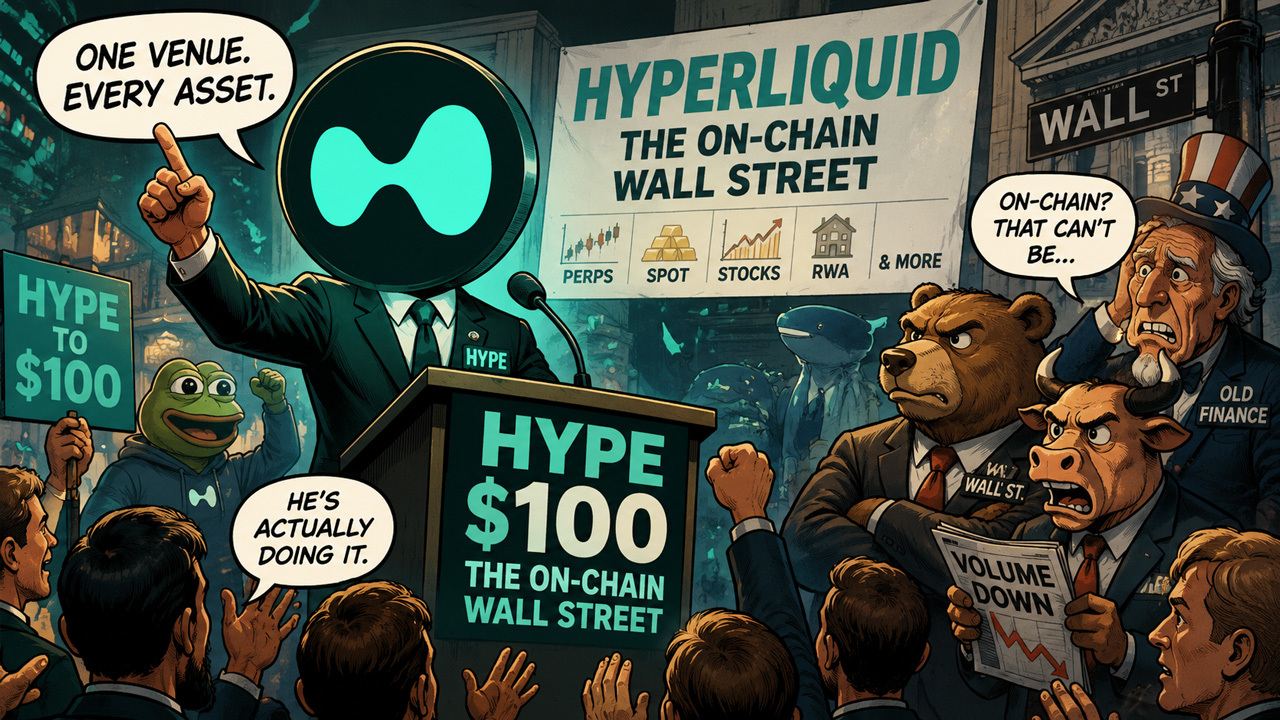
Market observers noted that this breakout was driven by a fundamental structural shift, with Hyperliquid rapidly evolving from a niche decentralized finance application to the primary on-chain Wall Street platform in the cryptocurrency sector.
By aggressively collapsing traditional financial silos that typically divide brokerage, exchange and custody services across entities, the network is creating a unified platform that encompasses a new class of institutional capital.
How HYPE defied the broader appeal of the crypto market
HYPE’s milestone comes amid a generally pessimistic period for digital assets, with Bitcoin and other major cryptocurrencies struggling.
This is because the broader cryptocurrency sector has faced continued downward pressure since September 2025.
To contextualize Hyperliquid’s divergence with the broader market, the total cryptocurrency market capitalization is down 36.5 percent.% during this period. Major assets mirrored this decline, with Bitcoin falling 33.4%, Ethereum drops 53.3% and Solana loses 65% of its value.
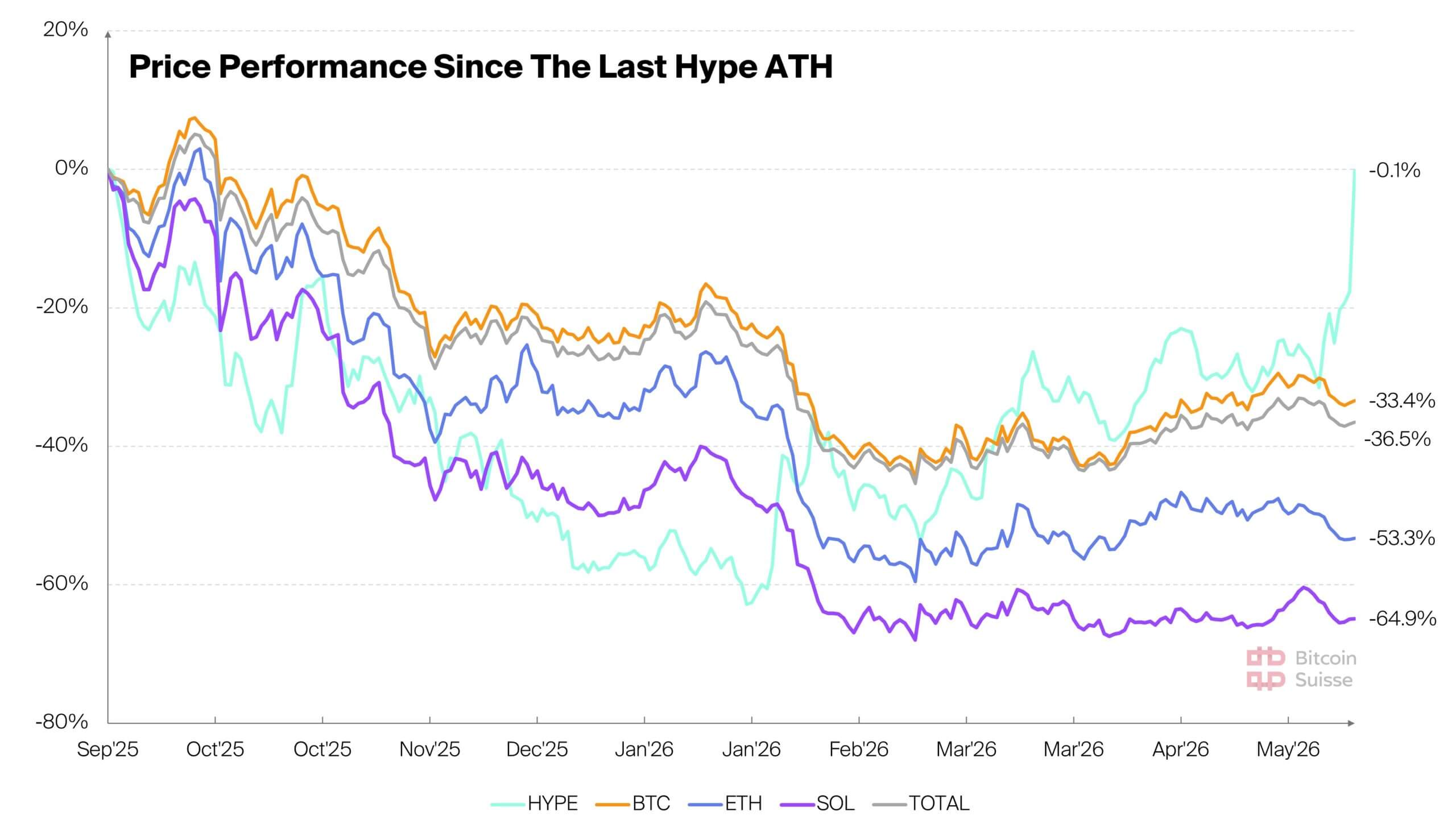
For months, the market traded in sync, with alternative cryptocurrencies suffering heavier losses than Bitcoin.
According to cryptocurrency analyst Aletheia, Hyperliquid was among the worst performers until January 2026. However, a sudden trend shift, catalyzed by strong stock market cash flows and institutional partnerships, decoupled HYPE from its peers.
Moreover, HYPE’s rally has been further accelerated by market mechanisms.
Blockchain analytics firm Santiment reported a severe spike in negative funding rates on the exchanges, indicating that a disproportionate number of traders are opening short positions in anticipation of a price drop. Instead, HYPE continued to rise, leading to a classic short squeeze.
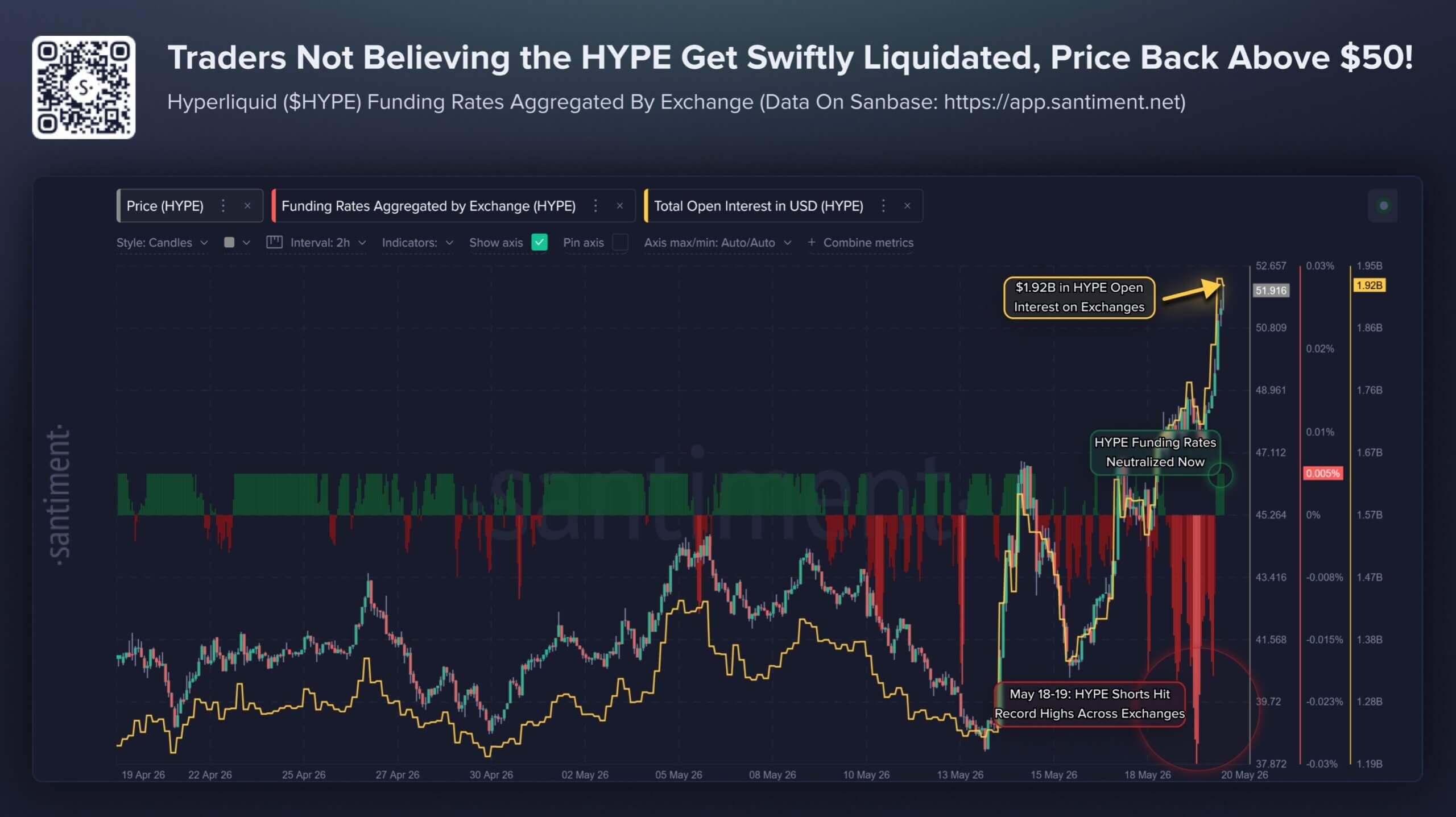
According to the company, bearish traders were automatically forced to buy back their positions, increasing upward pressure on the token.
Despite these liquidations, HYPE’s open interest, which measures the total value of active futures contracts, has remained high at $1.92 billion. Instead of collapsing after the liquidation, open interest continued to rise as new buyers entered the market to replace liquidated short positions.
Institutional validation and the ETF catalyst
The key catalyst supporting this continued open interest is the introduction of traditional financial packaging.
Earlier this month, asset managers including Bitwise and 21Shares launched exchange-traded funds linked to HYPE. These products allow traditional stock investors to gain exposure to the token without navigating decentralized exchanges or managing private keys.
Institutional adoption has been rapid. Data from SoSoValue shows that these newly launched products are already managing $81.13 million in assets.
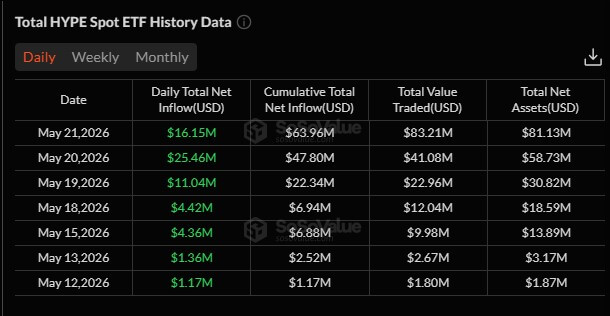
Bloomberg listed fund analyst Eric Balchunas noted that trading volume of its suite of HYPE-related products recently approached $100 million, up 42% since its launch in mid-May.
Due to this strong demand, Velo data indicates that more than 40% of the token’s recent price gains have occurred during US trading sessions.
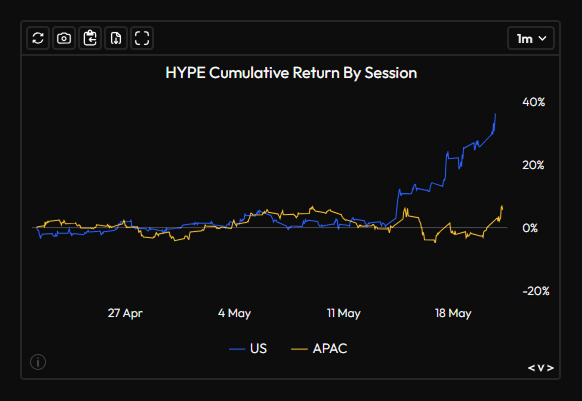
However, this strong performance occurs despite the fact that US residents cannot trade directly on Hyperliquid.
Market experts have linked Hyperliquid’s appeal to institutional investors to its quantifiable fundamentals. Bitwise CIO Matt Hougan said:
“Hyperliquid should be valued as a global super-app. Its addressable universe is not the $3 trillion crypto market, but the $600 trillion market for global assets.”
According to Hougan, Hyperliquid’s platform covers every asset class and its tokens capture real value. He added that the trading platform is “an early, credible look at what crypto will become if it is allowed to mature.”
Hyperliquid’s growing trading footprint
Hougan’s thesis on Hyperliquid is that the platform is becoming a one-stop financial app, as evidenced by its growing asset offering and underlying protocol upgrades.
The platform takes trading volume away from traditional markets by offering perpetual contracts on traditional commodities, pre-IPO stocks and performance-based events in a single environment.
Due to ongoing geopolitical tensions, including the US-Israeli conflict with Iran, traditional commodity markets are faced with weekend closures, just when international news often breaks through.
Traders have increasingly turned to Hyperliquid to hedge their positions, making gold, silver and oil perpetuals a significant segment of the exchange’s volume, alongside native digital assets.
Notably, open interest in this type of trading has doubled in the past two months to a new all-time high of $2.6 billion.
Additionally, the platform’s pre-IPO trading feature offers a distinctive utility that protects cryptocurrency traders from digital asset declines.
By offering exposure to private companies like SpaceX, Hyperliquid provides diversification previously reserved for accredited traditional financial investors.
Meanwhile, the recent expansion into prediction markets via the HIP-4 upgrade is also helping to boost the platform.
Research firm Delphi Digital emphasizes that HIP-4 completes the platform’s mission to bring together brokerage, exchange and custody in one location by introducing outcome contracts.
These binary options allow traders to express market views that standard perpetual futures cannot portray.
Historically, a trader who took a long position in Bitcoin ahead of a Consumer Price Index report could correctly predict the inflation data, but still lose money if the market reacted unpredictably to the news.
The HIP-4 upgrade allows traders to place capital directly on the outcome of the event itself, completely bypassing the secondary price reaction.
HYPE’s Road to $100
Considering all of the above, HYPE’s latest all-time high has made the $100 target of a marginal bet a central question for traders following Hyperliquid’s rally.
Polymarkt facts shows traders assigning a 70% chance of HYPE reaching new highs around $66, a 62% chance of it breaking $70, and a 30% chance of it reaching $100 before the end of the year. The odds of a move to $100 have doubled in the past week, reflecting how quickly sentiment has changed.
For this trade to survive, different drivers must work together. Demand for ETFs should continue to attract buyers beyond Hyperliquid’s own user base. The positioning of futures must prevent it from becoming too busy. Platform volume must remain high enough to generate fees. The total value is locked in, stablecoin balances and open interest should remain strong enough to support the view of more capital settling within the venue.
Still, market analysts believe that HYPE’s current momentum could support the uptrend.
Shaunda Devens, a research analyst at Blockworks Research, said the speed of the move reflects an imbalance between aggressive buyers and a seller base that had already spent months distributing tokens in the previous range.
In that climate, higher prices can be self-reinforcing. Existing holders feel less pressure to sell as the market confirms their position. Buyers on the sidelines feel more pressure to get in as the price moves away from them. That dynamic could push prices higher even as valuation multiples increase.
The risk, however, is that the same reflexive intent can quickly disappear. If demand for ETFs declines, if open interest becomes too crowded, or if long-term holders start taking profits, the market could lose some of the pressure that led to the breakout.