
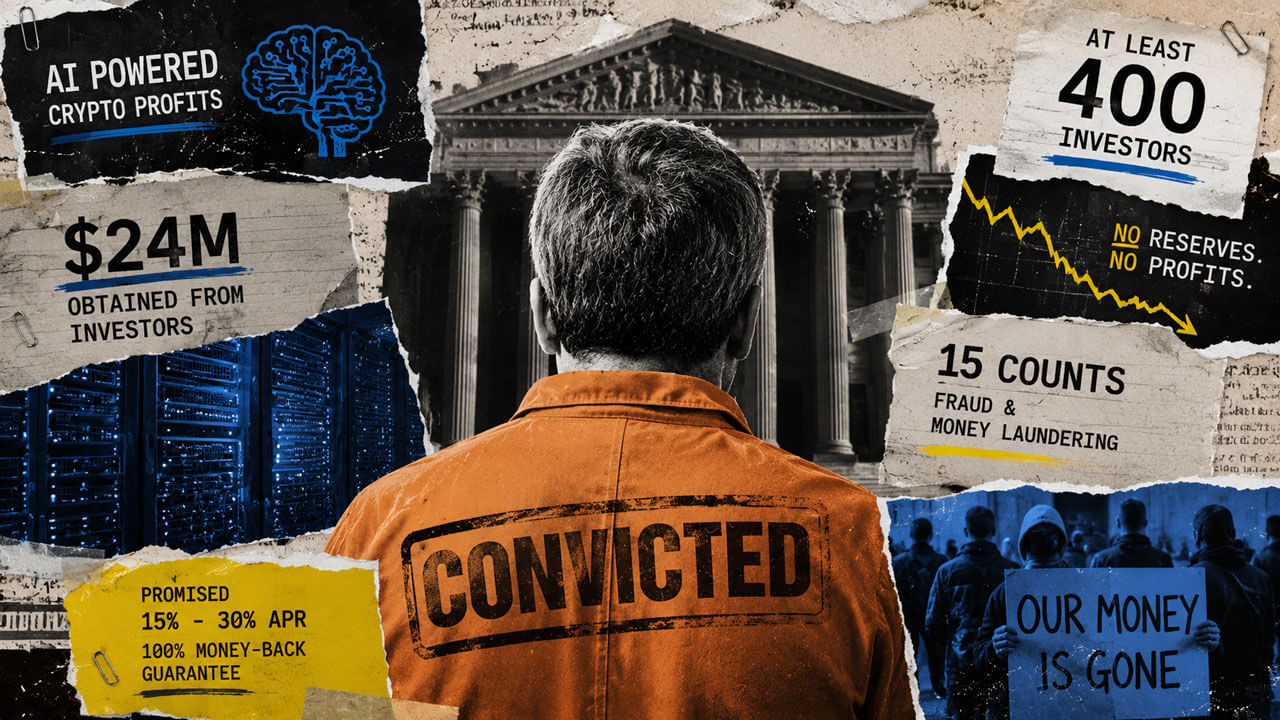
A federal jury recently convicted Brent C. Kovar, the owner of Profit Connect, on 15 counts of fraud and money laundering. Prosecutors alleged that Kovar deceived at least 400 investors, obtaining $24 million through false claims about an AI-powered crypto business.
The Justice Department revealed that the verdict came after a nine-day trial, during which jurors found Kovar guilty of 11 counts of wire fraud, two counts of mail fraud, and two counts of money laundering. The misconduct reportedly took place between late 2017 and July 2021, when Kovar promoted Profit Connect as a lucrative technology enterprise capable of delivering promised returns.
Kovar allegedly informed investors that Profit Connect utilized AI software on a supercomputer to mine cryptocurrency and validate crypto transactions. He asserted that the company was profitable, guaranteeing fixed returns of 15% to 30% APR and offering a 100% money-back guarantee. Additionally, Kovar claimed that Profit Connect held hundreds of millions of dollars in crypto reserves.
However, prosecutors contended that Profit Connect was actually unprofitable, had no reserves, and lacked a legitimate source for the promised returns or guarantee. They asserted that Kovar used investor funds to sustain Profit Connect, purchase gifts for employees, buy a house for himself, and repay investors. These repayments were allegedly portrayed as proceeds from mining and transaction verification.
The Securities and Exchange Commission (SEC) had previously filed a civil action in 2021, alleging that Joy and Brent Kovar had raised over $12 million from at least 277 retail investors through Profit Connect Wealth Services. The SEC claimed that they touted annual returns of 20% to 30% linked to an AI supercomputer. While CryptoSlate reported on these allegations, the criminal verdict in August 2026 specifically established Brent Kovar’s culpability.
The Justice Department’s $24 million estimation exceeds the SEC’s earlier figure, and the minimum investor count rose from at least 277 in the SEC case to at least 400 in the criminal case. These figures are not directly comparable due to different cases and time frames. They indicate that the scheme’s publicized scope expanded by the time of Kovar’s criminal conviction.
Following the verdict, the case proceeds to sentencing on Nov. 30. Prosecutors disclosed that the convictions carry a combined statutory maximum of 280 years in prison. A federal judge will determine Kovar’s sentence by considering the US Sentencing Guidelines and other statutory factors.