
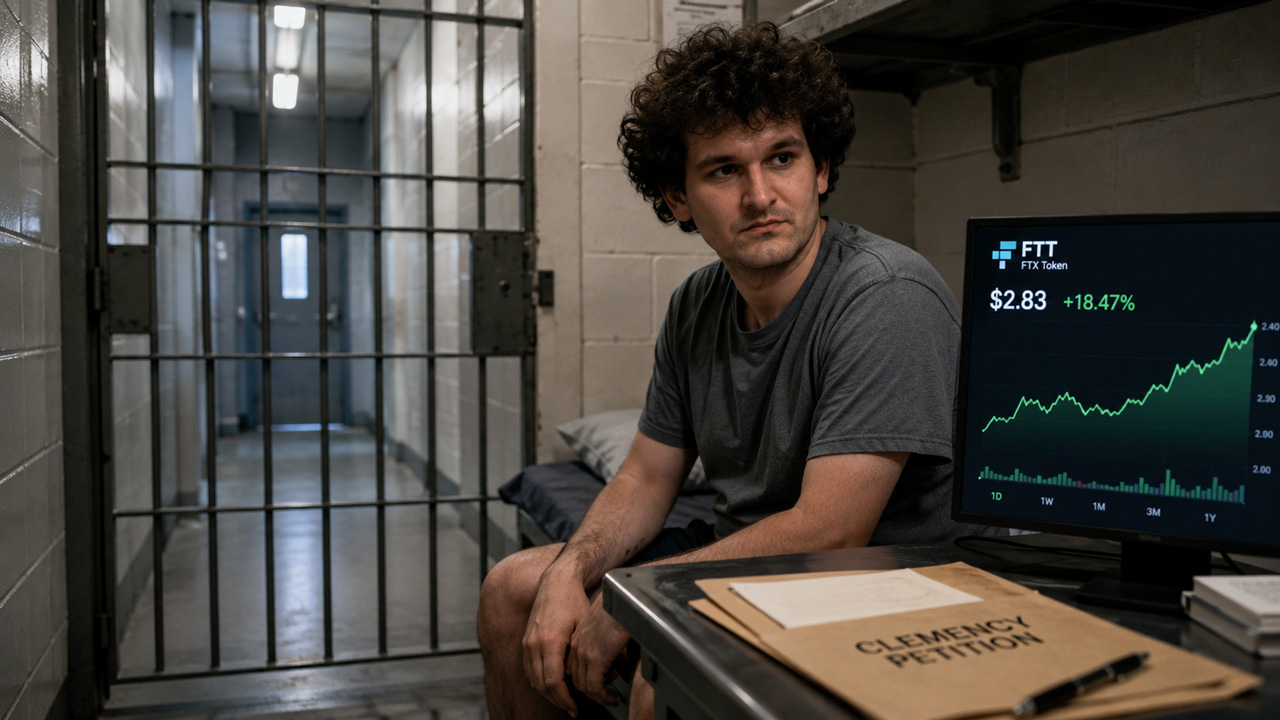
Sam Bankman-Fried (SBF), the disgraced founder of the bankrupt FTX exchange, has spent a quarter of a century in federal prison for orchestrating one of the largest financial frauds in American history.
Still, crypto speculators are betting that a newly filed application for a presidential pardon could somehow turn his fortunes around.
This week, the disgraced FTX founder officially requested an executive pardon through the Justice Department’s Pardon Attorney portal.

The move marks a formal escalation of a months-long shadow campaign by his family and legal surrogates to secure his freedom, contrary to conventional legal wisdom and the standard five-year post-conviction waiting period for clemency applications.
However, the chances of any approval are slim as President Donald Trump has repeatedly rejected the idea of granting SBF any leniency.
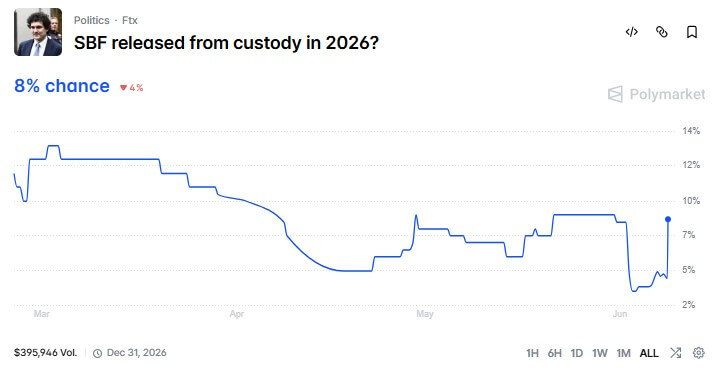
In particular, traders on the blockchain-based prediction market Polymarket are currently active prices with only an 8% probability that Bankman-Fried will receive a presidential pardon by the end of the year.
The speculative rally of a ghost token
While political analysts and blockchain-based prediction markets give the pardon virtually no chance of success, the mere filing was enough to unleash a speculative frenzy on the digital asset exchanges.
Data from CryptoSlate shows that the direct beneficiary of Bankman-Fried’s legal maneuvering has been the FTT, the original exchange token that once supported the FTX ecosystem.
FTT is essentially a ghost asset. The token has no inherent utility, no development team, and no underlying business after FTX’s catastrophic bankruptcy in November 2022.
Despite this, digital asset markets often trade on sentiment, disturbing stories and algorithmic responses to breaking news.
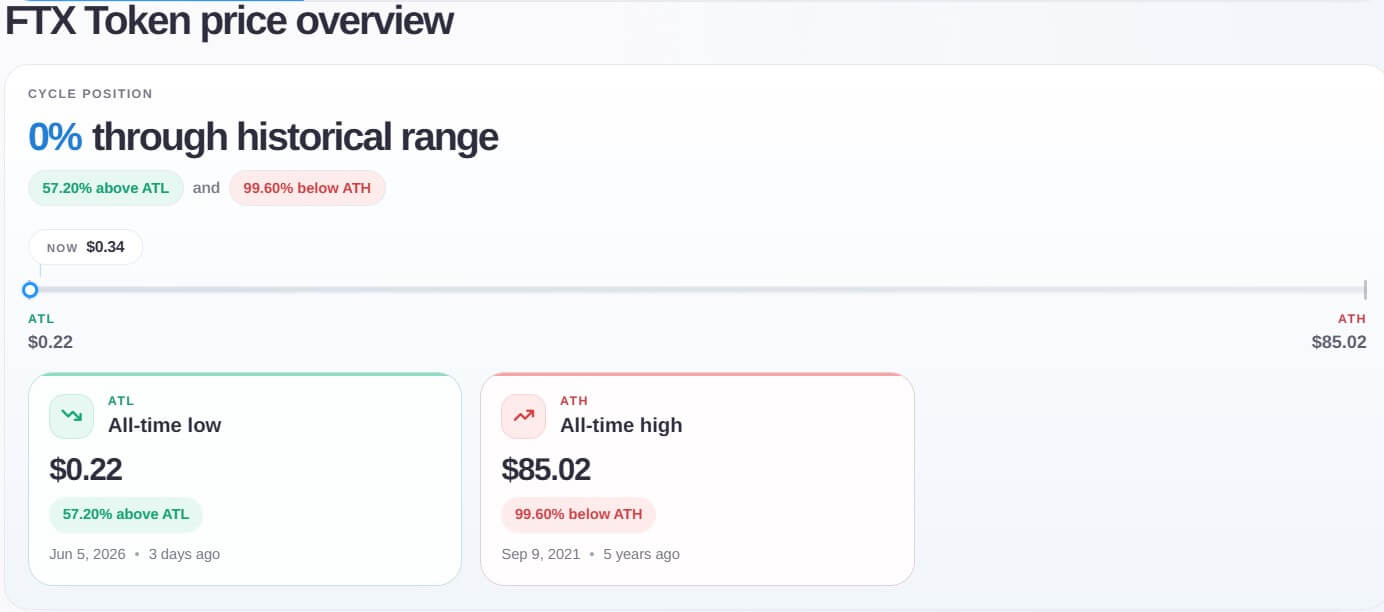
Following reports of the pardon application, the FTT rose more than 50% in 24 hours, peaking at $0.35. The rise represents a stark reversal from the all-time low of $0.2141 recorded just days earlier.
Furthermore, CoinMarketCap data shows that trading volume for the bankrupt token skyrocketed by more than 600%, topping $16 million.
Market data shows that about 30% of this speculative activity took place on Binance, the rival exchange that originally caused the bank run on FTX by liquidating its own FTT holdings in late 2022.
The latest rally shows that some market participants view FTT as a political option on Bankman-Fried’s fate. If traders believe that a pardon would revive public interest in FTX-linked assets, even for a short period of time, the token becomes a direct way to express that view.
Meanwhile, that trade remains disconnected from any apparent legal or bankruptcy recovery mechanism. A pardon would not automatically restore FTX, revive FTT’s old platform, or change the basic structure of creditor claims. Above all, it would affect Bankman-Fried’s personal freedom and political story.
Bankman-Fried turns to a political argument
Bankman-Fried was convicted in March 2024 after a jury found him guilty of two counts of bank fraud, two counts of conspiracy to commit bank fraud and conspiracy charges related to securities fraud, commodities fraud and money laundering.
Federal prosecutors said he embezzled billions of dollars in customer funds deposited with FTX, defrauded stock market investors and misled lenders to Alameda.
As a result, U.S. District Judge Lewis Kaplan imposed a 25-year prison sentence, three years of supervised release and forfeiture of more than $11 billion.
However, Bankman-Fried continues to challenge the basic public understanding of FTX’s collapse. In interviews and online statements, he has argued that the exchange faced a liquidity crisis rather than true insolvency, and that subsequent recoveries from the estate show that customers could have been cured much sooner.
His argument focuses on the value of FTX’s remaining assets and venture investments. He has argued that FTX owned assets that exceeded its liabilities when it went bankrupt and that control of the company should not have been handed over to outside restructuring advisers.
However, this version of the event conflicts with what prosecutors presented at trial.
The government alleged that customer deposits from FTX were secretly sent to Alameda and used for trading losses, investments, real estate purchases, political donations and debt repayments. Notably, former executives, including Caroline Ellison, Gary Wang and Nishad Singh, who cooperated with US prosecutors, testified against Bankman-Fried,
Ryne Miller, former general counsel of FTX, also dismissed Bankman-Fried’s post-conviction solvency claims.
Miller wrote on
Trump’s crypto-grace creates an opening, but not an easy one
Despite the aggressive lobbying efforts, the political reality facing Bankman-Fried is bleak.
President Trump explicitly ruled out leniency toward the FTX founder during a January 2026 interview with The New York Times, a position the White House has maintained since.
While Trump is willing to use his executive power to pardon other prominent crypto figures, including a high-profile pardon in October 2025 of Binance founder Changpeng Zhao, and previous commutations for Silk Road creator Ross Ulbricht and BitMEX executives like Arthur Hayes, the political calculus surrounding Bankman-Fried is fundamentally different.
Those previous pardons were largely based on correcting regulatory overreach, anti-money laundering technicalities or broader criminal justice reform.
The Bankman-Fried case, by contrast, is universally seen as a simple multi-billion dollar embezzlement scheme that has financially devastated millions of ordinary retail investors.
Even among pro-crypto Republicans on Capitol Hill, the pardon push was met with hostility, with Senator Bernie Moreno saying:
“The man should not be pardoned. The man should go to prison for a very, very long time.”
This view is also shared by several crypto enthusiasts, with one industry analyst proverb“Forgiving SBF does not mean one fraudster goes free, it only gives the green light to the next thousand. The message becomes: steal billions, carry out a MAGA rebrand from prison and walk free.”