

According to CryptoQuant analyst Darkfost, demand for Bitcoin has weakened significantly. According to CryptoQuant analyst Darkfost, apparent on-chain demand has fallen to the most bearish value of the year.
Darkfost, placed at X under the handle @Darkfost_Coc, shared a CryptoQuant chart showing that Bitcoin apparent demand on a 30-day sum basis has fallen deep into negative territory. The analyst said the value is now approaching minus 147,000 BTC, marking the weakest level since early 2026.
“Bitcoin apparent demand just reached its most negative level since the start of the year,” Darkfost wrote. “With the estimate now approaching -147,000 BTC, we would have to go back to December 2025 to find market sentiment this bearish.”
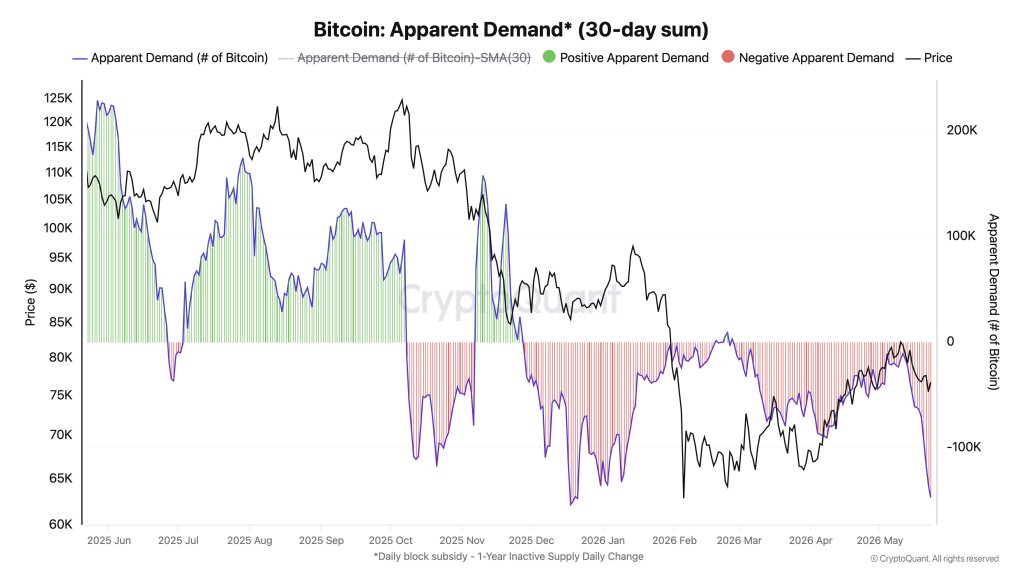
The apparent demand becomes seriously negative
The chart tracks Bitcoin’s apparent demand alongside its price, showing a transition from strong positive numbers for parts of mid-2025 to prolonged negative demand in late 2025 and again in 2026. The latest decline is notable because it comes after Bitcoin’s price recovered from its early 2026 lows, indicating that the recovery has not been accompanied by a marked improvement in structural demand in the spot market.
Related reading
Darkfost described apparent demand as “the difference between new BTC issuance and the amount of supply that has remained idle for over a year.” In practical terms, the metric aims to assess whether longer-term holder accumulation is strong enough to absorb newly issued Bitcoin.
“In other words, this measure helps estimate whether structural accumulation is strong enough to absorb the new supply created by the network,” the analyst wrote.
This interpretation defines the current reading as more than a measure of short-term sentiment. If the apparent demand is very negative, it indicates that the market is not showing enough underlying absorption to offset the issuance and support a more stable bullish phase.
Futures Momentum is facing a demand problem
Darkfost’s core argument is that Bitcoin’s rally structure could be vulnerable if derivatives activity does too much of the work. Futures markets can push prices higher, accelerate liquidations and amplify directional moves, but they do not necessarily represent sustainable accumulation.
“This development suggests that demand continues to gradually shrink,” Darkfost said. “Without a meaningful recovery in spot demand, it becomes difficult to imagine Bitcoin sustaining a sustained rally purely on the momentum driven by the futures markets.”
Related reading
This point is especially relevant in a market where price can move quickly due to leverage, positioning and liquidity shifts. A forward-looking move can still yield sharp upside potential, but Darkfost argued that sustained bullish phases generally require a firmer foundation.
“Futures can support short-term momentum and amplify price movements,” the analyst wrote, “but sustained bullish phases generally require true spot demand, as derivatives alone do not allow the market to build a stable and solid foundation.”
Bearish signal, long-term setup?
The analyst has not described the latest state of affairs as purely negative. While the near-term implications are bearish, Darkfost noted that the strongly pessimistic demand environment has historically been worth keeping an eye on for long-term investors.
“That said, even if this situation appears relatively bearish in the short term, these types of conditions have also historically created interesting opportunities for long-term investors who are able to remain patient,” the analyst wrote.
At the time of writing, BTC was trading at $77,300.
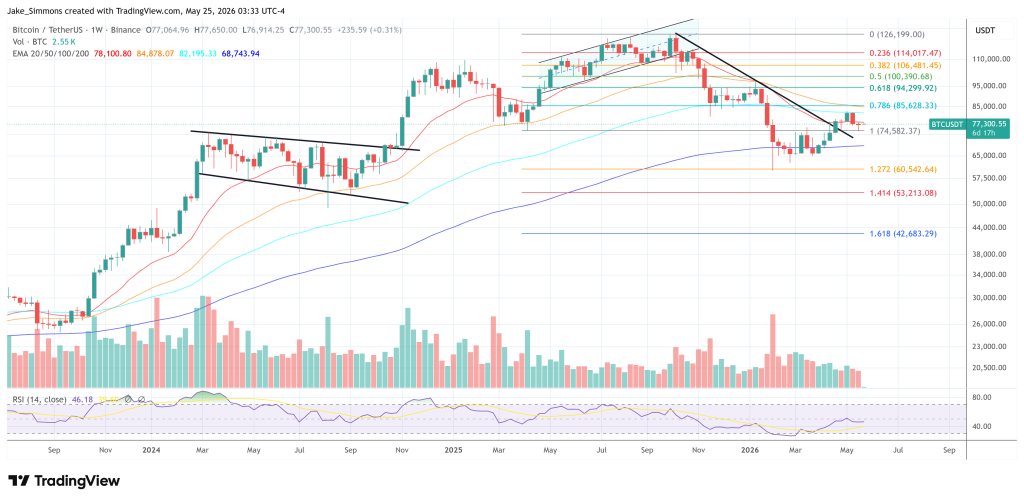
Featured image created with DALL.E, chart from TradingView.com