
As AI agents become increasingly capable of performing tasks on behalf of users, one issue continues to pose an obstacle: payments.
Most APIs still rely on subscriptions, API keys, billing accounts, and traditional payment rails that were never designed for autonomous software.
The Algorand Foundation wants to change that.
The organization has launched the Global x402 Challenge, a five-month competition aimed at developers building pay-per-request services powered by x402, an emerging protocol designed to enable AI agents to pay for online services directly through internet requests.
The competition has a prize pool of $100,000 and $500,000 $ALGO and will culminate at Devcon 8 India, where finalists will present their projects to judges and the wider developer community.
The urge for agentic commerce
The challenge follows growing momentum around x402, an open protocol originally developed by Coinbase that embeds payment functionality directly into HTTP requests.
Instead of requiring API keys, subscriptions, or separate billing systems, x402 gives software agents the ability to pay for services on a per-call basis.
Proponents believe this could become a key building block for what many are calling “agentic commerce” – a future in which AI systems autonomously purchase data, conduct transactions, access services and interact with digital infrastructure without human intervention.
For blockchain networks, the opportunities are significant.
If AI agents are going to execute millions of microtransactions every day, they will need settlement networks that can process payments instantly and at extremely low costs.
Algorand thinks it is well positioned for that role.
From Berlin hackathon to global competition
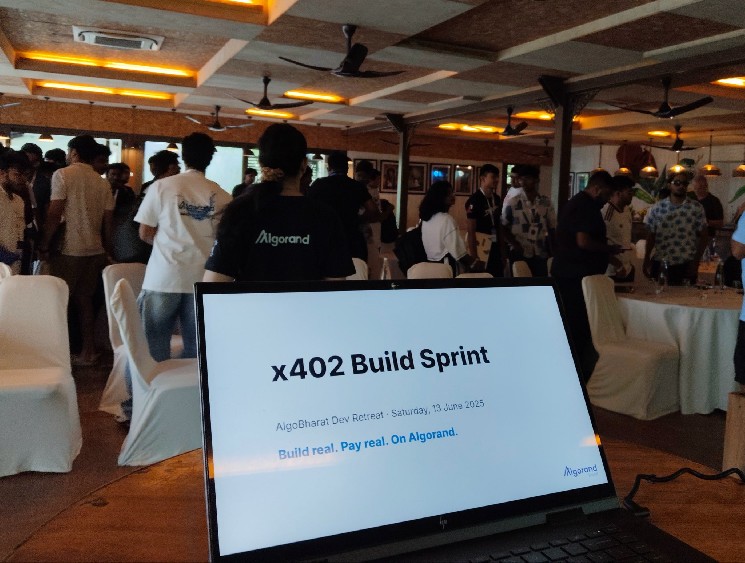
The launch comes shortly after the Algorand Builders Berlin hackathon, held from June 6 to 7, which brought together more than 100 developers for a 36-hour build sprint focused on x402-powered applications.
Projects ranged from AI-driven trust infrastructure for regulated financial services to peer-to-peer energy markets where electric vehicle agents could automatically purchase solar energy and settle payments in real time.
The event provided a preview of how developers envision the development of machine-to-machine commerce in the coming years.
The Foundation now hopes to expand that experiment worldwide.
To participate in the x402 Challenge, developers must deploy a paid x402 endpoint on Algorand Mainnet. Usage will be publicly tracked through a leaderboard powered by GoPlausible, allowing projects to compete based on real-world adoption rather than just theoretical concepts.
The top 50 projects will advance to the finalist round, with 10 teams presenting their applications at Devcon 8 India. The top five finalists will share the $100,000 prize pool, while another 500,000 $ALGO are distributed among the best performing endpoints.
Why developers are paying attention
The competition is coming as several major tech companies dig deeper into AI agents and autonomous systems.
OpenAI, Anthropic, Google and others have increasingly focused on agents that can take actions rather than simply generate text.
Yet payments remain one of the least developed parts of the stack.
Most autonomous systems still struggle to purchase services, access premium content, or pay for data without relying on traditional payment infrastructure designed for humans.
Protocols like x402 aim to solve that problem by making payments a standard part of Internet communications.
Instead of logging into an account or entering a credit card, an AI agent can simply pay for a service as part of the request itself.
If successful, this model could create entirely new business models for APIs, data providers and digital services.
A bet on the future internet
For Algorand, the competition represents more than a hackathon.
It’s a safe bet that autonomous software will become a meaningful participant in the digital economy.
As AI agents increasingly interact with online services, the infrastructure that enables these transactions may become as important as the agents themselves.
The x402 Challenge is intended to test that proposition in the real world.
Over the next five months, developers will compete to build services that can be accessed, paid for, and used by software agents operating independently.
Whether that future will come next year or in five years remains uncertain.
But Algorand is betting that the next wave of Internet commerce may not be driven by people clicking checkout buttons.
It can be powered by POS terminals.