



Bitcoin rose above $82,000 as oil prices plummeted amid a powerful tailwind due to a sudden and dramatic de-escalation in geopolitical tensions between the US and Iran.
Data from CryptoSlate showed that BTC has continued a week-long recovery, sending its value up more than 7% this week, after President Donald Trump halted a US military operation in the Strait of Hormuz.
According to CoinGlass, BTC’s upward price movement over the past 24 hours has led to the liquidation of more than $200 million from short traders. facts.
This came as reports of a possible US-Iran framework eased fears that the conflict would continue to disrupt one of the world’s most important energy corridors.
Following the news, crude oil prices went into freefall, with Brent crude falling 10% to $97 per barrel, effectively wiping out a significant portion of the geopolitical risk premium that had built up since late February. West Texas Intermediate (WTI) reflected the collapse, falling 9.82% to $88 per barrel.
A sudden thaw in the Strait of Hormuz
The catalyst for the changing global tides began with Trump’s decision to pause “Project Freedom,” the US operation aimed at reopening the Strait of Hormuz to stranded commercial ships.
Trump said the pause would be short while Washington tested whether a final deal could be reached with Iran.
The move marked a change in tone after weeks of military pressure around one of the world’s most important energy corridors, where shipping restrictions had fueled volatility in crude, refined products and Asian energy markets.
Meanwhile, this pause was followed by reports that the US and Iran were moving toward a memorandum of understanding aimed at ending the conflict and creating space for broader negotiations.
The proposed framework, led on the U.S. side by envoys Steve Witkoff and Jared Kushner, would seek to normalize commercial transit through the Strait of Hormuz while opening a path to a broader settlement.
Following this news, Trump wrote about truth social:
“Assuming Iran agrees to give what was agreed, which may be a big assumption, the already legendary Epic Fury will have come to an end and the highly effective blockade will ensure that the Strait of Hormuz is OPEN to all, including Iran.”
Notably, Tehran also softened its public stance.
Iran’s Revolutionary Guards said transit through the Strait of Hormuz was safe, citing the end of US threats and new procedures for ships passing through the area. The Guards did not detail the measures but thanked ship owners and captains for adhering to Iranian rules.
For the markets, the immediate impact of these developments was visible in the oil sector. Crude oil prices fell sharply as traders cut the war premium linked to the Hormuz disruption.
That gave Bitcoin and other risky assets a clearer macroeconomic backdrop, as lower oil prices eased fears that an energy shock would fuel inflation, delay Federal Reserve rate cuts and tighten financial conditions.
Bitcoin receives a bailout as institutional demand increases
Bitcoin’s climb above $82,000 brought it back near a supply zone that traders have been watching since the market collapsed earlier this year, with the $80,000 to $85,000 range emerging as a key test of the recovery.
That zone combines prior support, short-term profit taking and new leveraged positioning. A clean move through could strengthen the market’s longer-term structure, while another rejection would indicate the rally still hinges on fragile macroeconomic relief rather than sustainable spot market demand.
Taking this into account, market experts believe that the current wave of institutional demand could push the top cryptocurrency out of reach.
US-listed Bitcoin exchange funds in particular have seen renewed demand since early May, fueling the recovery through regulated investment channels rather than just foreign leverage.
Data from SoSo Value shows that the funds have attracted over $1.6 billion in net inflows since May 1, bringing cumulative inflows to almost $60 billion and assets under management at approximately $109 billion.
Meanwhile, ETF inflows are only part of the absorption story. Jamie Coutts, chief crypto analyst at Real Vision, said the primary marginal bid for Bitcoin is increasingly coming from corporate bonds rather than ETFs.
Coutts said ETFs absorb about 1,160 Bitcoin per day, while treasury companies, led by Strategy, handle about 1,834 Bitcoin per day. Strategy bought more than 50,000 Bitcoin in April alone, he said, adding that a break into the $80,000 to $85,000 range would impact the longer-term trend structure.
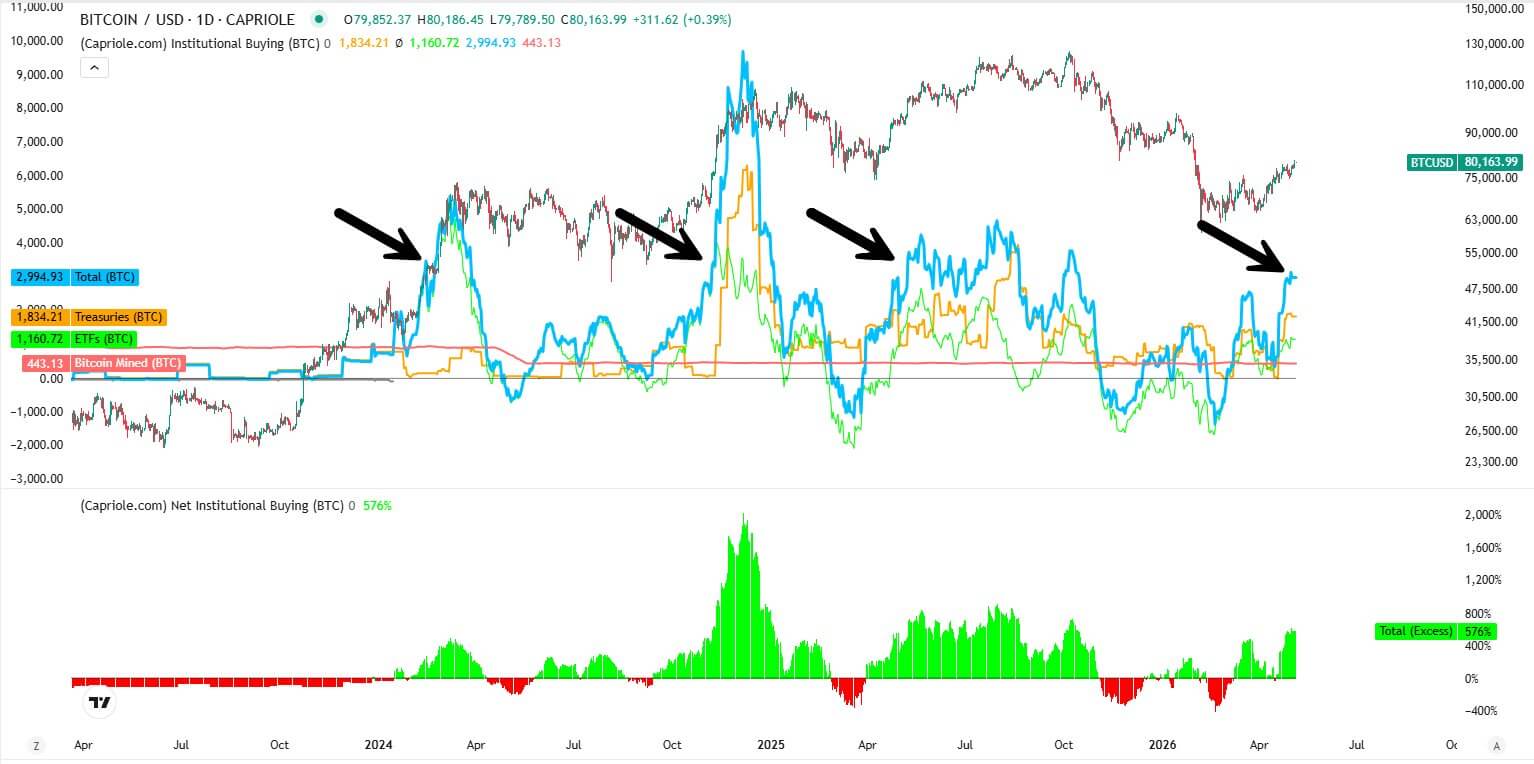
Corporate purchasing of government bonds changes the supply profile of the market, as companies adding Bitcoin to their balance sheets tend to withdraw coins from liquid circulation for extended periods.
That could boost rallies if spot market demand rises, but it could also leave the market exposed if issuance slows or corporate financing conditions tighten.
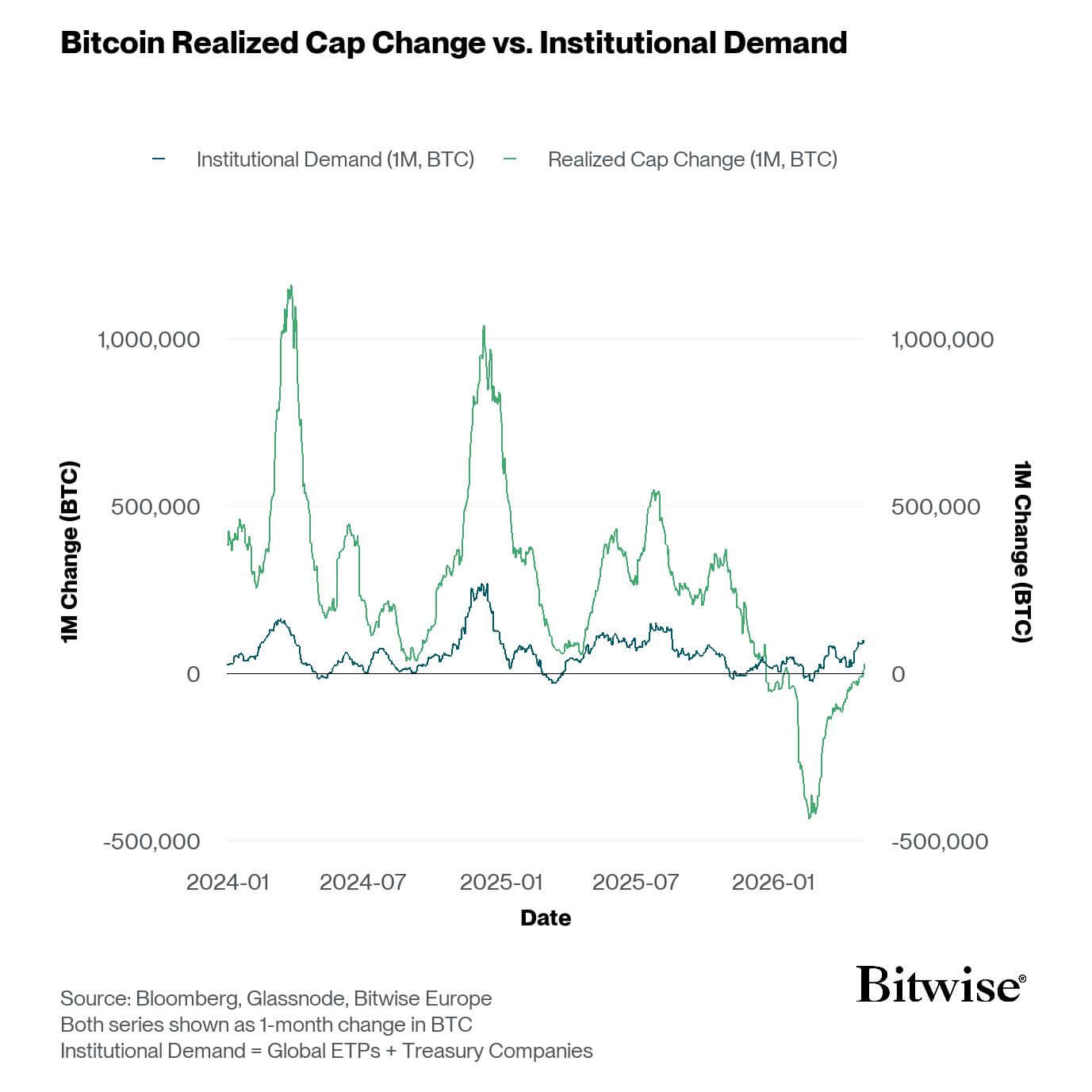
Andre Dragosch, head of research at Bitwise Europe, said that institutional investors accounted for almost all of the positive capital flows into Bitcoin last month. He said institutional demand totaled approximately 93,100 Bitcoin, which more than offset on-chain selling pressure during the period.
Retail demand is also starting to recover, although this remains a secondary signal. Data from CryptoQuant showed that the 30-day retail demand metric turned positive after several months of weakness, rising to 3.7% from a negative reading earlier this year.
The shift signals smaller investors are returning after selling heavily in the first quarter.
For now, stronger support comes from institutional accumulation, ETF inflows and corporate government bond demand.
Together, these buying sources have pushed Bitcoin back above $80,000 and given traders a clearer test of whether the recovery can extend beyond a macro-relief rally.
Derivatives and options traders are targeting further upside potential above $90,000
While spot demand provides a robust floor, the speed of Bitcoin’s current movement is greatly amplified by the derivatives market.
On leading options exchange Deribit, call options, bullish bets on future price rises, with strike prices above $82,000, have dominated trading volumes over the past 24 hours.
For context, call options with strikes of $85,000 and $90,000 have attracted open interest of more than $2.2 billion at the time of writing.
The sheer amount of leverage entering the system is causing some analysts to raise red flags.
Joao Wedson, CEO of the quantitative company Alphractal, pointed to the staggering accumulation of speculative capital. He noted:
“Bitcoin Open Interest has surpassed $50 billion USD, and we haven’t even added CME yet.”
This build-up of open interest is inextricably linked to technical upside targets, especially the much-discussed “CME gap.”
Because the Chicago Mercantile Exchange’s Bitcoin futures only trade on weekdays, huge price moves over the weekend leave unfilled gaps on the chart.
Analysts at CryptoQuant identify the $93,000 level as the next major upside magnet, driven by an unresolved gap.
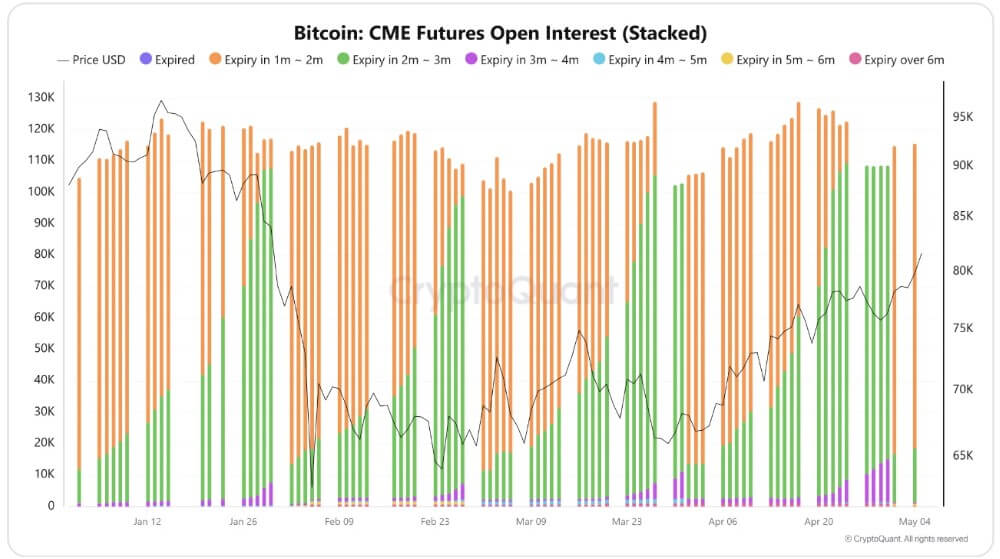
According to CryptoQuant’s mechanisms, these holes act as a liquidity vacuum. When open interest rises to extreme levels, the market builds up kinetic energy that must eventually be released through successive liquidations or profit-taking.
This $93,000 gap thus represents a historic zone of low liquidity, and price action often tends towards it as huge leveraged positions are unwound and rebalanced.
However, analysts warn that if leverage continues to exceed actual spot buying, the market could face a sharp downside reset to flush out late-entry long positions before a legitimate attempt to reach the $93,000 mark.