

The CLARITY Act has stalled Senate banking deliberations, rolling back a series of market rules that would enshrine into law most of the pro-crypto stance emerging in President Donald Trump’s administration.
Still, Congress may have given the crypto markets an unexpected experiment. Galaxy Research estimates the odds of enactment this year at about 50-50, possibly lower, with unresolved disputes over DeFi provisions, jurisdiction, and stablecoin yield language.
The bill includes token classification, exchange and registration between brokers and dealers, software carveouts and DeFi provisions, with the reward dispute representing one contentious layer within a much larger framework.
The reward layer is where Wall Street’s most concrete stablecoin-related fears lie, and a stall could allow the market to answer before Congress does.
The reward job
The GENIUS Act explicitly prohibits stablecoin issuers from paying interest or returns solely for holding a stablecoin, solving the simplest version of the fight.
The more difficult question is whether exchanges and third parties can offer cash back, referral bonuses, or promotional returns without running into the same ban.
Both the OCC’s March proposal and the April FDIC’s proposal expanded anti-circumvention presumptions to a number of affiliated and related third-party arrangements, narrowing the path.
Yet both documents are still proposed rules that have not yet been finalized, and regulators are still defining the practical scope of what counts as prohibited.
Banks have portrayed this open perimeter as an existential threat to their competitiveness. The ABA’s community banking letter cited up to $6.6 trillion in deposits as potentially risky, warning that exchange-funded incentives could drain savings from the banking system.
Standard Chartered has made a more limited forecast of up to $500 billion in deposit outflows into stablecoins by the end of 2028, with regional banks bearing most of the risk.
The argument focuses on exchange-funded rewards that make stablecoin balances functionally competitive with bank deposits, while avoiding the reserve requirements, capital rules, and insurance costs that banks bear.
The White House Council of Economic Advisers published a direct rebuttal in April, concluding that eliminating interest on stablecoins would increase bank lending by about $2.1 billion, or about 0.02%, and impose a net welfare cost of $800 million.
The stablecoin market was over $320 billion as of April 27, compared to roughly $19.1 trillion in U.S. commercial bank deposits.
At around 1.66% of the deposit base, stablecoins are large enough to create competitive friction at the margins and small enough to maintain the system’s overall funding.
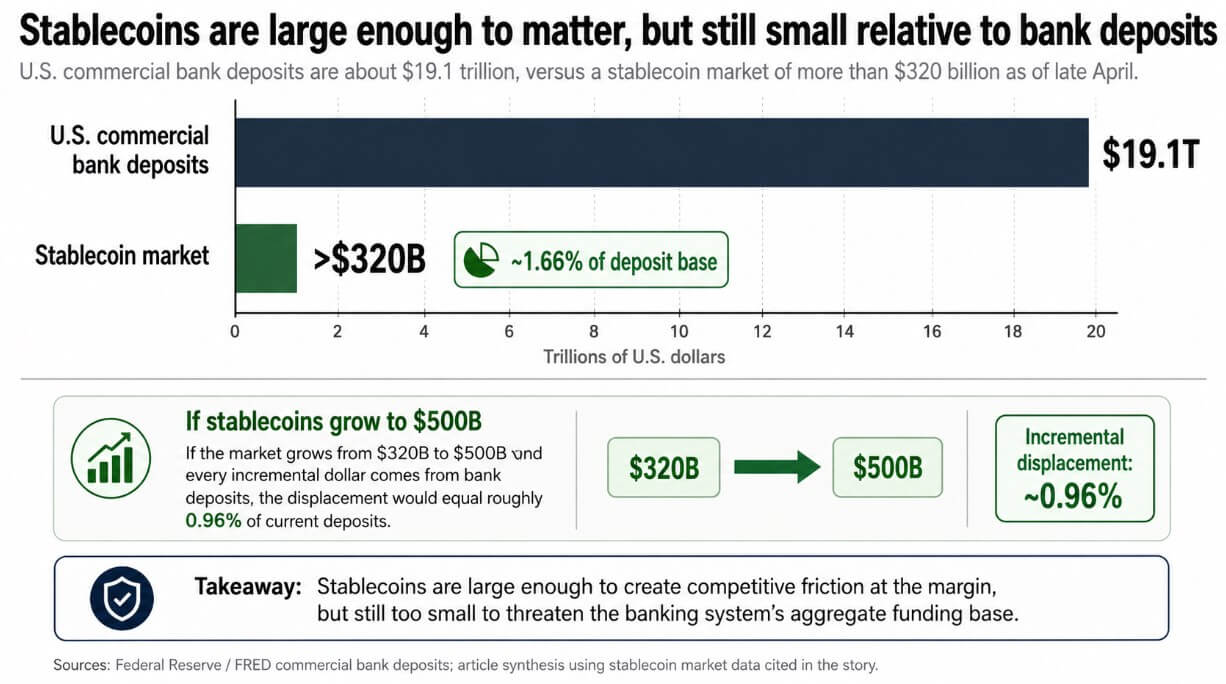
If the stablecoin market grew from $320 billion to $500 billion and every additional dollar came from bank deposits, the move would be about 0.96% of current deposits. The amount is enough to test the pricing power of community institutions, while keeping the system’s overall funding intact.
The positive outcome
If CLARITY stagnates and agency regulations don’t close the reward lane, exchanges can continue to operate within the uncertain perimeter.
In that environment, the rewards market has existed long enough to generate observable data, such as flows between bank accounts and intra-chain balances, movements in the allocation of cash to retail, and competitive bank responses to deposit rates.
Congressional hearings have taken 18 months to generate arguments, and a delay in legislation could produce evidence. The difference between the ABA’s $6.6 trillion alert and the CEA’s $2.1 billion credit impact would start to fill with actual data.
The global dimension makes any data that emerges immediately relevant beyond US borders.
MiCA explicitly prohibits e-money token issuers from paying interest and extends that restriction to crypto asset service providers. Hong Kong operates a license-based stablecoin issuing regime.
The BIS noted in April that the main division between jurisdictions now centers on whether exchanges and CASPs can offer rewards, with some markets banning this, others restricting access to retail and others not having an explicit ban.
A BIS working paper published in February shows that a five-day stablecoin inflow of $3.5 billion reduces three-month government bond yields by 2.5 to 3.5 basis points, providing evidence that stablecoins are already connecting to the front of the government bond curve in measurable ways.
If the US gray area provides data on deposit flows, it will be the first empirical input into an international policy debate based entirely on projections.
| Claim/source | What they claim | Cited size | What a live market test would reveal |
|---|---|---|---|
| ABA / banks | Rewards can take away deposits from banks | Up to $6.6 trillion is at risk | Whether the outflow of deposits actually takes place on a large scale |
| Standard chartered | Stablecoins could attract meaningful deposits by 2028 | Up to $500 billion | Which banks are most exposed, especially regional banks? |
| White House CEA | Banning returns has a limited benefit for bank lending | Credit impact of $2.1 billion; ~0.02% | Whether actual rewards change deposit behavior more than the model suggests |
| The reality of the market | Stablecoins already exceed $320 billion | ~1.66% of the deposit base | Whether competition manifests itself in rates, flows and the allocation of cash to retailers |
A bearish outcome
Congress or agencies could close the lane before the test produces anything useful.
If the OCC and the FDIC finalize the anti-circumvention rules broadly enough to reach promotional and activity-related awards, or if CLARITY succeeds with hard-yield prohibition language, the experiment will end before it begins.
Banks get the ban they asked for, the small CEA estimate becomes the only available empirical reference point, and the debate continues on the same contentious theoretical ground.
The White House CEA’s April paper noted that the GENIUS framework will take effect within 18 months after it becomes law, or 120 days after final implementing regulations, whichever comes first. This clock limits how long a gray area can last, regardless of what Congress does with CLARITY.
The slowdown comes with structural costs that will compound regardless of what the stablecoin rewards market reveals, such as token classification that remains ambiguous, software developers bearing liability risks, DeFi protocols operating under embattled regulatory authorities, and exchange and broker-dealer registration frameworks in limbo.
These costs are borne by the industry and its users the longer the account remains inactive.
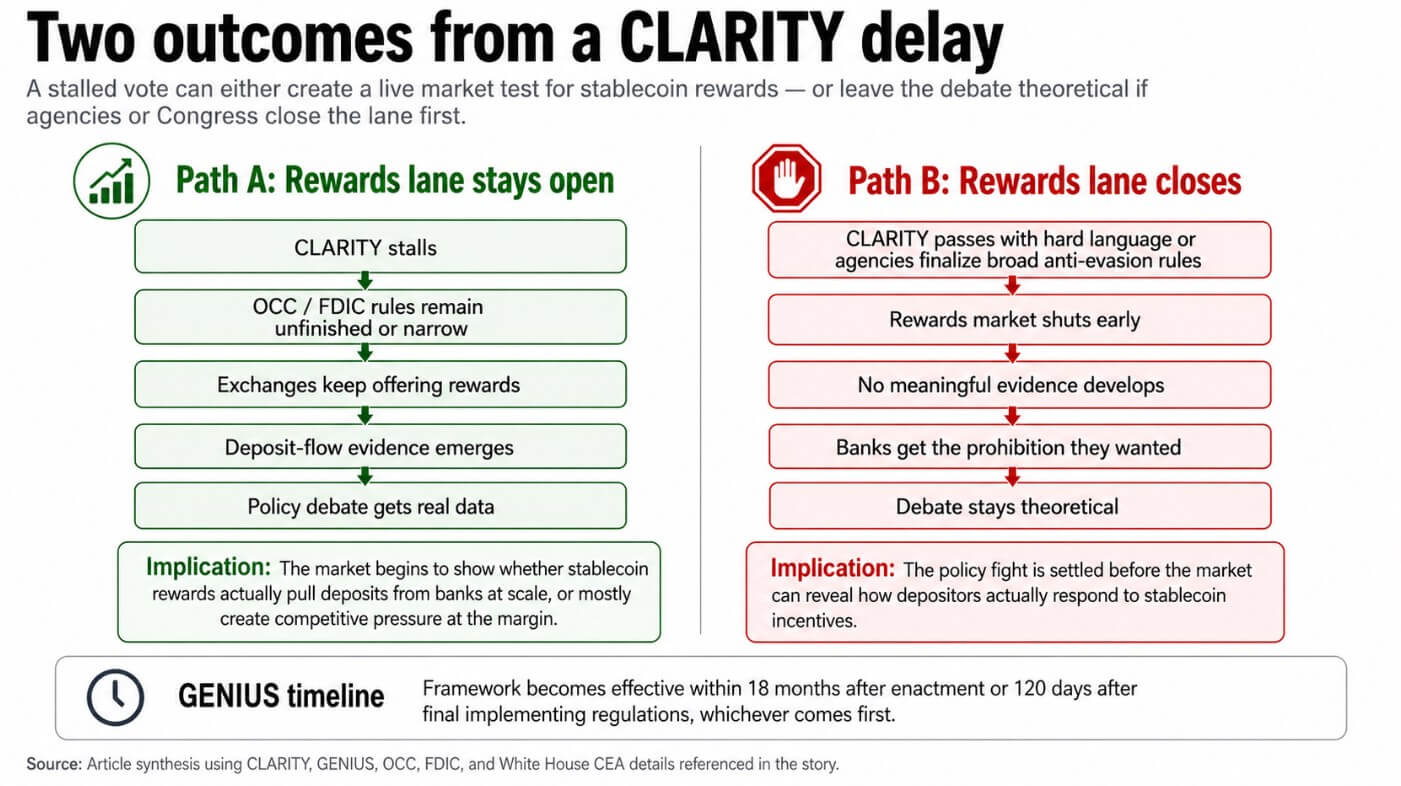
Deposits leaving banks for stablecoin rewards would flow into reserves such as government bonds and repos, shifting funding from bank balance sheets to the front of the government bond curve.
The test shows whether rewards change deposit behavior at the margin, and for which savers.
At the current size of the stablecoin market, that’s a check on deposit sensitivity, a real measure of bank pricing power and competitive friction that the industry has only modeled at this scale.
If CLARITY stagnates, it means we have to watch as that mechanism accelerates deposit migration or keeps it steady despite any competitive incentive, and both results provide the first real data on deposit behavior that a market of this size has ever generated.