

Banks have largely remained on the sidelines when it comes to directly holding XRP, even as interest in digital assets continues to grow. That hesitation is not due to any lack of use or demand but to strict capital regulations that made owning XRP economically impractical for regulated institutions.
However, there is a slight adjustment in how XRP is treated under global banking rules could remove that barrier and change the way banks handle the cryptocurrency.
Why banks can’t hold XRP
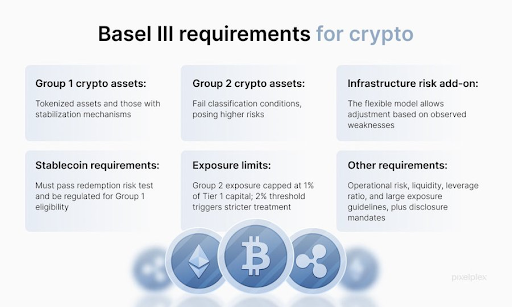
The main obstacle preventing banks from holding XRP is its treatment within the global banking framework known as Basel III. Basel III is an international regulatory framework developed after the 2008 financial crisis that introduces higher quality and quantity of capital requirements in the international banking sector.
Currently, XRP currently falls under Type 2 crypto exposure under Basel III, which is set up with rules for assets that carry higher risks. Under these rules, most cryptocurrencies, including XRP, fall into a high-risk category that has a punitive capital requirement. Banks are required to apply a 1,250% risk weight to such assets, which implies they must set aside much more capital than the value of the XRP itself.
This means that under the Basel III framework, for every $1 of XRP exposure, a bank must maintain $12.50 in capital. This dynamic was recently stated by a crypto commentator named Stern Drew on the social media platform X.
In a post on X, Drew explained that this capital inefficiency alone is responsible for years of institutional hesitation. The problem was not the technology, but the capital treatment that made holding XRP irrational from a balance sheet perspective.
The regulatory tipping point
The conversation about XRP’s regulatory status is becoming increasingly important for its long-term prospects. Interestingly, Drew’s analysis goes further by pointing to what he describes as an inflection point that markets may be missing. As legal and regulatory clarity around cryptocurrencies improves, XRP could be reclassified into a lower-risk category under Basel III.
The end game is that XRP is on a clear path to becoming a Tier-1 digital asset for global institutions, which is mainly intended for tokenized traditional assets and stablecoins with strong mechanisms. If that reclassification takes place, the economy will change immediately. XRP would become acceptable for direct balance sheet exposure, allowing banks to hold, deploy and settle the asset without the need for excessive capital.
This is not a discussion about short-term price movements, but about capital mechanisms that determine whether large pools of institutional money can participate in holding XRP at all. In this case, banks’ liquidity provision of XRP would change from off-balance sheet use to direct institutional ownership.
Featured image created with Dall.E, chart from Tradingview.com