



Bitcoin is accelerating toward the $80,000 threshold as market participants navigate a complex intersection of Middle Eastern geopolitics, shifting monetary policy regimes and a deeply skewed derivatives market.
Data from CryptoSlate shows that the rise in digital assets from recent lows was driven by the temporary diplomatic assistance between the US and Iran.
However, the underlying structural data suggests that the current price action is as much about forced liquidations as it is about macroeconomic optimism.
The ceasefire lifts Bitcoin, but Hormuz risk remains in play
The immediate catalyst for the market’s recovery was President Donald Trump’s announcement Tuesday that he is extending the United States’ ceasefire with Iran for two weeks.

The Trump administration characterized the government in Tehran as deeply divided and gave diplomats extra time to come up with a joint proposal to end the broader conflict.
This diplomatic pause previously caused a substantial relief rally in the digital asset space. Since the initial announcement last week, Bitcoin has risen aggressively by 7% to trade at $79,470 at the time of writing. It has returned somewhat to $78,200 at the time of writing.
The price movement has helped quell the immediate panic that gripped markets after Iran initially rejected a second round of peace talks.
However, Iran’s continued objections show that the underlying macroeconomic threat is still very much alive.
MasoudPezeshkian, the president of Iran, claimed that “violations of commitments, blockages and threats are the main obstacles to real negotiations.”
He added:
“The Islamic Republic of Iran has always welcomed and continues to welcome dialogue and agreement. Bad faith, siege and threats are the main obstacles to genuine negotiations. The world is witnessing your hypocritical empty talk and the contradiction between your claims and your actions.”
The Strait of Hormuz remains operationally restricted after its closure on April 18, and the US blockade of Iranian ports continues to be strictly enforced.
For digital assets, this structural overhang from a geopolitical escalation continues to limit risk appetite.
Fed transfer becomes the next market variable
As geopolitical concerns continue to mount, the impending regime change at the Federal Reserve is quickly becoming the next critical variable for risk assets.
With current Chairman Jerome Powell’s term soon to end, markets are actively studying what a post-Powell central bank might look like under candidate Kevin Warsh.
After his confirmation hearings on Tuesday, institutional agencies are not simply labeling Warsh as “softening”; rather, they analyze a fundamental restructuring of the central bank’s operating mechanisms.
During his testimony, Warsh argued for a significantly different inflation framework. He rejected the rigidity of a 2% spreadsheet target in favor of assessing the impact of inflation on consumers at the ‘dinner table’, suggesting a review of data collection methods.
Furthermore, Warsh explicitly criticized the practice of forward guidance, arguing that telegraphing interest rate movements prevents the Fed from responding dynamically to changing economic realities.
He also outlined a clear preference for using interest rates as the main policy tool over balance sheet activism, noting that asset purchases disproportionately benefit wealthier investors.
As a result, traders are starting to price in the possibility of a more nimble, forward-looking Federal Reserve. Thomas Perfumo, Kraken’s chief economist, said:
“Warsh has laid the foundation for a more nimble, less bureaucratic Fed – one that could cut rates sooner than expected. While this wasn’t a moment of retreat for risk assets, I think on balance it was a positive signal.”
So even if an immediate rate cut at the upcoming April 28 meeting is not guaranteed, the prospect of a less bureaucratic institution that responds quickly to changing economic data is interpreted as a net positive for liquidity-dependent assets like Bitcoin.
Negative financing and tighter supply are creating pressure
While macroeconomic and geographic variables provide the backdrop, the internal mechanisms of the cryptocurrency market explain how Bitcoin can soar higher even without clear macroeconomic confirmation.
The current rally is heavily subsidized by a severely sidelined derivatives market.
According to data from Alphractal, Bitcoin funding rates have fallen to their most negative levels since 2023, with the seven-day moving average at -0.005%. The prevailing sentiment among retail participants is dominated by short bias, fear and disbelief.
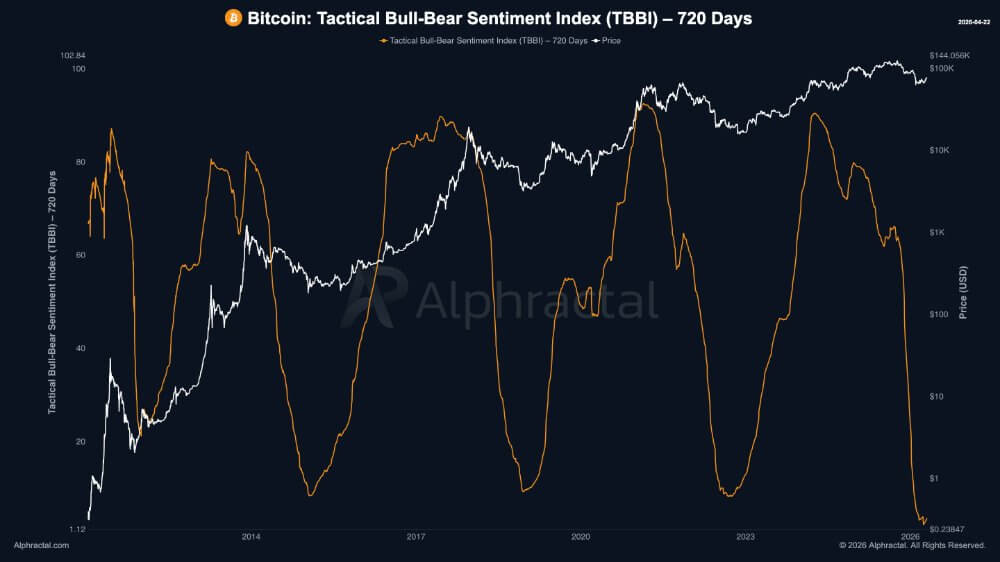
Historically, such extreme positioning, previously seen during the March 2020 crash and FTX collapse, has reliably indicated a local low as the market runs out of willing sellers.

At the same time, BTC’s currency supply is tightening at an aggressive pace. Foreign exchange reserves have plummeted to a seven-year low, and global net flows are in deep deficit.
Facts from CryptoQuant indicates that a “Squeeze Risk Oscillator” tracking major exchanges has reached 0.7925, near the depletion warning level.
This combination of extreme short bias and an accelerated drought in stock markets has created a volatile powder keg.
According to CoinGlass data, approximately $300 million in short positions have been liquidated in the last 24 hours.
As BTC prices rise, traders with leveraged short positions are forced to buy back their contracts to cover their losses, creating artificial demand. This forced repositioning is currently the main driver pushing Bitcoin towards the $80,000 mark.
The real test is above $80,000
Despite the momentum generated by forced liquidations, the market’s ultimate trajectory depends on how it interacts with the massive overhead supply.
CryptoQuant facts shows that the real test for Bitcoin is firmly above the $80,000 threshold, where behavioral economics and historical cost bases will dictate the next directional move.
Two of the most influential marginal buyer cohorts are currently testing their breakeven points. As of this week, the realized price for Bitcoin exchange-traded fund investors is approximately $76,400.
Likewise, short-term whales, entities that have acquired significant quantities in recent months, have a realized price hovering around $79,600. Both cohorts have been deeply underwater for months, carrying billions of dollars in unrealized losses.
This makes $80,000 act as the first major decision point. When trapped capital finally reaches equilibrium, distribution pressures typically arise as investors rush to exit their positions without incurring a loss.
However, an even larger construction wall looms a little higher. The realized price for the broader cohort of all short-term holders is currently set at $83,055.60.
The market is now in a critical testing area. If Bitcoin can successfully absorb the expected selling pressure from these cohorts and hold above the $83,000 level, the current rally will look increasingly sustainable, indicating that heavy resistance from above has turned into structural support.
Conversely, if the price falls violently at these thresholds, the entire move will begin to look like a temporary relief in supply, exposing the asset to a deeper, long-term capitulation.