
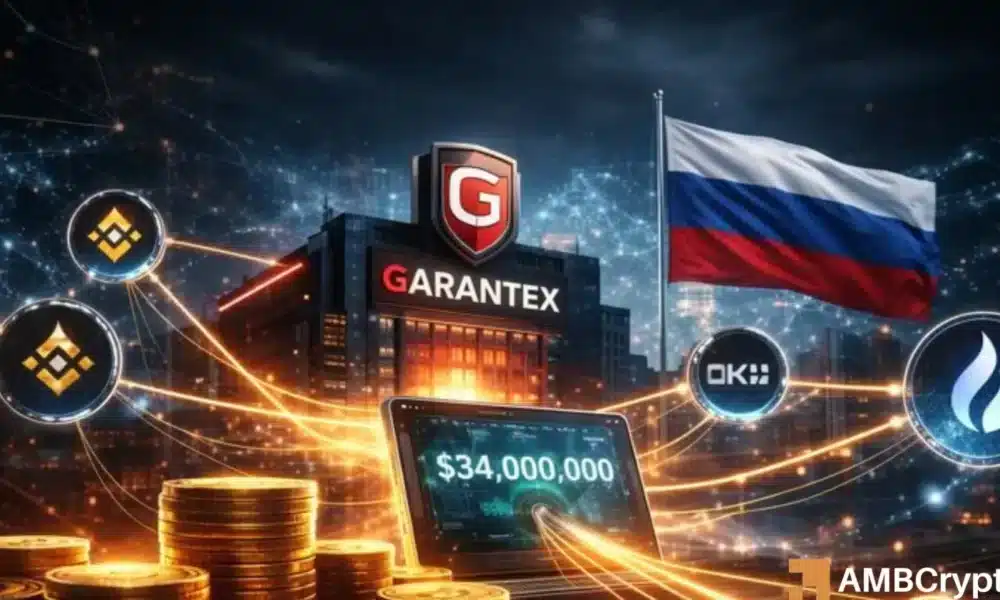
In a surprising turn of events, Russian crypto exchange Garantex, which has been blacklisted for facilitating illicit financing, has quietly resumed moving funds.
Garantex’s quiet comeback
A new study by blockchain analytics firm Global Ledger showed that Garantex has rebuilt a sophisticated payout system, proving that Russian operators have restored the exchange’s financial activity despite server seizures, asset freezes and other shutdown attempts.
This finding shows that high-risk exchanges are constantly adapting their on-chain practices, often outpacing regulators.
The analysis confirmed that, despite seizing servers and freezing millions in assets in early 2025, Garantex had successfully collected significant amounts of money in new wallets.
Garantex’s Bitcoin and Ethereum wallets
Global Ledger has identified new Bitcoin [BTC] and Ethereum wallets controlled by Garantex that had collectively amassed more than $34 million in crypto.
The stock was not intended for exchange operations. Instead, it was reserved for customer payouts.
That decision reflected a deliberate attempt to preserve liquidity. It was also intended to maintain goodwill among core users.
At least $25 million in crypto has already been paid out to former Garantex users. This development caused new concerns among supervisors.
Moreover, more than 88% of the collected Ethereum is present [ETH] reserve remained untouched, indicating a significant war chest for future operations.
In particular, a key finding is the direct exposure of these reserve and payout portfolios to centralized exchanges (CEXs) that are ranked in the top 10 on CoinMarketCap.
This link revealed that the network was still using regular financial inputs and outputs, introducing a vulnerability to compliant exchanges and a challenge for regulatory enforcement to track these indirect flows.
Russia vs USA
All of this begs the question: Is Russia copying American financial innovation to undermine it, or is it pursuing a unique strategy of its own?
While the US led the development of blockchain, Russia used the technology for sanctions evasion on a state-aligned, systemic scale.
Researchers identified parallel efforts through successors including Grinex and the ruble-backed crypto clearing network A7A5.
These developments pointed to a long-term strategy to build sovereign, non-USD payment rails that challenged Western financial dominance.
At the same time, the Garantex network evolved into a decentralized sanctions evasion-as-a-service model using Telegram workflows and agency contracts.
In short, Russia did not adopt Western crypto tools, but weaponized them to build a shadow financial system that could withstand pressure.
Russian view on crypto
This coincided with the paradoxical Russian regulatory strategy.
A recent order from the Russian Central Bank shows that the country is not abandoning digital assets, but instead co-opting them for state-oriented objectives.
Final thoughts
- The pristine Ethereum reserve indicates long-term operational planning, not opportunistic activity.
- The contrasting Russian crypto rules show a drive to centralize control, not encourage open adoption.