
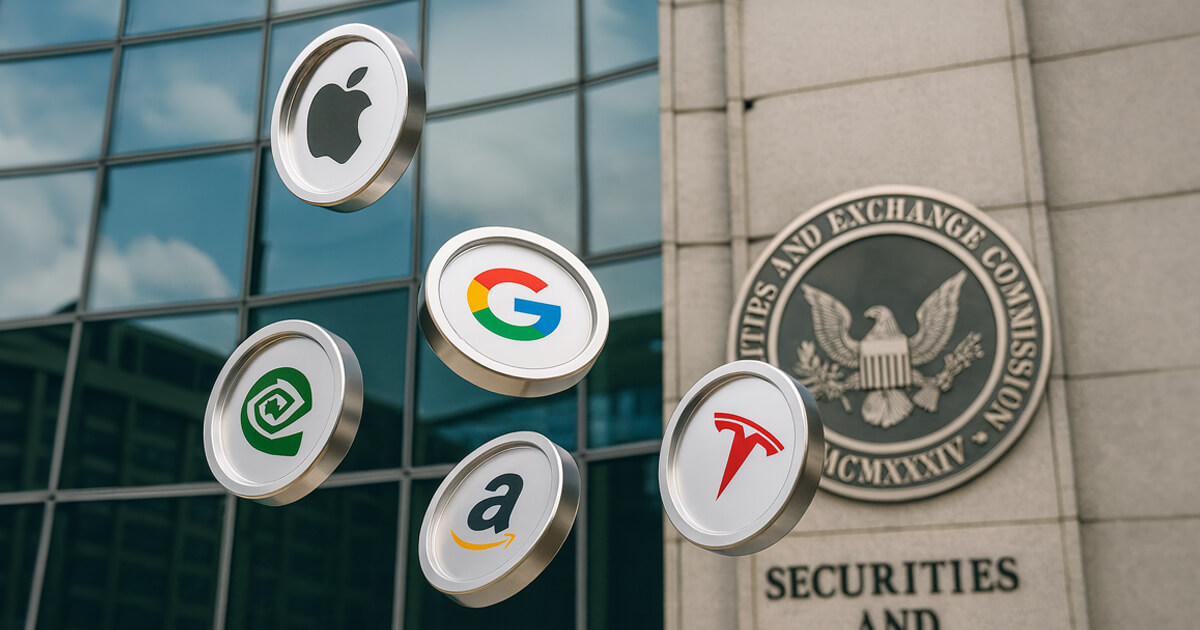

The Dec. 4 meeting of the SEC’s Investor Advisory Committee will begin with a question the agency has avoided for years: “What does it actually look like for publicly traded stocks to live on a blockchain?”
Not as packaged derivatives on foreign exchanges, not as speculative tokens divorced from shareholder rights, but as registered securities traded within the same regulatory framework that applies to Apple shares today.
The two-hour panel, titled “Tokenization of Equities: How Issuance, Trading, and Settlement Would Work with Existing Regulation,” brings together market structure architects from Nasdaq, BlackRock, Coinbase, Citadel Securities, Robinhood, and Galaxy Digital to publicly outline that path for the first time.
The timing reflects pressure that the SEC can no longer avert. Nasdaq recently submitted a formal proposal to trade tokenized versions of publicly traded stocks alongside traditional stocks on the same order book, arguing that blockchain settlement would not require forks from the national market system.
Commissioner Hester Peirce made it clear in July that tokenization “has no magical ability to transform the nature of the underlying assets.” Furthermore, tokenized securities remain securities and are subject to the full federal regime.
What will be tested on December 4 is whether that framing can survive contact with implementation details: who has the keys? How does the NBBO work if transactions are settled within seconds instead of two days? Can you short a token the same way you short a stock?
The compliant stack: same rules, different plumbing
Nasdaq’s blueprint provides the clearest picture of what tokenization “inside the system” looks like. The exchange proposes to allow listed shares to trade in traditional digital form or as tokens, with both versions sharing the same CUSIP, execution priority and economic rights.
The token is located on the settlement layer. Issuers still register under the Securities Act, exchanges still operate under the Exchange Act, broker-dealers still route orders through consolidated feeds, and the Depository Trust Company (DTC) still guarantees delivery.
Blockchain replaces the back-end ledger, not the front-end rulebook.
That structure keeps tokenized shares within Regulation NMS, meaning trades still contribute to the national best bid and offer, market makers still face quote obligations, and surveillance still identifies wash trades and spoofing.
Nasdaq warns that parallel platforms outside the NMS would fragment liquidity, undermine price discovery and leave issuers blind to where their shares actually trade.
The filing explicitly rejects exemptions: tokenization is a settlement technology, not a new asset class that warrants lighter oversight.
In terms of settlement, Nasdaq points out that DTC is building a blockchain infrastructure so that token transactions can be settled on-chain, while the exchange’s matching engine and data feeds remain unchanged.
If that plumbing arrives in time, live trading could begin as early as the third quarter of next year.
The model assumes that transfer agents maintain tokenized records in the same way they maintain accounting records today, with the same custody standards and financial responsibility rules, just with a different database underlying them.
Where the fight actually lies: indigenous issuance versus wrappers
The December 4 agenda signals a distinction that the crypto press often breaks down: natively issued tokenized shares versus wrapper structures.
Native tokens involve the issuer itself placing shares on the chain or instructing its transfer agent to maintain a blockchain register, detailing full voting rights, dividend claims and liquidation preferences.
Wrapper tokens, common on offshore platforms, only provide economic exposure: the price goes up, investors benefit, but they can’t vote the shares or sue in a derivative action.
The Nasdaq filing uses European locations as a cautionary tale. Tokens following Apple and Amazon traded there at prices that deviated sharply from the underlying shares, did not require issuer consent, and did not grant holders voting or liquidation rights.
When those tokens crashed, buyers discovered they owned synthetic derivatives, not stocks.
The exchange argues that allowing such products without registration would undermine investor protection and create a shadow stock market that regulators cannot see.
The panel will examine how ownership rights flow through tokenized structures, not because the SEC is confused about what a stock is, but because encapsulation introduces intermediaries who may or may not go through governance and economic rights.
If a token only follows price, it can become similar to a security-based swap, creating different disclosure and margin rules.
The Securities Industry and Financial Markets Association (SIFMA) commentary explicitly stated that investors must maintain the same legal and beneficial ownership in tokenized form, otherwise the product will turn into something completely different.
What is likely to work under current law (and what won’t)
The December 4 agenda covers a spectrum of regulatory frictions. On the low-friction side are issuers that register tokenized stocks, list them on national stock exchanges, and trade them interchangeably with traditional digital stocks, as Nasdaq is proposing.
Existing statutes already allow this if tokenization is treated as a settlement method rather than a product innovation.
Blockchain as a record keeping technology is also appropriate, provided that registered clearing agencies and transfer agents comply with current custody and accounting standards.
Previous statements from SEC staff on digital asset custody describe this as compliance engineering and not groundbreaking.
On the high-friction side, there is actual 24/7 trading in publicly traded stocks, which conflicts with Reg NMS’s assumptions about market hours and consolidated data.
Regulators keep markets moving 24/7 in the crypto context, but applying that to tokenized Apple shares means rewriting how best execution works when New York sleeps and Tokyo trades.
Models where tokenized shares are only traded on non-NMS blockchain platforms, not registered as exchanges or alternative trading systems, also clash with existing rules.
Nasdaq and SIFMA both argue that allowing the migration of equity volume to disconnected platforms would destroy the National Best Bid and Offer (NBBO) and leave retail investors with outdated quotes.
The Senate’s work on the Responsible Financial Innovation Act points in the opposite direction, explicitly classifying tokenized stocks and bonds as securities and strengthening SEC oversight.
That suggests that any attempt to treat tokenized shares as outside the agency’s purview will create a regulatory headwind, not a tailwind.
What December 4 decides and postpones
The Investor Advisory Committee may submit findings and recommendations, but does not write rules.
The panel is a stress test to see if Coinbase, Citadel and Nasdaq can agree on what compliant tokenization looks like when they are forced to reconcile custody models, interoperability standards and short-selling mechanisms in the same room.
If they can, the SEC will have a reference architecture for evaluating filings like Nasdaq’s. If that doesn’t work, the agency investigates where the technical or incentive mismatches are before approving anything.
What the panel won’t do is approve Nasdaq’s proposal, rewrite the definition of a security, or bless offshore equity tokens that skip issuer consent.
It will also be inconclusive on whether 24/7 trading or cross-chain interoperability will require new exemptions, as these questions depend on technical details that the advisory body cannot answer.
At best, December 4 will provide a menu of options that the Commission can refer to when deciding whether tokenized equity belongs in the national market system or requires a parallel structure that current law does not yet consider.
The meeting is important because it brings the question into the open. The answer still depends on whether the market wants to build blockchain into existing rails or build new ones, and the SEC must approve this from the start.