

The latest Cloudflare outage caused widespread disruption to crypto applications, demonstrating the industry’s heavy dependence on centralized internet infrastructure. The incident was Cloudflare’s worst service disruption since 2019 and exposed a major contradiction within the crypto industry’s claims of decentralization and resilience.
This outage raised difficult questions: can there be true decentralization if a single provider can eliminate large parts of the sector?
Scale and cause of the Cloudflare outage
The outage began on November 18 at 11:20 UTC, due to a database permissions change that caused an outage in Cloudflare’s network. In its official incident report, Cloudflare explained that a bot management function file doubled in size, exceeding memory limits and resulting in widespread HTTP 5xx errors.
Core Cloudflare services (including CDN, security, Workers KV, Access authentication, and Dashboard logins) experienced major disruptions between approximately 11:20 and 14:30 UTC, with some services partially mitigated starting at 1:05 PM and residual issues continuing into the afternoon. All services were fully restored by 17:06 UTC.
The team confirmed that no cyberattack was responsible for the incident. Instead, it arose from a configuration change and query behavior that quickly spread through the system.
“Today was Cloudflare’s worst outage since 2019. We’ve had outages that made our dashboard unavailable. Some caused newer features to be unavailable for a while. But in the last six years, we haven’t had another outage that stopped the majority of core traffic flowing through our network…. On behalf of the entire team at Cloudflare, I’d like to apologize for the pain we caused to the internet today,” wrote Matthew Prince, CEO of Cloudflare.
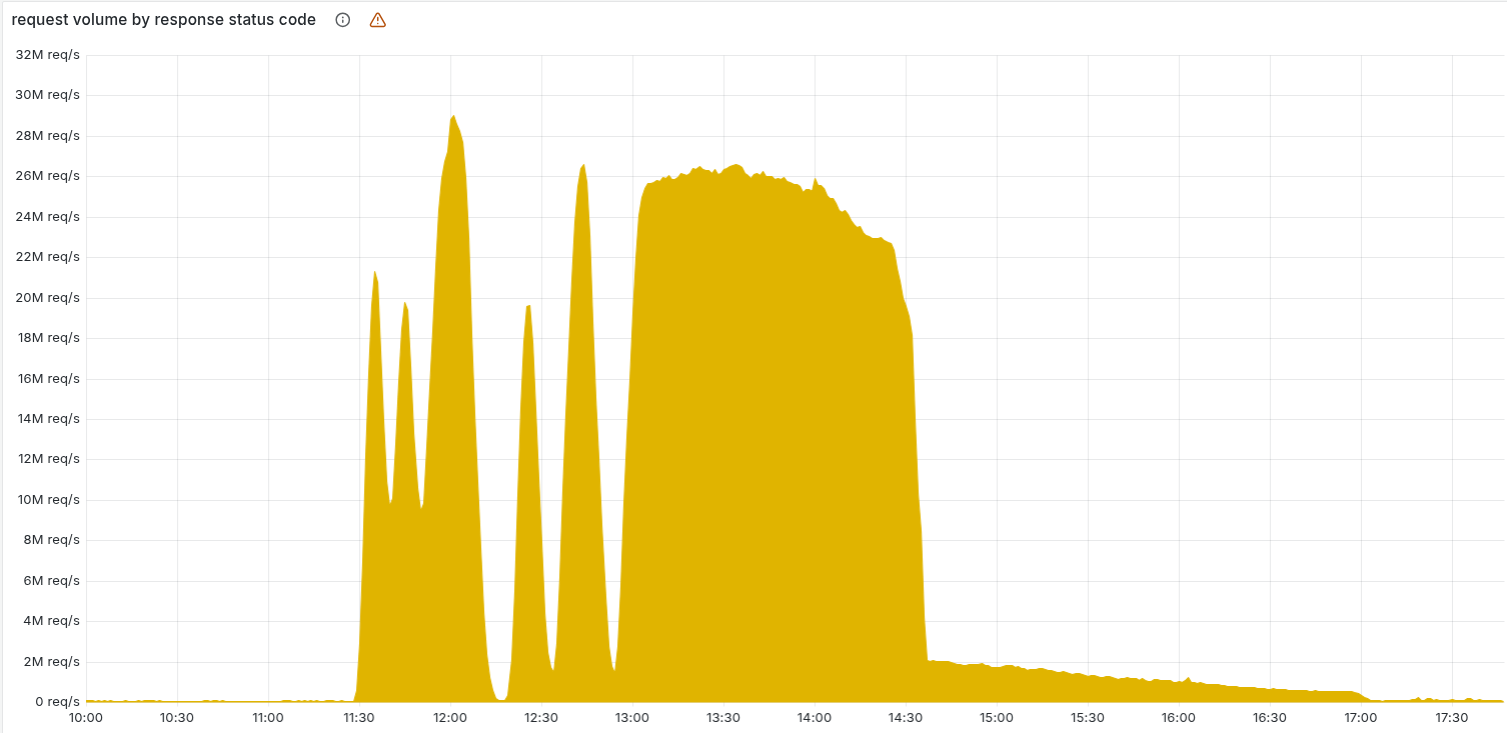
HTTP 5xx error spike during the Cloudflare outage. Source: Cloudflare
Cloudflare plays an important role in directing global Internet traffic, with its infrastructure supporting a wide range of online services. In its ‘Browser Market Share Report for 2025 Q3’, the company noted that more than 10% of all websites connect through the reverse proxy system.
Additionally, nearly 25 million online properties depend on Cloudflare’s network to reach their audiences. Because manWhile online platforms are highly dependent on their systems, outages or disruptions can have far-reaching consequences.
Crypto’s Decentralization Paradox Exposed
Notably, when Cloudflare faltered, major exchanges and DeFi protocols went offline at the same time.
YES!!!
Cloudflare’s global network outage just took several crypto front-ends offline.
What chaos!!! pic.twitter.com/pQPbMhjsXj
— Kyle Chassé / DD🐸 (@Kylechasse) November 18, 2025
The incident quickly drew criticism from industry analysts. They pointed out the gap between cryptocurrency’s decentralization rhetoric and its operational reality.
Nader Dabit, Director of Developer Relations at Eigen Labs, illustrated the irony in a post on X, highlighting the failure of “unstoppable” apps when Cloudflare went offline.
Your favorite DeFi protocol is down due to the AWS outage. Now your favorite DeFi protocol is unavailable due to the Cloudflare outage. And all the oracles consider Binance to be the first gospel in the crypto bible. Not as decentralized as we were told, right?” Added the White Whale.
The outage revealed that many crypto applications rely on centralized networks for essential services. Although blockchains themselves can operate independently, users access them through the Web2 infrastructure, creating weaknesses.
The event also exposed gaps in DeFi risk management. If users cannot access their accounts or conduct transactions at crucial times – even if on-chain protocols continue to function – the practical reality of permissionless finance becomes shaky.
Nevertheless, not all experts viewed the incident as an existential threat to Web3. Helius Labs CEO Mert put the outage into perspective by noting Cloudflare’s sheer size relative to blockchain throughput.
“Cloudflare processes 85 trillion more requests per second than all chains have ever combined in a lifetime. Leave this alone. Like a toddler bragging about flying a toy plane to a pilot,” Mert noted.
This perspective illustrates the technical challenge ahead. While the blockchain industry values uptime, few projects handle traffic at a scale comparable to Cloudflare.
Building decentralized systems with comparable capacity is not yet solved. For now, Web3 projects typically rely on an established, centralized infrastructure due to practical considerations.
Still, some analysts said the disruption could boost innovation. Blockchain data expert Alex Svanevik noted that the outage could spur alternative crypto infrastructure solutions.
crypto without cloudflare
who builds this?
— Alex Svanevik 🐧 (@ASvanevik) November 18, 2025
Whether the crypto sector will diversify or continue to rely on convenience over ideology is a question industry leaders must confront as they weigh security and resilience.
The post Cloudflare outage exposes Web3’s centralization problem appeared first on BeInCrypto.