

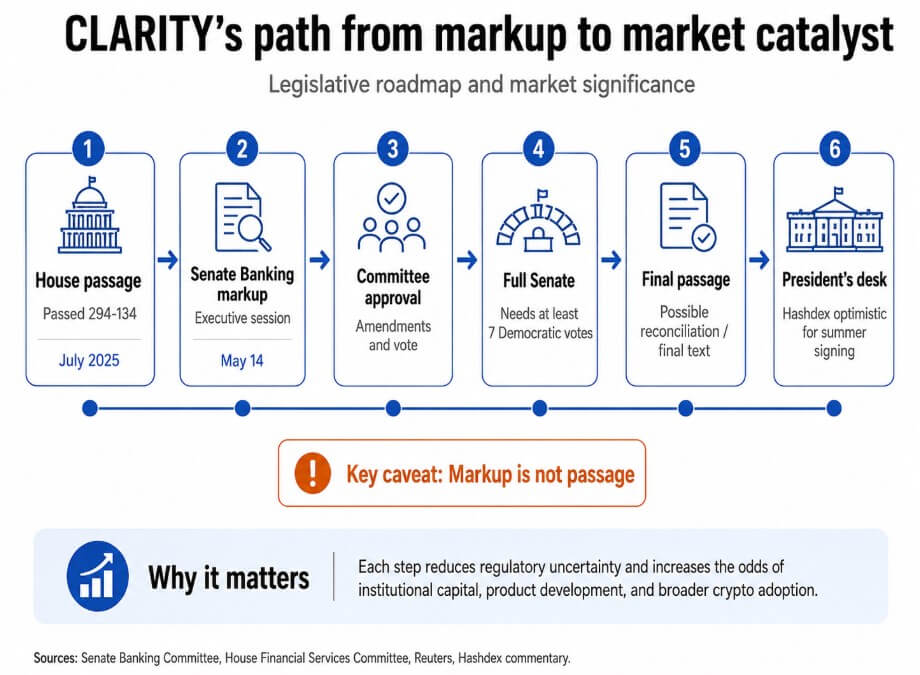
The Senate Banking Committee will meet later today, May 14, to discuss the CLARITY Act, a bill that already passed the House 294-134 in July 2025 and that needs at least seven Democratic votes to advance in the full Senate.
Hashdex CIO Samir Kerbage sees the current crypto price action as confirmation that the market is estimating the chances of a committee vote, leaving the capital flow scenario of a signed bill completely outside of current valuations.
Kerbage told CryptoSlate:
“If signed into law, the CLARITY Act will not only be a compliance milestone, it will be a market activation event that should lead to significant capital inflows, product development and broad institutional adoption.”

He added that Hashdex is optimistic the bill will reach President Donald Trump’s desk this summer.
What the Clarity Act establishes
CLARITY covers stablecoin rewards, anti-money laundering regulations, SEC fundraising exemptions, DeFi treatment, and tokenization.
The stablecoin provision is the most controversial, as the bill prohibits rewards on inactive stablecoin balances that resemble bank deposits while allowing transaction-based rewards and requiring the SEC, CFTC, and Treasury Department to issue joint rules.
Banks have pushed back against the risk of deposit flight, while crypto companies argue that limiting third-party rewards is anti-competitive.
The bill would bring digital commodity exchanges, brokers and dealers under Bank Secrecy Act treatment as financial institutions, adding AML, customer identification and due diligence obligations.
For institutions on the sidelines, that framework is a must because it gives compliance teams a rulebook to defend internally and investment committees a structure they can approve.
Kerbage said:
“The CLARITY Act is especially important for institutional investors. These investors have fiduciary responsibilities and investment policies that require a much greater level of regulatory clarity than individual investors.”
Institutions need policy clarity, investment committee approval, product packaging, and fiduciary justification before they can allocate at scale. If signed, the CLARITY Act will provide the policy layer that unlocks the rest of that chain.
Kerbage expects most of that institutional capital to flow through ETFs and index-based crypto products, giving demand a sustainable, reportable structure.
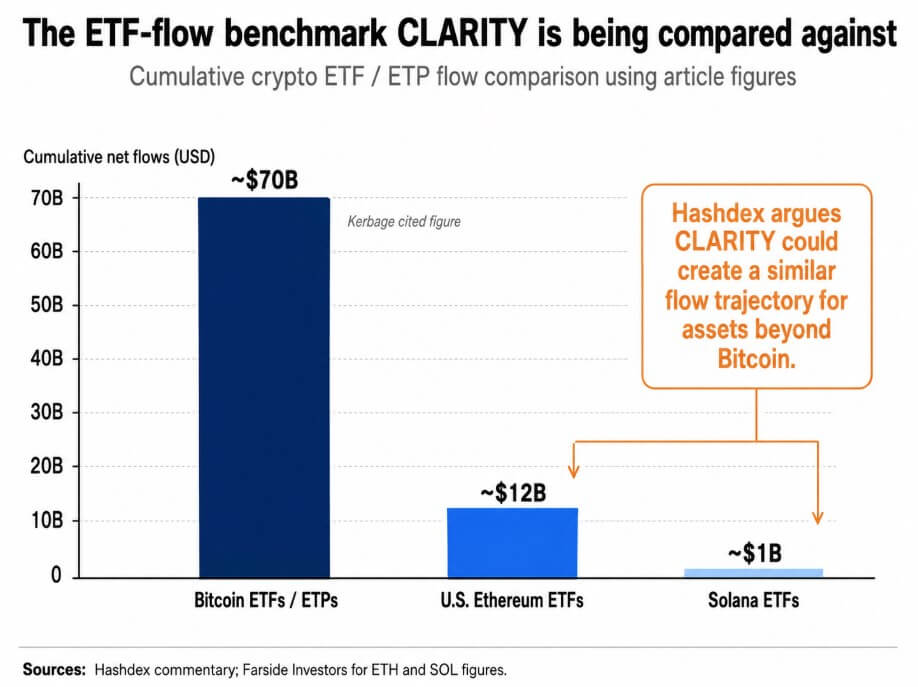
Data from Farside Investors shows that US-traded Ethereum ETFs have amassed approximately $12 billion in cumulative net flows since launch, and Solana ETFs have surpassed $1 billion.
Both are well below the Bitcoin ETF scale, piling into a market where CLARITY would establish the regulatory status of their underlying assets for the first time.
The Bitcoin ETF Comparison
Kerbage’s measure of CLARITY’s potential is the SEC’s January 2024 approval of spot Bitcoin ETF listings, which converted latent demand into packaged, committee-approved flows on a much larger scale than the pre-approval consensus expected.
He argued:
“For Bitcoin alone, that regulatory action led to cumulative flows that exceeded $70 billion in just two years.
If the legislation on the structure of the digital asset market is passed into law, we expect a similar trajectory for crypto assets beyond Bitcoin, particularly the smart contract platforms that provide the underlying infrastructure for stablecoins and tokenization initiatives.”
CLARITY would give the broader crypto asset class a definitional framework, determining when tokens are securities, commodities, or something else, and what products issuers should build and institutions should buy.
Kerbage points to the creation of new products as the mechanism through which capital enters the market once legislation is passed, creating a pipeline of ETFs and wrappers for institutions to tap.
He expects issuers will build around crypto’s unique features, such as staking-based initiatives, index-based broad exposure, and income strategies that exploit the crypto market’s liquidity and improve financial infrastructure.
Kerbage said:
“Passage of the CLARITY Act will only make it easier for these products to launch and attract investor capital.”
The Senate bill text includes an exemption from Crypto regulation allowing companies to raise up to $50 million per year and $200 million in total, disclosure rules for additional assets, DeFi cybersecurity standards, and clarifications in banking law for digital asset activities.
Repricing the Clarity Act asset class versus change friction
If the Banking Committee advances the bill and mutual momentum builds toward legislative change, Kerbage sees a credible path to repricing the entire asset class.
Bitcoin’s base case is trading between $74,000 and $85,000 in the coming weeks, without a major catalyst.
He said:
“Passage of the CLARITY Act could be the catalyst that helps push crypto prices much higher, potentially pushing prices closer to recent record highs before the end of the year.”
Smart contract platforms, staking assets, tokenization infrastructure, and index-based crypto ETFs all have a larger uncertainty discount than Bitcoin, which has already cleared its entry event in 2024.
A signed CLARITY Act compresses that discount across the entire asset class simultaneously, making the bull case for assets beyond Bitcoin more directly tied to the bill’s fate than BTC itself.
| Scenario | Policy outcome | Market interpretation | Likely impact |
|---|---|---|---|
| Basic case | Markup is moving forward, but no signing anytime soon | Market prices are a process, not a certainty | BTC remains within Kerbage’s $74k-$85k range |
| Taurus case | The bipartisan momentum is building toward summer signings | CLARITY becomes a catalyst for capital flow | BTC is moving towards recent ATHs; Assets outside BTC perform better |
| Delay case | Stablecoin rewards, AML, ethics or bank lobbying slow down the bill | A statutory discount continues to exist | ETF/product development delayed |
| Dilution case | The final text loses important provisions on market structure | Signing matters less than expected | Institutional access is weaker than Hashdex expects |
The legislative path involves real friction, as full passage through the Senate requires at least seven Democratic votes, and the provision on stablecoin rewards, banking industry opposition, ethical considerations, and AML implementation details all carry amendment risk that could delay or dilute the final text.
A prolonged battle for profit margins would leave uncertainty in the crypto pricing process, leaving the regulatory discount intact and limiting the institutional capital unlocking that Kerbage describes.
Kerbage concluded by calling CLARITY “the most important piece of legislation in the history of this industry.”