

The following is a guest post and opinion from Shane Neagle, editor-in-chief of The Tokenist.
It’s no secret that large language models (LLMs) have crossed the capability threshold by collecting massive amounts of public and private data. Combined with breakthroughs in transformer architectures and computing power, this data scraping led to concerns about intellectual property (IP) rights.
Intellectual property frameworks exist to encourage innovation and creative sparks and protect creators and businesses. In turn, society as a whole benefits from that incentive structure. Ultimately, IP protections usually expire, after which IP is integrated into the public domain.
The globally harmonizing IP framework is the Agreement on Trade-Related Aspects of Intellectual Property Rights (TRIPS Agreement) under the umbrella of the World Trade Organization (WTO), together with the World Intellectual Property Organization (WIPO).
However, as AI rapidly blurs the line between human and machine creativity, the fundamental assumptions of the IP system are under threat. Without explicit permission and compensation, LLMs are routinely trained in copyrighted works, eroding the important incentive structure.
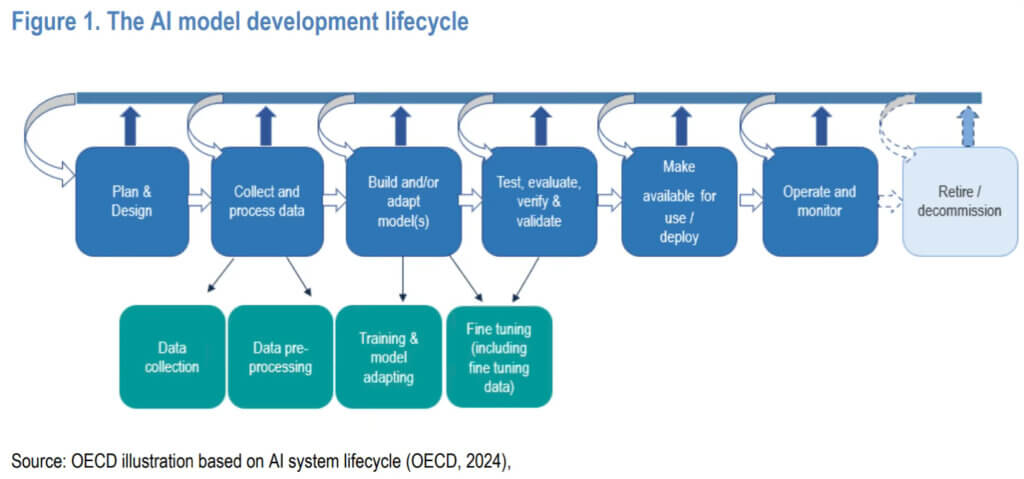
It is not difficult to see digital oligopolies entrenching their power over time with the greatest computing power and data access, while keeping smaller players from scraping data on a large scale.
But again when it comes to data flows, a potential solution could emerge from the blockchain ecosystem. Specifically with layer-1 Camp Network (CAMP) blockchain.
How does Camp Network tackle the erosion of IP incentives?
Just as Bitcoin Mainnet immutably records the transfer of value, Camp Network aims to immutably record the transfer and attribution of people’s work. With permanent and verifiable ownership registration, creators can automatically enforce licensing terms – through smart contracts – when AI models use this registered content.
To achieve this, Camp Network uses the proof-of-provenance (PoP) protocol, which handles IP origination and licensing terms. In addition to this core protocol, Camp Network uses BaseCAMP as a global IP registry and SideCAMPs tailored to dApps related to IP enforcement in various sectors such as music, books or gaming.
Specifically, creators and organizations could register IP as non-fungible tokens (NFTs), which have already pioneered a form of on-chain royalty system despite market deflation since late 2021. While this was an important proof of concept, royalty enforcement is more dependent on market collaboration, not the blockchain itself.
For example, there was a period of ‘royalty wars’ between OpenSea and other marketplaces like Blur, where marketplaces introduced a model where royalties were optional and opted for token incentivization instead. Ultimately, this led to a fragmented and voluntary NFT royalty ecosystem, exacerbated by poor metadata.
Building on these lessons, Camp Network integrates royalty logic at the protocol layer, rather than relying on marketplaces. This means that royalties apply not only to content, but also to data usage – ideal for scenarios where LLMs train on registered data sets.
Camp Network’s registration and monetization process
With its purpose-built layer 1 blockchain, Camp Network is primarily aimed at individual creators across all digital content categories. Whether it’s a music track or a digital image, the process is as follows:
- Using Origin Framework, creators register their work on-chain, embedding licensing terms and royalties tied to the asset’s smart contract.
- On the other hand, when an AI developer uses mAltrix Framework to train an AI agent, he uses content from Camp’s registry.
- Because AI uses a registered asset to generate new content or for training, Camp Network’s proof of provenance tracks its use. Accordingly, smart contracts automatically execute the creator’s predefined terms, distributing CAMP payments to the wallet.
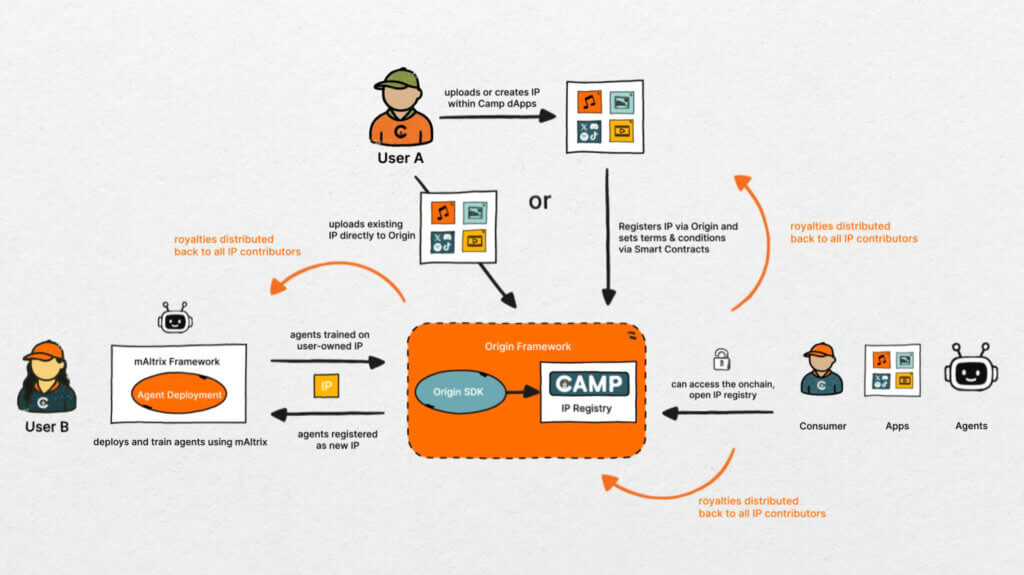
Put another way, Camp Network is better understood as an add-on infrastructure rather than another protocol. Up portalusers can even natively transfer ETH from Ethereum, which contains the largest number of dApps and developers.
Currently Camp Network’s ecosystem includes 141 dApps. This is not surprising as the protocol is fully compatible with the Ethereum Virtual Machine (EVM), allowing for easy dApp migration.
To support Ethereum-Camp interoperability in a secure manner, Camp Network uses Decentralized Verifier Network (DVN), powered by the native token CAMP, for the purpose of staking to the CAMP Vault.
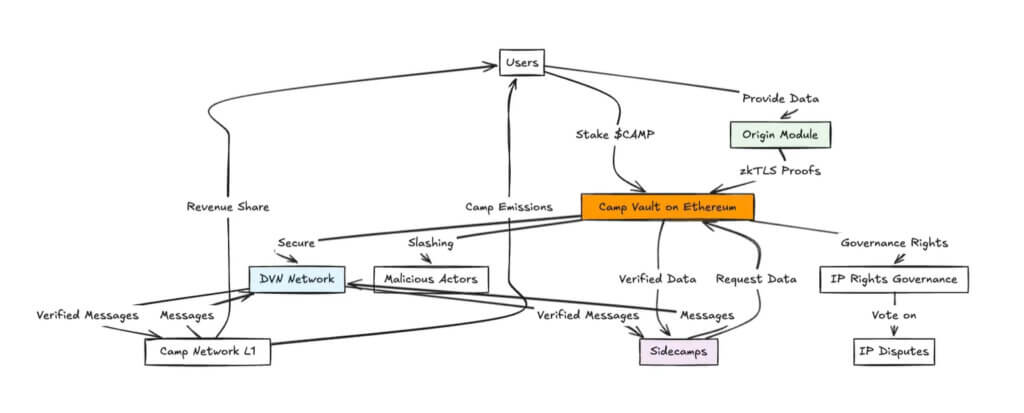
Moreover, each dApp has its own SideCAMP to avoid traffic congestion. And because SideCAMPs support different runtime environments, different ecosystems can come on board the Camp ecosystem. This interoperability of the blockchain network is of great importance for Camp Network to gain traction and ensure that the content maintains its traceable origin across all chains.
CAMP tokenomics
After launching relatively recently, at the end of August 2025, there are 10 billion CAMP tokens available to secure and monetize the network, of which 2.1 billion are in circulation. Early backers have the most tokens, namely 29%.
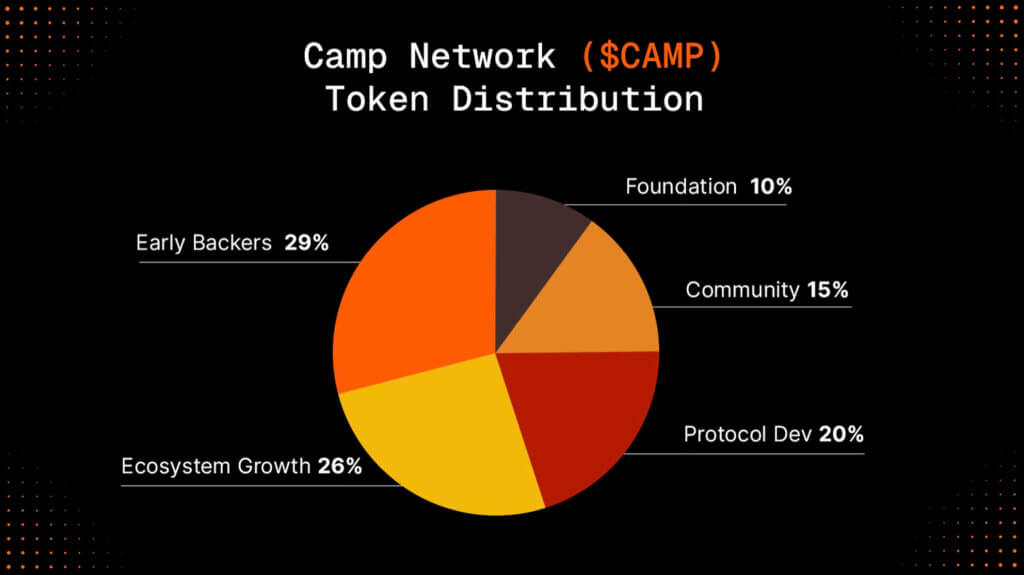
For the Ecosystem and Base, 3% of CAMP tokens each are unlocked during Token Generation Events (TGE). The remaining tokens will be awarded monthly for 60 months with the aim of supporting airdrops, grants, wagering rewards and community engagement. In many ways, these return incentives mirror the recurring payouts that investors receive dividend stocksbut in a decentralized, blockchain-native form.
Protocol developers obtain CAMP tokens gradually over a period of four years, after an initial one-year waiting period. Likewise, after waiting a year, early backers get a two-year straight-line vesting period for a total of three years.
The bottom line
After the one at the beginning of October crypto crashthis is a good time to consider investing in assets that are likely to gain merit-based traction. Next to Ethereum, Camp Network belongs in this category of considerations, at least to look forward to CAMP’s future airdrop campaigns.
At the end of the line, Camp Network tackles a fast-growing problem where AI devours data without giving anything in return. You might even see Google’s AI overview erode website traffic as it summarizes different websites for user searches.
By embedding royalties and usage logic into the protocol layer, Camp Network turns digital content into verifiable monetizable assets. And the longer we are in the AI era, the longer the demand for transparent, on-chain provenance and automated compensation will grow.