

A group of crypto tokens tied to some of the industry’s biggest revenue-generating applications could be positioned for a revaluation as Congress moves closer to enacting a federal rulebook for digital asset markets.
The Digital Asset Market Clarity Act, known as the CLARITY Act, would define regulatory responsibilities for crypto assets and the companies that trade them. Supporters say the legislation could give banks, asset managers and other traditional financial companies more confidence to do business on public blockchains.
Asset management company Grayscale expected which are shifting to applications that already process transactions and collect fees, especially applications built around trading, lending and other financial services.
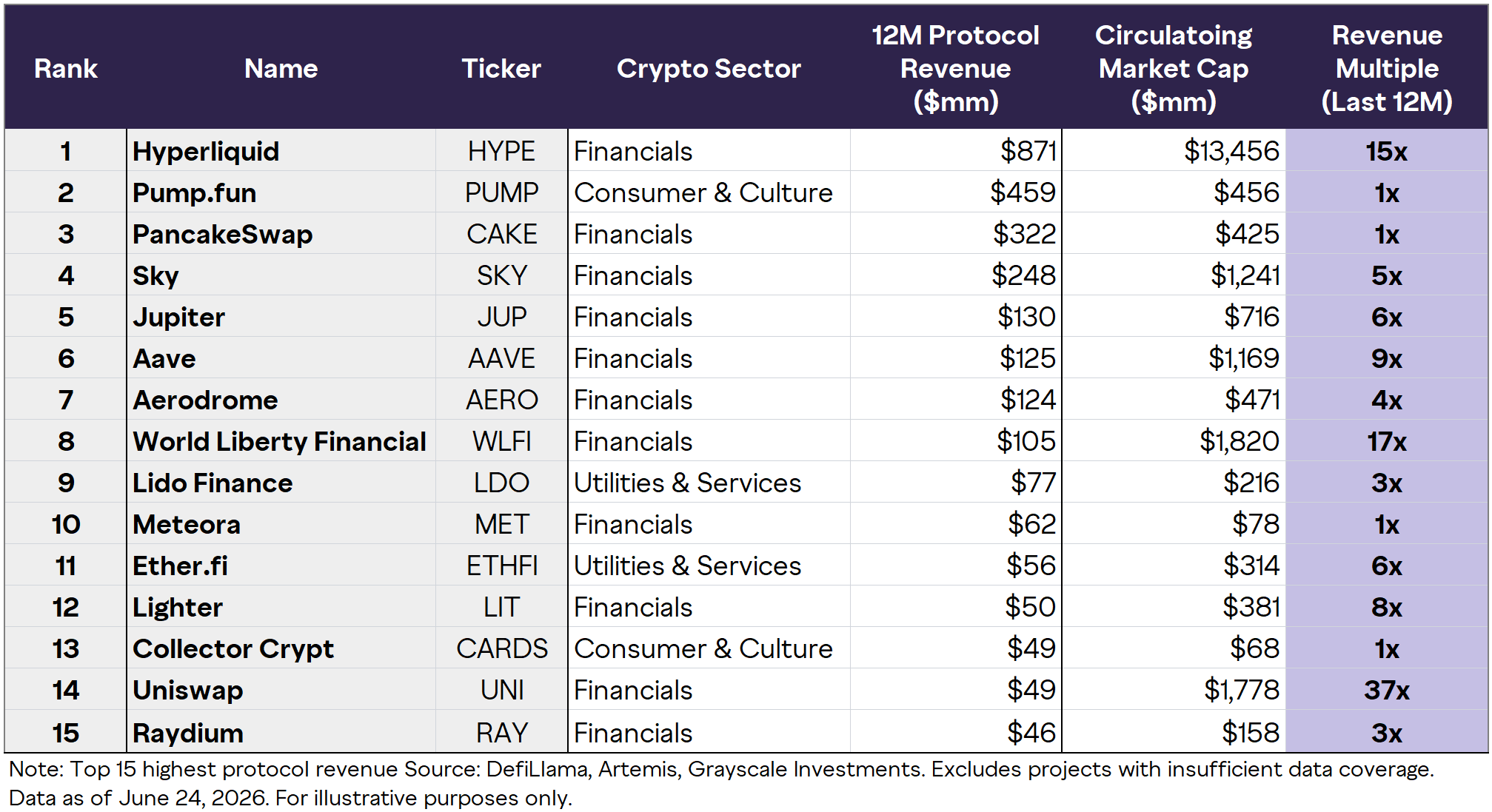
The potential catalyst comes after a prolonged market downturn left many of their tokens valued at relatively low multiples of the revenue their protocols generated over the past year.
The Senate Banking Committee advanced the legislation in May after the House approved an earlier version in 2025. Grayscale said the bill could move forward next month, although its timing and final provisions remain subject to negotiations in Congress.
Trading tokens lead the potential winners
Hyperliquid is at the front of the group due to the size of its derivatives business.
The decentralized trading platform generated $871 million in protocol revenue in the 12 months through June 24, more than any other application in a ranking compiled by Grayscale.
HYPE, the original token, had a circulating market cap of about $13.46 billion, giving it a revenue multiple of about 15. That rating is higher than that of most of the tokens on the list, but Hyperliquid also generated almost twice as much turnover as its nearest competitor.
Clearer rules for the US market structure could expand the pool of assets and participants entering blockchain-based trading platforms. Greater certainty about whether digital assets are subject to securities or commodities regulation could also make it easier for regulated institutions to connect to on-chain markets.
The opportunity extends across decentralized exchanges and trading aggregators.
PancakeSwap generated $322 million in the last 12 months, while the CAKE token had a circulating value of $425 million. That placed it at almost 1x protocol revenue, one of the lowest multiples in the rankings.
Jupiter, a Solana-based trading aggregator, posted revenues of $130 million and a circulating market cap of $716 million, equivalent to about six times revenue. Aerodrome generated $124 million in sales and traded at almost four times sales, while Meteora generated $62 million in revenue and had a valuation of just $78 million.
Raydium’s revenue of $46 million compared to a circulating market value of $158 million, making the Solana exchange token about three times revenue.
These platforms could benefit if legislation encourages issuers to bring more regulated assets onto blockchains. Any new tokenized security, commodity or fund would need markets where investors can buy, sell and provide liquidity.
Uniswap offers a different valuation profile. The decentralized exchange generated $49 million in protocol revenue, but the UNI token had a circulating market value of approximately $1.78 billion, equal to 37 times revenue and the highest multiple of the 15 protocols.
This premium suggests that investors already attribute substantial value to Uniswap’s brand, market position and prospects for generating future fees.
It also means the token may have less room for an appreciation-driven recovery than competitors trading at lower multiples, unless regulatory clarity delivers a significant increase in activity or strengthens the connection between protocol fees and UNI holders.
Pump.fun, the Solana-based memcoin launch pad, ranked second overall with $459 million in annual protocol revenue and a circulating market cap of $456 million.
While the Solana-based platform is less directly tied to institutional financing, clearer rules around the issuance and trading of digital assets could still impact the company’s operations.
The roughly 1x revenue reflects both the size of the fees and investor doubts about whether the activity associated with speculative token launches can remain sustainable through changing market cycles.
Aave and Sky could benefit from tokenized credit
Credit protocols could benefit from the next phase of on-chain adoption as tokenized assets move beyond trading and become collateral for loans.
Aave generated $125 million in residual protocol revenue. The AAVE token had a circulating market cap of approximately $1.17 billion, making its multiple nearly 9.
The protocol allows users to borrow and lend digital assets through automated markets. An increase in regulated stablecoins, tokenized funds and blockchain-based securities could expand the pool of assets available as collateral and attract more borrowers and lenders to the markets.
Institutional participation could be particularly important. Banks and asset managers entering public blockchains would need credit markets, collateral management systems and liquidity sources in addition to trading platforms.
Aave already operates much of that infrastructure, although the extent of its benefits would depend on whether institutions use open protocols directly or prefer permissioned systems with regulated intermediaries.
Sky, the project formerly known as Maker, could also benefit from the expansion of tokenized credits and stablecoins.
The protocol generated $248 million last year, the fourth highest total on the rankings. The SKY token had a circulating market capitalization of approximately $1.24 billion, equivalent to five times the protocol’s turnover.
Sky’s exposure to stablecoins and tokenized real-world assets gives it a direct link to the type of financial activity Grayscale expects the legislation to stimulate. Greater use of blockchain-based treasury products, credit instruments and cash-like tokens could increase demand for the infrastructure used to issue, borrow and settle these assets.
President Donald Trump-backed World Liberty Financial is also among the top revenue producers, with $105 million over the 12 months. The WLFI token was valued at approximately $1.82 billion, or 17 times revenue.
That relatively high multiple indicates that investors are assigning value beyond the current fees the protocol generates. The political connections and evolving product strategy may also make direct comparisons with more established credit and exchange protocols difficult.
Staking out and infrastructure can benefit indirectly from this
An increase in on-chain financial activity would also create demand for systems that secure blockchain networks and enable investors to earn returns on their assets.
Lido Finance generated $77 million in residual protocol revenue, while the LDO token had a circulating value of $216 million. Thanks to its triple turnover figure, it is one of the cheapest assets in the group in that respect.
Lido offers liquid staking services, allowing users to stake assets to help secure blockchain networks, while receiving tokens that can continue to circulate through decentralized financial applications.
Ether.fi operates in a related part of the market. The protocol generated $56 million over the period and had a circulating market cap of $314 million, giving the ETHFI token a multiple of approximately 6.
If the CLARITY Act encourages more assets and transactions to be moved to public networks, staking providers could benefit from increased demand for blockchain security and yield-bearing products. The growth of tokenized finance could also lead to increased use of liquid staking tokens as collateral for trading and credit applications.
The effect would probably be less directly reflected than on the stock exchanges or credit markets. Deportations remain the subject of separate legal questions, while the final legislation may not resolve all issues surrounding the handling of deportation services or rewards.
Still, the inclusion of Lido and Ether.fi among the industry’s largest revenue generators shows that the economic activity behind crypto extends beyond trading. Financial applications rely on underlying networks, validators and liquidity systems, which can also expand as transaction volumes increase.
Low multiples leave room for a price revision
The broader investment scenario rests on how little the market currently pays for the revenue generated by many of these applications.
Twelve of the fifteen protocols in Grayscale’s rankings traded at single-digit multiples of trailing revenue. Pump.fun, PancakeSwap, Meteora and Collector Crypt were each valued at around 1 times revenue. Lido and Raydium traded at almost 3x, while Aerodrome was valued at 4x.
Sky, Jupiter and Ether.fi had multiples between 5 and 6. Lighter, an on-chain trading platform that generated $50 million in revenue, traded at around 8x, while Aave was at 9x.
Grayscale argues that valuations appear even lower when compared to potential revenue or cash flow, because many blockchain applications operate without the large personnel, real estate and administrative costs associated with traditional businesses.
The comparison has limits. Protocol revenue does not always belong to token holders in the same way that corporate revenue belongs to a company and ultimately supports its shareholders.
Fees may accrue to validators, liquidity providers, developers, protocol depositories, or users. Some applications also distribute tokens to attract activity, creating economic costs that may not appear in total revenue figures.
Circulating market capitalization can further underestimate a project’s ultimate valuation when a large portion of the token supply remains locked and scheduled for future release.
For investors, the strongest potential winners will therefore be protocols that combine revenue growth with a clear mechanism to drive economic value to their tokens. These links may include fee distribution, token repurchases, cessation of demand, or governance rights over protocol revenues.
The CLARITY Act does not guarantee higher prices for any asset. However, it could reduce a regulatory discount that has limited institutional participation and complicates the way investors value U.S.-focused crypto projects.