

Disclosure: Crypto is a high-risk asset class. This article is provided for informational purposes and does not constitute investment advice. By using this website, you agree to our terms and conditions. We may utilise affiliate links within our content, and receive commission.

Parallelized EVMs are redefining blockchain capabilities, enhancing transaction speed and efficiency across platforms. Image by İnci Özgür, DALL-E 3.
Blockchain technology is witnessing a major shift—one that promises to reshape how we think about and interact with digital ledgers. We’re talking about the emergence of parallelized Ethereum Virtual Machines (EVMs), a development that may redefine transaction processing in blockchain networks.
Parallelized EVMs offer an alternative to how blockchain networks currently manage and process transactions. By reducing congestion, especially during periods of high demand, parallel execution offers a more streamlined and efficient experience for users.
Understanding Parallelized EVMs and Their Impact on Blockchain
Historically, the execution of operations in blockchain networks has followed a sequential pattern. Each transaction within a block is processed one after the other, demanding comprehensive validation from the network. While this method has underpinned the robust and secure nature of blockchain technology, it has not been without its drawbacks.
Sequential processing is both energy-intensive and places a high workload on network validators. The result has often been high transaction costs and a less efficient user experience—issues that have frequently been cited as barriers to wider blockchain adoption.
Parallelized EVMs transform the consensus process by enabling multiple operations to be executed simultaneously. The parallel execution capability greatly increases the network’s throughput, enhancing the overall performance and scalability of the blockchain.
With Parallelized EVMs, blockchain networks can handle more transactions in a shorter period, effectively addressing congestion issues and slow processing times that have often plagued traditional blockchain systems.
The impact extends to various aspects of blockchain technology:
- It offers a more energy-efficient approach to transaction processing. By reducing the workload on validators and the network at large, parallelized EVMs contribute to a more sustainable blockchain ecosystem.
- The enhanced scalability and increased throughput directly translate to reduced transaction fees. Users benefit from a more cost-effective experience, making blockchain platforms more accessible and appealing to a broader audience.
- The ability to process multiple transactions concurrently rather than sequentially means decentralized applications (dApps) can operate more seamlessly, even during periods of high network demand.
This technological advancement not only improves the user experience but also opens new possibilities for complex and high-volume applications on the blockchain.
Parallelized EVMs in Ethereum and Beyond
The benefits of parallelized EVMs are not confined to Ethereum alone. They are also being integrated into other blockchain platforms, such as Solana, which is known for its high throughput and low latency.
By adopting a parallelized EVM on a platform like Solana, the potential for scalability and performance is magnified. This integration allows for a seamless execution of transactions across multiple nodes concurrently, greatly enhancing the network’s capacity to handle large volumes of transactions.
CT saying parallelized chains are the future
Parallelized chains are the *present*.
Chains like @solana @Aptos_Network and @SeiNetwork (and @monad_xyz is coming)
I use EVM chains daily. Big fan of @avax.
Go try one. Compare the speed. Compare the fees to these
Just try. pic.twitter.com/31SCcpN7KD
— GJ Flannery (@GJFlannery19) December 19, 2023
This advancement is particularly crucial for a wide range of decentralized applications. Whether it’s in the DeFi, gaming, decentralized autonomous organizations, or decentralized exchanges, the adoption of parallelized EVMs will ensure that these applications can operate efficiently without overwhelming the network.
This is a critical factor in ensuring the long-term viability and success of dApps, as it addresses one of the biggest challenges they face: scalability.
The Developer’s Role in Maximizing Benefits
The successful implementation and optimization of parallelized EVMs are heavily reliant on the foresight and skill of developers. To fully harness the capabilities of parallelized technology in blockchain, developers must integrate considerations for parallel processing from the inception of their projects.
This is particularly crucial when designing smart contracts and data structures, as these elements play a key role in determining whether transactions can be executed in parallel.
In the context of smart contracts, the design must accommodate parallel execution to ensure different transactions can operate independently without interference. For example, if a smart contract utilizes the same data structure for various transactions, it restricts the possibility of parallel processing. Developers must carefully structure their contracts and associated data to avoid such limitations.
The requirement for thoughtful design extends to data structures as well. Effective use of parallelized EVMs necessitates data structures that support independent transactions. This approach not only enhances the efficiency of transaction processing but also ensures that the full potential of parallelized technology is leveraged.
The role of developers, therefore, is not just about coding but also about architectural planning and strategic thinking. By designing with parallel processing in mind, developers can create dApps that are not only novel but also capable of operating at an unprecedented scale and efficiency.
This proactive approach is essential in unlocking the power of parallelized EVMs, making blockchain technology more adaptable, efficient, and scalable.
Comparing Parallelized EVMs with DAG
As a scalable blockchain technology, parallelized EVMs represent a major advancement. It’s instructive to compare them with other scalable technologies, however, such as Directed Acyclic Graph (DAG), to appreciate their unique contributions and potential in the blockchain ecosystem.
DAG presents an alternative approach to achieving scalability. Unlike traditional blockchains that chain blocks in a linear sequence, DAG structures allow transactions to be linked in a graph format, where multiple transactions can be added concurrently.
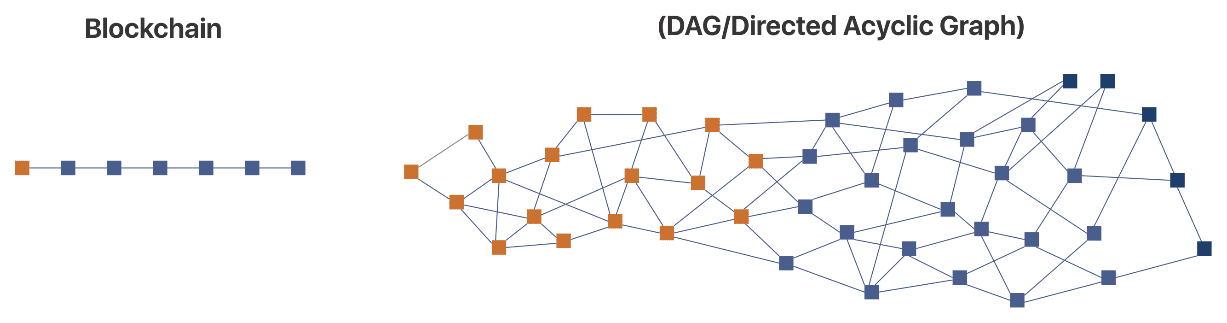
Image by Central Blockchain Council.
This structure substantially reduces the time needed for transaction confirmation and increases the network’s ability to handle high transaction volumes. DAG technology is known for its low transaction fees and high scalability, making it an attractive choice for applications requiring fast and efficient transaction processing.
Parallelized EVMs offer distinct advantages over DAG, however, particularly in the context of Ethereum-based applications. While DAG excels in transaction speed and scalability, it does not inherently support smart contracts and decentralized applications in the same way Ethereum does.
They retain the robust smart contract capabilities of Ethereum while enhancing scalability and efficiency through parallel processing. This makes them particularly suitable for complex decentralized applications that require both smart contract functionality and high transaction throughput.
Additionally, parallelized EVMs maintain compatibility with the Ethereum ecosystem, which is a critical consideration for developers and users already entrenched in Ethereum-based applications. This compatibility ensures a smoother transition and integration for existing dApps, which is a challenge in DAG-based systems that often require major modifications to existing applications.
Spotlight on Projects Developing Parallelized EVMs
The evolution of parallelized EVMs is not occurring in isolation. Several projects are leading the charge of this technological shift, each contributing unique insights and advancements to the blockchain world. Three such projects—SEI, Neon EVM, and Monad—are working to integrate the technology into their platforms, setting new benchmarks in blockchain scalability and efficiency.
SEI v2’s Parallelized EVM Update
SEI Network is gearing up for a big leap forward with its version 2 (v2) update, scheduled to enter testnet in Q1 2024. SEI v2 will integrate a parallelized EVM, marking a synergistic blend of Solana’s high-performance capabilities with the extensive tooling and community support inherent to Ethereum.
The anticipation surrounding SEI v2 is heightened by its projected transactional throughput of 20,000 TPS and a transaction finality time of 380 milliseconds. These anticipated metrics suggest that SEI v2 could handle substantial transaction volumes both swiftly and securely.
I’m hearing parallelized EVM are hot right now, just gonna leave this here… pic.twitter.com/jGCjE07R0f
— 0xAmishMagic (@MagicAmish) December 23, 2023
A key aspect of SEI v2 is its commitment to backward compatibility, which is expected to facilitate the smooth migration and continued operation of existing Ethereum-based applications.
Additionally, SEI v2 plans to introduce SeiDB, a novel data structure designed to enhance the platform’s performance. This development is particularly relevant in addressing the issue of state bloat, a challenge that has been a concern in blockchain networks. SeiDB’s role in potentially improving the overall performance and scalability of the SEI network could be a critical factor in its adoption and success.
Neon EVM: Bridging Ethereum and Solana
Neon EVM distinguishes itself as the first EVM compatible with Solana, leveraging Solana’s parallel processing capabilities. This unique fusion allows Neon EVM to offer Ethereum developers the benefits of Solana’s network, such as low fees, high transaction speeds, and parallel execution, without requiring big changes to their existing Solidity or Vyper-based dApps.
I’d love to see @aave and other foundational EVM products launch on @Neon_EVM.
this parallelized EVM has been in development for a long time. it should be seriously considered amongst alternative L1’s coming up that will share no benefits of @solana’s battle hardened infra. https://t.co/FTd6VLqUZJ
— raj 🖤 (@rajgokal) December 27, 2023
The integration with Solana ensures stable transaction costs and takes advantage of the high throughput and swift block speeds inherent to Solana’s architecture.
Monad: The Future of Ethereum-Compatible Blockchains
Monad represents the next step in Ethereum-compatible Layer 1 blockchains. Currently in development, with a testnet launch anticipated in Q1 2024, Monad seeks to balance decentralization with scalability, targeting a throughput of 10,000 transactions per second.
Its compatibility with Ethereum’s Virtual Machine means that developers familiar with Ethereum can easily transition to Monad. The platform’s design incorporates various optimizations, such as MonadBFT and Deferred Execution, to boost performance.
Additionally, Monad’s architecture will support asynchronous, parallel execution of EVM transactions, enhancing its processing capabilities and positioning it as a potential game-changer in the blockchain space.
Contrary to popular belief, parallel execution is not what brings the ultimate performance enhancement.
You first need to build a custom database that enables parallel access to state.
Custom Database + Parallel Execution = Monad
— Keone (evm/acc) (@keoneHD) December 20, 2023
A New Chapter in Blockchain Technology
The advent of parallelized Ethereum Virtual Machines (EVMs) marks a key moment in the evolution of blockchain technology. This leap forward is not just a technical upgrade; it signifies a major shift in how blockchain networks can operate, enhancing scalability, reducing fees, and improving overall performance.
The transition from sequential to parallel processing in EVMs addresses critical challenges that have long been barriers to broader blockchain adoption.
Parallelized EVMs bring about a transformative change for both developers and users. For developers, the shift necessitates a strategic approach to smart contract and data structure design, emphasizing the importance of architectural planning in maximizing the benefits of parallel processing. For users, this technological advancement translates to faster, more efficient transactions and an enhanced overall experience.
Projects like SEI, Neon EVM, and Monad are leading this technology, each contributing uniquely to the development of parallelized EVMs.
From decentralized finance (DeFi) to gaming applications and beyond, the ability to process transactions concurrently rather than sequentially means these applications can operate more smoothly and at a scale previously unattainable.