

Bitcoin climbed back above $65,000 earlier today, ending weeks of intense selling pressure after a sudden diplomatic breakthrough between the United States and Iran lifted a major geopolitical cloud over global financial markets.
Data from CryptoSlate shows that the flagship digital asset rose more than 3% to $65,940, but has since fallen back slightly to $65,668 at the time of writing. Ethereum, the second largest cryptocurrency by market cap, also rose to $1,724 at the time of writing.
The market reversal followed a weekend announcement from President Donald Trump saying a peace deal to end the three-month-old conflict in the Middle East had been finalized.
The deal includes the immediate lifting of the US naval blockade and the reopening of the Strait of Hormuz, a crucial maritime chokepoint through which about 20% of the world’s crude oil supply passes.
The framework for the peace deal, brokered by Pakistan, is expected to be formalized at an official signing ceremony in Switzerland on June 19.
Shehbaz Sharif, the Prime Minister of Pakistan, confirmed the resolution. said:
“After intensive discussions, we are pleased to announce that the peace agreement between the United States of America and the Islamic Republic of Iran has been ACHIEVED. Both sides have declared the immediate and definitive cessation of military operations on all fronts, including in Lebanon.”
After confirmation, the announcement quickly spread across several asset classes. Oil prices fell, stock futures rose and crypto markets rallied as traders unwound some of the war bounty built up since the conflict began in late February.
Facts from oilprice.com showed West Texas Intermediate crude fell nearly 5% to around $80 a barrel, while Brent crude fell below $84. Both benchmarks had risen above $110 earlier in the conflict as traders priced in the risk of a prolonged disruption to energy flows.
The drop in crude oil prices helped ease concerns that a new energy shock would fuel inflation and force central banks to tighten policy for longer. That shift gave risky assets, including Bitcoin, room to recover.
Yet the recovery remains fragile. The Iran deal removed an immediate macro stressor, but also shifted the market’s focus to the Federal Reserve, where newly appointed Chairman Kevin Warsh has his first policy meeting this week.

The selling pressure is starting to subside
Bitcoin’s recovery wasn’t just driven by macroeconomic relief, as on-chain and fund flow data indicate that some of the forced selling that weighed on the market earlier this month has started to cool.
Data from SoSoValue shows that US spot Bitcoin ETFs recorded outflows of $316 million last week, marking a notable slowdown after more than $5 billion disappeared from the funds in the past four weeks.
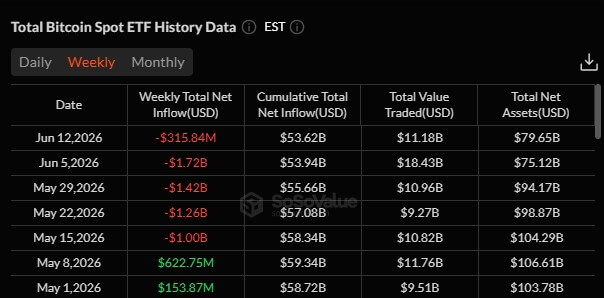
That easing became more apparent last Friday, when the funds posted net inflows of $85 million, the strongest single-day positive inflows in more than three weeks.
The reversal suggests that Wall Street’s aggressive reduction of long exposure to Bitcoin may have reached a point of temporary exhaustion.
CryptoQuant facts points to a similar shift among large agricultural companies. The company said pressure on whale sales eased as large portfolios appeared to absorb supply near recent lows.
The price-earnings ratio rose to 62.3% during the drawdown, indicating that large holders accounted for a larger share of the stock market activity as Bitcoin neared the bottom of its recent range.
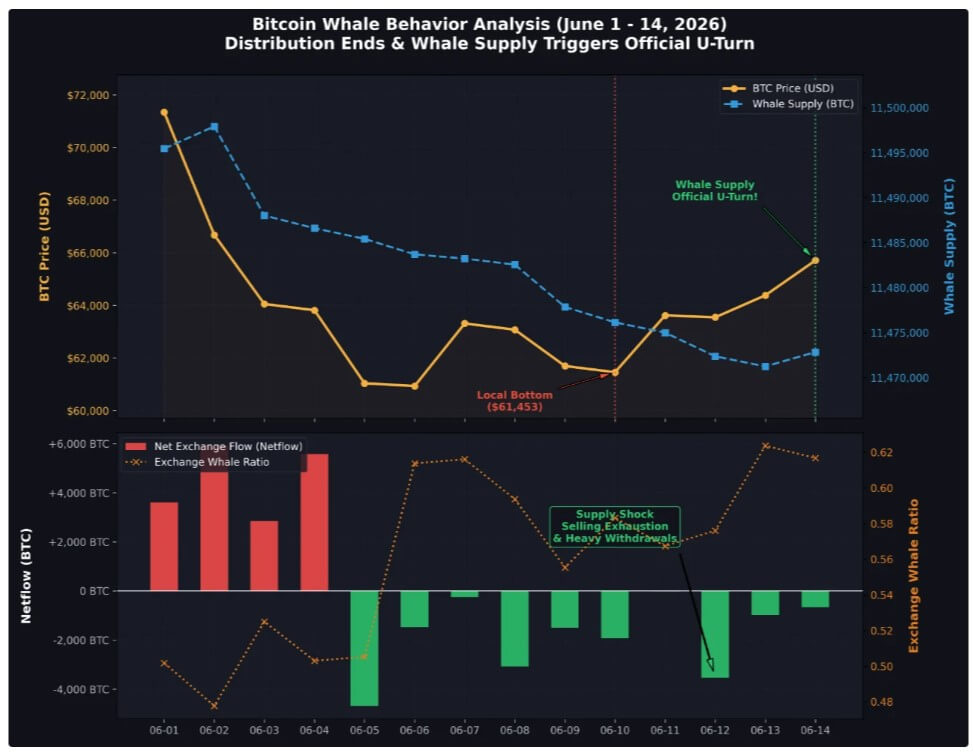
The shift was followed by a wave of withdrawals from trading platforms. According to CryptoQuant, more than 11,400 BTC, worth approximately $750 million at current prices, have been moved from exchanges to cold storage. By June 14, the total supply of wallets holding at least 100 BTC had reversed a 12-day decline.
These signals suggest that Bitcoin has turned away from its most aggressive phase of forced selling towards a more balanced structure.
This is important because the recent decline was amplified by weak liquidity, ETF outflows and derivatives positioning. When these pressures begin to ease and macro conditions improve, relief meetings can take place quickly.
Bitcoin must convert aid into demand
For Bitcoin, the next few sessions will reveal whether today’s move marks the start of a broader recovery or another short-lived stabilization rally.
The derivatives market could help determine that outcome.
Crypto research firm 10X Research said Bitcoin’s previous break below $70,000 led to forced selling by options traders who were short around that level. As prices fell, dealers had to sell more of the underlying asset to hedge their exposure, adding to the downward pressure.
That positioning has now shifted downward. According to the company, the largest negative gamma strike on the board, worth approximately $1.8 billion, is now close to Bitcoin’s current spot price.
The arrangement could cut both ways. If Bitcoin fails to maintain current levels, hedging by dealers could bring new pressure.
However, if the market moves higher, the same mechanisms that exacerbated the selloff could force dealers to buy, amplifying the recovery.
The signal is especially important as the implied volatility of key crypto assets has fallen below the realized volatility. In fact, the options markets are pricing in less movement than Bitcoin has recently delivered.
That leaves the market vulnerable to sharp price revisions if this week’s macro events surprise traders.
The $65,000 level is now the immediate line to watch. If Bitcoin can hold above that range and rise toward $68,000 to $70,000 on stronger spot market demand and improving ETF flows, the market would have a stronger case for a sustained recovery.
However, a move back below $62,000 would weaken that setup and bring the $60,000 region back into focus.