

Crypto analyst Will Taylor, known as Cryptoinsightuk on His latest chart of XRP.D charts a potential long-term move toward 31.26% dominance, well above the current area of nearly 3.315%.
Taylor’s argument focuses on market structure rather than short-term sentiment. The chart shows XRP dominance above a key horizontal level around 3.315%, after breaking a multi-year range and failing to fully reach the 6.127% area. The weekly setup then compresses into a falling wedge, with the analyst suggesting that the retracement has not yet wiped out the broader breakout.
“Looking at $XRP.D, I’m still struggling to feel bearish here,” says Taylor wrote. “What I think we’re seeing is: a completed Wyckoff accumulation, a breakout above key resistance at 3.315%, a failed attempt to completely break the 6.127% high, and then a pullback into a compressed falling wedge.”

The road to 31% market dominance for XRP
The chart presents 6.127% as the next high in the range, while 31.26% is much higher on the dominance scale as a possible upside target. This framing implies an aggressive expansion of XRP’s share of the overall crypto market if the analyst’s follow-up thesis comes to fruition. It doesn’t just take XRP to rise in isolation; Its dominance could also increase if XRP outperforms other major crypto assets during a broader rotation.
Related reading
Taylor’s focus is on the behavior after the failed 6.127% push-through. Instead of seeing the rejection as evidence of distribution, he described the current structure as compression. According to him, a decisive bearish collapse would likely look different, with stronger downward momentum and heavier selling pressure.
“To me that is important,” he said. “Because falling wedges are often reversal/continuation structures, especially when accompanied by declining volume. If sellers were truly in control, I would expect increasing downside volatility and aggressive selling volume, not compression.”
The chart also includes the RSI, which is trending lower in addition to the price compression. Taylor argued that this does not mean complete structural collapse. Instead, he said the indicator appears to be compressing into its own downtrend while XRP dominance remains above the breakout zone.
That distinction is central to his dissertation. A market that breaks out, pushes off at higher resistance and then consolidates above the previous resistance can still be considered constructive, provided the previous breakout level is defended. In this case, the 3.315% zone is the main reference point. A continued loss of that area would weaken the continuation argument, while a breakout from the wedge could bring the 6.127% high back into focus.
The Wyckoff theorem
The Wyckoff labels on Taylor’s chart are central to the bullish value. The structure marks a long accumulation streak, starting with preliminary support, or PS, followed by a selling climax and secondary test around the 2020-2021 lows. The subsequent automatic rally, secondary test and ‘spring’ are presented as the base-building phase before XRP dominance regained higher ground.
Related reading
From there, the chart identifies a move across the “creek,” a Wyckoff term often used to describe the move out of an accumulation range, followed by a sign of strength near the 6.127% high. The final pullback is labeled an LPS, or final support point, which in the Wyckoff analysis is typically viewed as a potential higher-low area before continuation.
That makes the 31.26% mark more than a casual upward arrow in Taylor’s box. The chart effectively argues that XRP’s dominance has shifted from accumulation to markup, with the current falling wedge serving as a potential consolidation above the breakout zone rather than evidence of demand failure. The bullish case depends on that LPS interpretation; If the structure were to break back below the 3.315% recovered level, the Wyckoff continuation thesis would be harder to defend.
Taylor also framed the lineup as one that may need a catalyst. “It honestly feels like XRP dominance is waiting for a catalyst before taking another step higher,” he wrote. “I know this goes against much of the current sentiment and market interpretation, but I would like to hear the bearish argument structurally here as I still see more signs of bullish continuation than full distribution at this point.”
The 31.26% mark gives the chart the most striking implication, but the more technical question is whether XRP dominance can continue to hold the recovered 3.315% level and resolve the wedge to the upside. For now, Taylor’s interpretation is clear: the structure has retreated, but he says it hasn’t broken yet.
At the time of writing, XRP was trading at $1.36.
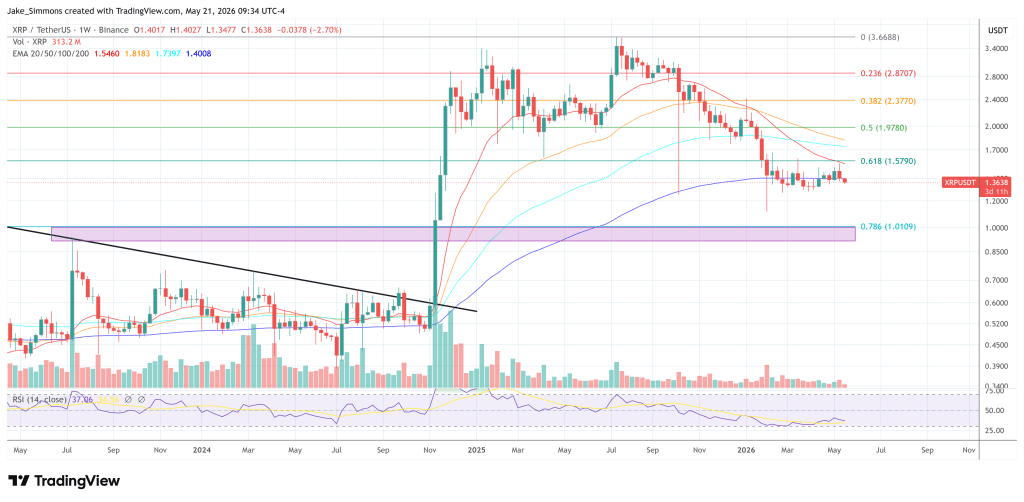
Featured image created with DALL.E, chart from TradingView.com