Close Menu
  • News
    • Bitcoin
    • Altcoins
    • DeFi
    • Market Cap
  • Blockchain
  • Web 3
    • NFT
    • Metaverse
  • Regulation
  • Analysis
  • Learn
  • Blog
What's Hot

How Does Quant Network Connect Blockchains That Were Never Built to Communicate?

2026-06-26

Examining whether STABLE’s uptrend is sustainable after the latest 5% price increase

2026-06-26

Mantle Brings Franklin Templeton ETF On-Chain and Drives RWA Tokenization on Ethereum L2s

2026-06-26
Facebook X (Twitter) Instagram
  • Contact
  • Terms & Conditions
  • Privacy Policy
  • DMCA
  • Advertise
Facebook X (Twitter) Instagram
Bitcoin Platform – Bitcoin | Altcoins | Blockchain | News Stories Updated Daily
  • News
    • Bitcoin
    • Altcoins
    • DeFi
    • Market Cap
  • Blockchain

    How Does Quant Network Connect Blockchains That Were Never Built to Communicate?

    2026-06-26

    Mantle Brings Franklin Templeton ETF On-Chain and Drives RWA Tokenization on Ethereum L2s

    2026-06-26

    Crypto Critic Roubini Joins the Tokenization Boom with Onchain ‘Technodollar’

    2026-06-25

    Allfunds expands access to tokenized funds to Solana, with a $1.8 trillion network

    2026-06-25

    Chainlink partners with 47 South Korean and European banks to speed up international money transfers

    2026-06-25
  • Web 3
    • NFT
    • Metaverse
  • Regulation

    Russia Creates Crypto Sanctions Loophole, But Payout Routes Remain Shielded

    2026-06-26

    Why Europe is struggling to give Binance the MiCA license it needs

    2026-06-25

    Cynthia Lummis promised the CLARITY Act in July, but it still needs a path in the Senate

    2026-06-25

    Crypto finally has a CLARITY Act date

    2026-06-24

    The US Treasury Department’s $10 billion scam alert shows why crypto is rushing itself into the police force

    2026-06-24
  • Analysis

    Solana reaches $1 billion in weekly tokenized stock trading as demand for hard-to-access stocks rises

    2026-06-25

    Bitcoin’s $60,000 Recovery Just Collapsed as $427 Million in Long-Term Liquidations Follow Stubborn Inflation Data

    2026-06-25

    Goldman Sachs Lists Three Reasons Why $700,000,000 in IPOs and Follow-on Issues Won’t Overwhelm the Stock Market

    2026-06-25

    Tokenized Shares of SpaceX Betting on More than $50 Million in Liquidations as Crypto Leverage Hits Wall Street

    2026-06-25

    US Bitcoin buying turns negative as BTC moves closer to the $57,300 liquidation trap

    2026-06-24
  • Learn

    Most Profitable Crypto to Mine in 2026: Best Altcoins for Mining

    2026-06-23

    Bitcoin Alternatives: Our Top Altcoin Picks for You in 2026

    2026-06-23

    What Is a Bull Flag Pattern in Crypto and How to Use It

    2026-06-20

    What Is OTC Trading? Over-the-Counter Trading Explained

    2026-06-20

    The Top 10 Bitcoin Wallets in 2026

    2026-06-20
  • Blog
Bitcoin Platform – Bitcoin | Altcoins | Blockchain | News Stories Updated Daily
Home»Regulation»Russia Creates Crypto Sanctions Loophole, But Payout Routes Remain Shielded
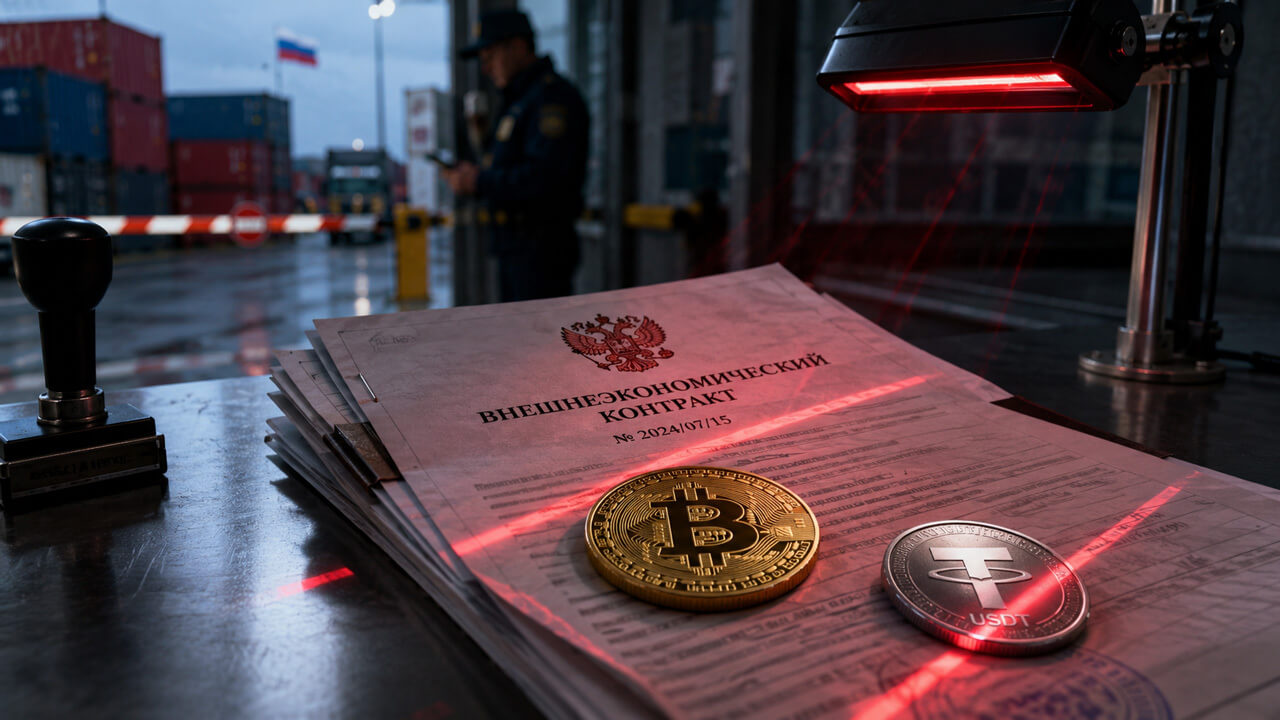
Bitcoin and USDT beside Russian foreign trade documents under customs inspection, illustrating the use of digital currencies in cross-border settlements and international trade under Russia's experimental legal regime.
Regulation

Russia Creates Crypto Sanctions Loophole, But Payout Routes Remain Shielded

2026-06-26No Comments7 Mins Read
Share
Facebook Twitter LinkedIn Pinterest Email

Russia has turned its cryptocurrency foreign trade regime into a live test of how far sanctions pressure can extend beyond banks.

The Bank of Russia says selected exporters and importers will be allowed to use cryptocurrencies for cross-border settlements under foreign trade agreements, but only within an experimental legal regime.

Moscow has created a state-backed corridor for select trade payments, while infrastructure surrounding digital asset flows remains exposed to sanctions. The Federal Law No. 223-FZ profile registers the same limit: selected digital currency payments under foreign trade contracts, with participants and limits established by the ELR.

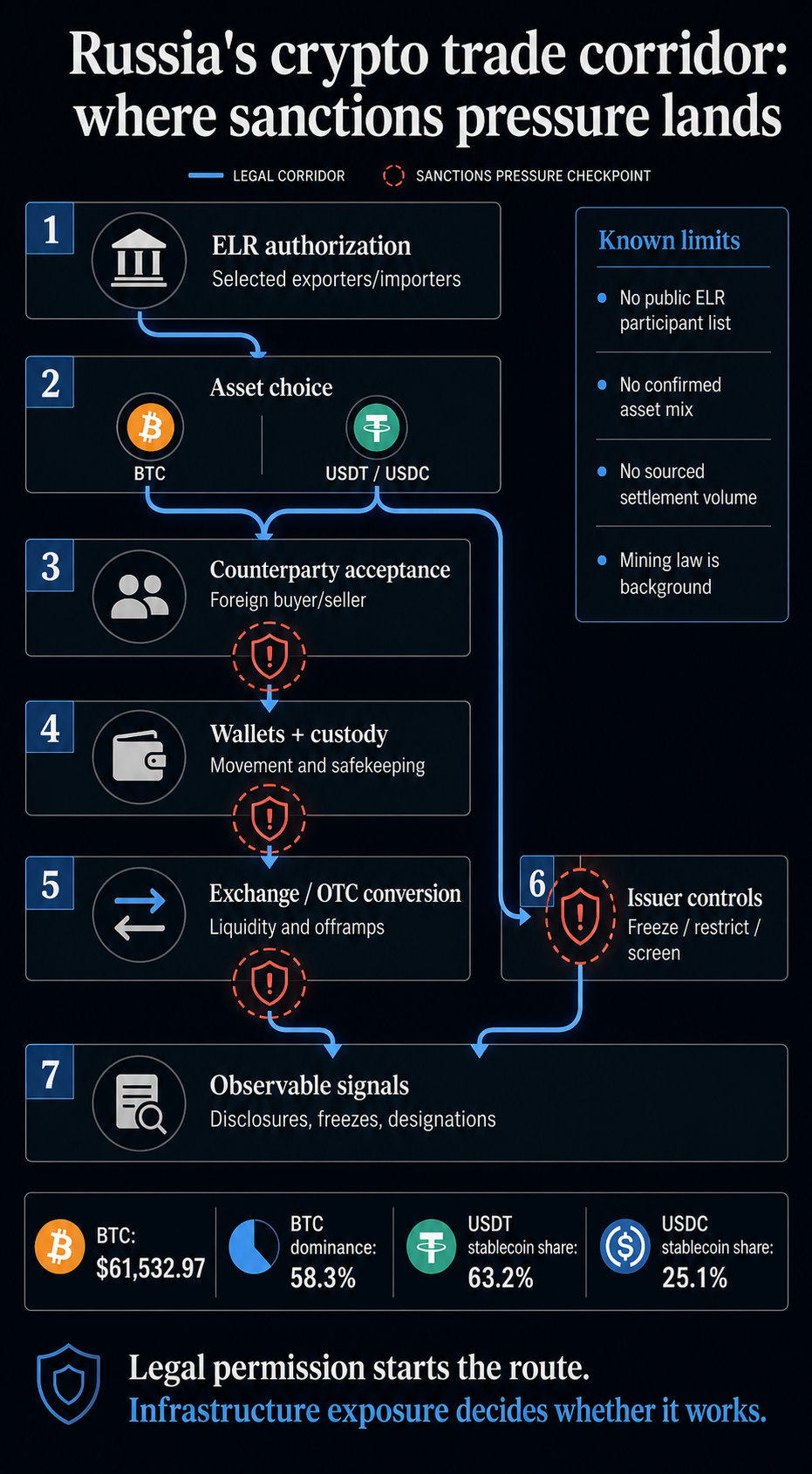
Russia can legalize certain crypto settlements within its own framework. The usefulness of the corridor still depends on counterparties, wallets, exchanges, issuers, custodians, liquidity providers and compliance controls that may be beyond Russia’s control.

A legal corridor with external bottlenecks

The corridor provides a formal route for a Russian exporter or importer to test digital assets in cross-border trade, especially where conventional banking has become slower, more expensive or unavailable.

The legal change shifts crypto settlement from an unofficial solution to a controlled experiment for select foreign trade payments.

A trade payment still requires more than domestic consent. A buyer and seller must agree on the settlement asset. Someone has to acquire liquidity, move the asset, store it and convert it into usable value.

If the asset is a dollar-backed stablecoin, the route may face issuer controls or issuer-linked restrictions. If it’s Bitcoin, the route avoids an issuer but still relies on counterparties, analytics, exchanges, custodians, brokers, and offramps before or after the blockchain transfer.

This makes the ELR both a question about market structure and a legal issue. A sanctioned economy can create domestic legal space for the settlement of crypto trading, while each service provider in that payment path must evaluate its exposure to sanctions.

The operational question is whether companies outside Russia’s regulatory perimeter view the corridor as an acceptable settlement route, a compliance risk or a path to be avoided.

See also  Kamala Harris' crypto stance: Democratic senator promises 'sensible legislation'
Settlement step Which changes the course Where sanction pressure can land
Russian legal consent Selected companies can use crypto in the context of foreign trade agreements within the ELR. Participant limits, permitted transaction types and regulatory oversight.
Asset selection Bitcoin can offer issuer-free settlement; stablecoins can offer simpler dollar accounting. Exchange access, liquidity pools, stablecoin issuer controls and wallet tracking.
Acceptance by the opposing party Foreign sellers or buyers must be prepared to receive or route the asset. Secondary sanctions risk, compliance policies and banking or exchange relationships.
Conversion and exits Crypto usually has to become a usable currency or asset somewhere along the chain. OTC desks, exchanges, custodians, payment companies and compliance screening.

Infographic showing the Russian crypto trading corridor, from ELR authorization to asset selection, counterparties, wallets, conversion, issuer controls and observable sanctions signals.Infographic showing the Russian crypto trading corridor, from ELR authorization to asset selection, counterparties, wallets, conversion, issuer controls and observable sanctions signals.

The Russian mining framework provides background for this legal stack, rather than for the analysis of trade settlement itself. The profile of Federal Law No. 221-FZ illustrates how Russia has established rules for digital currency activities.

It shows the broader legal framework, but does not provide evidence of domestic payment authorization on a large scale or the volume of foreign trade settlement under the ELR.

Where sanction pressure lands

The U.S. Treasury Department’s Virtual Currency Sanctions Guidelines then determine the enforcement framework. Digital asset companies are expected to screen for sanctioned activity, block prohibited transactions and enforce controls even if the payment method is crypto.

That framework makes the Russian corridor an issue for any company that might come into contact with a settlement route.

The Treasury Department has already placed Russia-linked crypto infrastructure within sanctions limits. Action against it in 2022 Garantex focused on a Russian virtual currency exchange.

CryptoSlate’s previous coverage of Garantex-linked enforcement provides context on the service provider. Recent sanctions around stablecoin routes and Russian crypto services point in the same direction: enforcement follows the route, the location and the intermediary as well as the bank account.

American and European authorities dismantle Garantex as part of the fight against money launderingAmerican and European authorities dismantle Garantex as part of the fight against money laundering
Related reading

American and European authorities dismantle Garantex as part of the fight against money laundering

US authorities have seized $26 million in illicit assets in the operation targeting Russia-linked crypto exchange Garantex.

See also  Crypto Exchange Executives and 29 Other People Accused of $24,560,000 Fraud in Taiwan: Report

March 8, 2025 · Assad Jafri

The available record does not provide a public list of approved ELR participants, asset mix, counterparties or settlement scale. This absence supports a cautious conclusion.

The corridor is legally real, but current sources support a struggle for compliance rather than a claim of visible large-scale adoption. If counterparties and service providers decide that sanctions exposure is too high, the route may remain limited or symbolic.
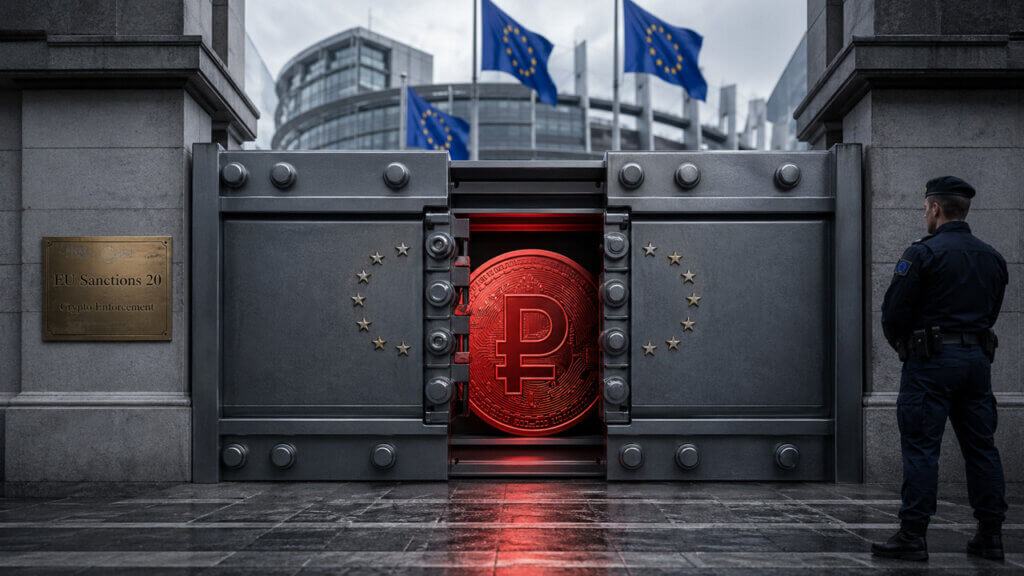
EU sanctions are pushing deeper into Russia's crypto rails with a ban on supporting digital rublesEU sanctions are pushing deeper into Russia's crypto rails with a ban on supporting digital rubles
Related reading

EU sanctions are pushing deeper into Russia’s crypto rails with a ban on supporting digital rubles

The new package goes beyond just named exchanges, bringing Russia-linked stablecoins, platforms and settlement agents within its scope.

April 27, 2026 · Liam ‘Akiba’ Wright

If willing counterparties and offshore liquidity persist, the corridor will become a practical test of how far sanctions controls can reach into crypto infrastructure.

CryptoSlate daily briefing

Daily signals, no noise.

Market-moving headlines and context, read in one sitting every morning.

5 minute summary 100,000+ readers

Free. No spam. You can unsubscribe at any time.

Oops, looks like there’s a problem. Please try again.

You are subscribed. Welcome aboard.

Bitcoin and stablecoins emphasize that system in different ways. Bitcoin does not have an issuer that can freeze a token at the contract or account layer.

The Bitcoin market price at the time of writing is around $59,300, with a market dominance of approximately 58.3%, making it an obvious benchmark for a state studying non-bank settlements.

The design also means that there is no company between the sender and the recipient, unlike a stablecoin issuer. That issuer-free design still leaves practical bottlenecks. Commercial settlement requires liquidity, counterparties, custody choices and eventual conversion.

A BTC transfer can take place peer-to-peer, while a trade route often touches exchanges, brokers, analysis tools, wallets, custodians or banks at some point in the transaction. Sanctions compliance may reappear on these interfaces.

See also  CFTC Chairman Rostin Behnam Disagrees with Gary Gensler on the State of Digital Asset Regulation

Stablecoins solve another trading problem. A dollar-referenced token may be easier to price than the volatile BTC. Therefore, settlement talks quickly move to USDT and USDC, which hold 63.2% and 25.1% in stablecoin dominance, respectively.

Circle’s USDC terms strengthen the issuer’s point of control: stablecoin access is within contractual and sanctions compliance frameworks.

OFAC targets Kyrgyzstan-based companies and stablecoins for violations of Russian sanctionsOFAC targets Kyrgyzstan-based companies and stablecoins for violations of Russian sanctions
Related reading

OFAC targets Kyrgyzstan-based companies and stablecoins for violations of Russian sanctions

Kyrgyzstan-based companies are under scrutiny for facilitating Russian sanctions through stablecoins.

August 14, 2025 · Assad Jafri

The trade-off is clear. Bitcoin may be harder to stop at the asset layer, but it may be less useful for invoices and conversions. Stablecoins may be easier for dollar accounting, but issuer controls such as freezes, exchange rate restrictions and screening requirements can leave them more exposed to direct compliance actions.

The Russian corridor will be determined by which of these restrictions approved participants and counterparties can absorb.

Signals that determine the value of the corridor

The next actionable evidence will be operational, not just legal. The Bank of Russia’s announcements about participants or transaction types would reveal whether the ELR is expanding beyond its policy framework.

Named counterparties, repeated settlement routes, exchange or OTC restrictions, wallet freezes, actions by stablecoin issuers, new sanctions, and changes in the way non-Russian companies handle ELR exposure would all outweigh generic crypto market moves.

We are now looking at whether the corridor produces observable behavior from counterparties and infrastructure providers.

The Russian trade corridor is now both a market structure test and a sanctions story. Moscow can create legal space for select companies to regulate foreign trade in crypto, while Western enforcement can try to make the surrounding infrastructure unusable, risky or expensive.

The outcome will depend less on the existence of the ELR and more on whether the payment path survives contact with the networks that make crypto commercially useful.

Source link

Creates Crypto Loophole payout remain routes Russia sanctions Shielded
Share. Facebook Twitter Pinterest LinkedIn Tumblr Email

Related Posts

Crypto Critic Roubini Joins the Tokenization Boom with Onchain ‘Technodollar’

2026-06-25

Why Europe is struggling to give Binance the MiCA license it needs

2026-06-25

Cynthia Lummis promised the CLARITY Act in July, but it still needs a path in the Senate

2026-06-25

Bitcoin Falls Below $60,000 as ETF Outflows and $1.48 Billion Liquidations Fuel Crypto Selloff

2026-06-25
Add A Comment

Comments are closed.

Top Posts

Wall Street and gold are breaking records, while Bitcoin is catching up

2026-01-27

Major League Soccer launches ‘MLS Quest’ collectibles on Sui

2024-10-28

Bitcoin: What Drives BTC’s Price Stability Despite $111 Million Liquidations?

2026-04-06
Editors Picks

XRP – Price Slips again – is a deeper correction underway?

2025-05-30

Proofpoint sets an innovative precedent for source-agnostic research into modern enterprises

2026-05-06

Bitcoin – Price consolidates – Is a narrow correction on the horizon?

2025-07-22

Bitcoin Bulls continue to struggle, this is why the benefits may be limited

2023-09-07

Our mission is to develop a community of people who try to make financially sound decisions. The website strives to educate individuals in making wise choices about Cryptocurrencies, Defi, NFT, Metaverse and more.

We're social. Connect with us:

Facebook X (Twitter) Instagram Pinterest YouTube
Top Insights

How Does Quant Network Connect Blockchains That Were Never Built to Communicate?

Examining whether STABLE’s uptrend is sustainable after the latest 5% price increase

Mantle Brings Franklin Templeton ETF On-Chain and Drives RWA Tokenization on Ethereum L2s

Get Informed

Subscribe to Updates

Get the latest news and Update from Bitcoin Platform about Crypto, Metaverse, NFT and more.

  • Contact
  • Terms & Conditions
  • Privacy Policy
  • DMCA
  • Advertise
© 2026 Bitcoinplatform.com - All rights reserved.

Type above and press Enter to search. Press Esc to cancel.