
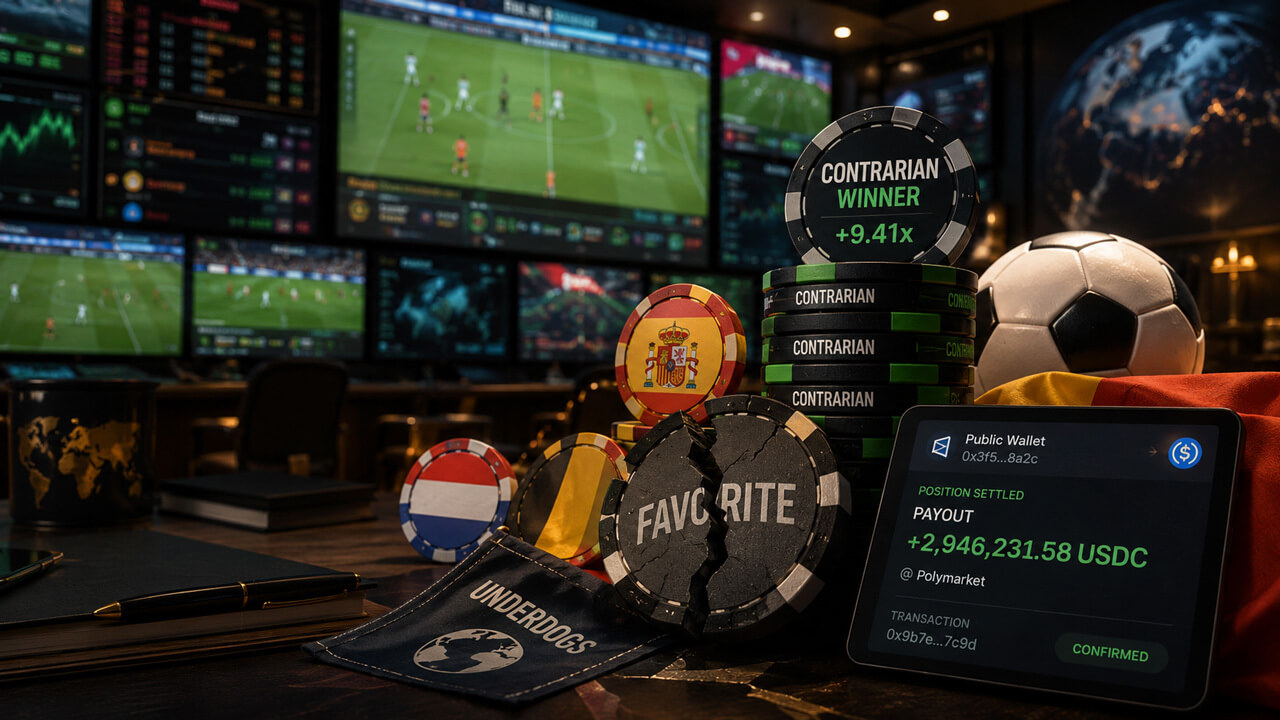
Spain controlled the ball for almost 75% of the match and fired 27 shots into the Cape Verde goal on June 14, a statistic that usually ends in a victory.
Cape Verde’s 40-year-old goalkeeper Vozinha walked away with player of the match honors after a 0-0 draw that cost Polymarket punters millions and made an obscure wallet around $9 million richer in one day.
The wallet belongs to an account called fish-alivewhich joined Polymarket in June 2026 and has made exactly two recorded predictions.
The account cashed out about $4.7 million on a “Spain Not to Win” contract and another $8.5 million on a Cape Verde +2.5 spread, turning about $400,000 in stakes into a profit of almost $9 million.
Polymarket Sports reports this a $400,000 bet at 9% odds, $4,702,769.23 was paid out. The size, timing and newness of the account are attracting attention online, with some commentators noting that a $4.5 million position was landed just eight minutes before kick-off.
A brand new wallet read Cape Verde’s odds better than the market, and Polymarket’s ledger allowed everyone to see the payout country in real time.
| Position / metric | Reported amount | What it shows |
|---|---|---|
| Bet on “Spain will not win” | ~$400,000 | fishalive’s contrarian entry with odds of around 9% |
| Payout on “Spain not to win” | $4,702,769.23 | The draw meant Spain failed to win, so the contract was paid out |
| Payout on Cape Verde +2.5 spread | ~$8.5 million | Cape Verde easily capped the match by drawing 0-0 |
| About. one day profit | ~$9 million | The combined benefit of betting on Spain to win |
| Implied position of the Spanish gambler | ~$1 million risked a profit of ~$85,000 | Shows the other side: big favorite, slim lead, total loss if drawn |
Polymarket’s World Cup winners market alone has recorded a volume of $2.46 billion, with France leading the pack with around 17.6%, Spain next with around 13.9%, and Portugal and England following closely behind with around 10.8% and 10.5% respectively.
The contract expires around July 20 and Polymarket says the broader 2026 World Cup line-up includes 362 active markets, bringing in more than $2.5 billion.
That scale turns individual matches into standalone financial events, and the Spain game itself brought in about $64 million in business.
Favorites keep losing
A trader identified as betoor619 backed Spain to win at around 92% implied odds, risking almost $1 million for a potential profit of only around $85,000, and the draw completely erased the position.
Polymarket Sports had captured the lineup days earlier when it was a separate user placed $1 million on Spain to beat Cape Verde, resulting in a payout of $1,085,943.48. Cape Verde held its line during stoppage time and took the first World Cup point in its history, deflating both positions in one go.
The pattern repeated itself within 24 hours, as Inc. reported that a trader named FlickRaw lost about $4.2 million betting $2.7 million on the Netherlands to beat Japan, and then $1.5 million on Belgium to beat Egypt.
Japan equalized twice, including a goal in the 88th minute that finished the match at 2–2. Belgium conceded against Egypt in the 19th minute and settled for a 1-1 draw, despite tying the match in the 66th minute.
| Trader | Favorite supported | Stake | Potential payout | End result | What went wrong? |
|---|---|---|---|---|---|
| review619 | Spain over Cape Verde | ~$1 million | ~$1.085 million | 0-0 | Draw-killed-win-only bet |
| FlickRaw | The Netherlands over Japan | $2.7 million | $5.83 million | 2-2 | Japan equalized late |
| FlickRaw | Belgium over Egypt | $1.5 million | $2.4 million | 1-1 | Belgium failed to win |
| leeroyjenkins | Belgium over Egypt | $8.6 million | ~$13.1 million | 1-1 | Draw the deleted position |
The same result in Belgium wiped out the largest bet of the tournament so far: a trader named Leeroyjenkins bet $8.6 million on Belgium, a position that would have paid out about $13.1 million if Belgium had won.
Polymarktsport followed the match in real timegiving Egypt a 1–0 half-time lead before confirming the final draw which nullified the bet.
Why now
Spain, the Netherlands and Belgium were the strongest parties on paper, as shown by the shared gambling markets. Win-only positions pay off for just one outcome, and football’s draw speed turns a dominant performance into a worthless ticket the moment the final whistle confirms a tie.
A 92 cent ‘Yes’ share trades with near certainty and then collapses to zero the moment the team it follows fails to score one more goal than its opponent. Fishalive’s two positions worked because a Spain not to win contract and a Cape Verdean spread both paid out on a draw, the very outcome that erased every favorite bet placed that week.
The winners board acts as a sentiment meter, tracking how the public ranks the national teams once the results come in. Match-level contracts act as the viral engine because they resolve in about 90 minutes, generate visible win-and-loss screenshots, and punish poor sizing immediately.
Whales have concentrated their biggest bets on favorites to win outright matches, while the biggest asymmetric payouts come from spreads and ‘no-win’ contracts that explicitly take into account the risk of a draw.
Goldman Sachs’ pre-tournament model had given Spain a 26% chance of winning the tournament, ahead of France at 19%. Polymarket audiences have since repriced France over Spain, a move that immediately followed the Cape Verde result.
The World Cup offers a global audience already fluent in football scores, a compressed group stage schedule that produces a match-driven news cycle every few hours, national team bets that carry emotional weight independent of money, and a settlement structure that turns every big bet into a trackable story ready for screenshots.
These are almost all the ingredients that make a prediction market spread beyond crypto circles.
Two outcomes ahead
World Cup volume continues to increase as the knockout rounds approach, and the combination of public purses, live repricings and emotionally charged national results makes Polymarket a staple of sports media coverage.
The Cape Verde trade and the Belgian wipeouts become the first participants in a tournament that produces a new viral wallet story every few days, with match markets establishing themselves as a faster, more entrenched complement to traditional sportsbooks.
| Scenario | What’s happening | Market signal to watch |
|---|---|---|
| Volume connections | Knockout rounds provide more liquidity, more viral portfolio stories and broader sports media coverage. | Increasing volume in the match market, larger published whale positions, faster repricing after disruptions/draws |
| Whales retreat | Burned traders are reducing the oversized favorite bets and liquidity moves towards spreads, hedges and ‘not to win’ markets. | Lower average favorite bet size, more spread volume, fewer win-only positions with low uptrend |
| The regulatory burden is increasing | CFTC, states, tribes, gaming interests and offshore access questions become part of the tournament story. | More geofencing, enforcement news or exchange rules changes |
A pullback scenario consists of whales getting burned by favorite low-upside bets, such as the Spanish position that risked $1 million for $85,000 in return, while the oversized win-only bets are scaled back, and liquidity migrates to spreads and hedges that already account for draw risk.
Regulatory friction is contributing to the pushback, as the CFTC’s June 10 draft rules aim to formalize federal oversight of prediction markets while recognizing that sports contracts can drive price discovery.
Still, states, tribes and gaming interests are fighting the move, and the American Gaming Association points to survey data showing that 85% of Americans view these contracts as gambling.
Spain itself briefly blocked Polymarket and Kalshi in late May over licensing gaps, turning the narrative away from raw market growth and toward a fight over whether anonymous wallets and sportsbook-sized betting sites belong in the same regulatory category as financial derivatives.
Whether Fishalive is sharp, lucky, or simply too early for structural mispricing in win-only contracts is still an open question, and Polymarket’s ledger won’t solve this alone.
What the ledger does show, match after match, is a direct flow of money from bettors who price with certainty to those who price football.