

BlackRock has updated its regulatory filing for a new Bitcoin Premium Income ETF, signaling an impending launch that intensifies a Wall Street race against Goldman Sachs Group to capture yield-seeking digital asset investors.
On June 10, the world’s largest asset manager submitted an update prospectus to the Securities and Exchange Commission (SEC) for the iShares Bitcoin Premium Income ETF, which will trade under the ticker BITA.
The amendment introduces key operational and pricing parameters, including an annualized sponsorship fee of 0.65% that will be payable at least quarterly.
The fee positions BITA as a higher-priced alternative to mainstream Bitcoin funds, such as BlackRock’s own iShares Bitcoin Trust (IBIT).
Yet this fee is significantly below the fee structures typical of larger equity-based covered call ETFs currently operating in traditional financial markets.
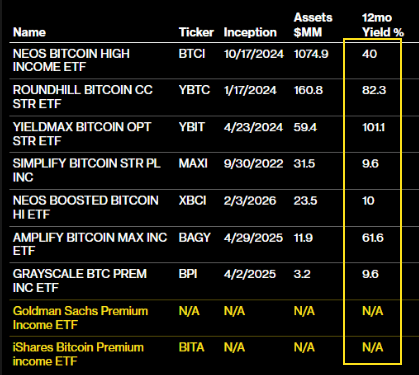
Meanwhile, Bloomberg Intelligence ETF analyst Eric Balchunas said the entry likely represents the final structural adjustment before the fund receives regulatory approval to begin public trading.
A look into the mechanisms of start-up capital and trust
The updated registration statement provides an operational view of the fund’s initial financial position, filling in several key figures that were omitted from the initial January filing.
The filing notes that an initial seed investor acquired 198,000 shares at $50 per share on June 1, generating $9.9 million in proceeds to establish the trust.
BlackRock deployed that capital to build the fund’s base portfolio on June 9, according to the filing. The trust acquired exactly 109.9630217 Bitcoin in addition to 90,901 shares of IBIT.
At the same time, the fund managers wrote 856 options contracts to initiate the income-generating component of the strategy. Following these transactions, the trust reported a net asset value of approximately $9.99 million, representing an initial net asset value per share of $49.97.
To maintain day-to-day operations, the prospectus notes that the trust plans to meet its ongoing 0.65% sponsorship fee by periodically liquidating portions of its IBIT holdings.
This mechanical design reflects the fund’s mixed composition, simultaneously holding physical Bitcoin, liquid spot ETF shares and cash instruments, while option contracts are written primarily based on the IBIT stock allocation.
The covered call strategy and volatility dynamics
The investment mandate positions BITA as a covered-call Bitcoin ETF designed to track Bitcoin’s fundamental performance while generating premium distributions.
The management team plans to achieve this by selling call options on IBIT shares and, occasionally, on specialist indices that monitor broader spot Bitcoin-listed products.
By selling these options, the fund collects upfront premiums from counterparties seeking exposure to potential upward movements in IBIT’s share price. In exchange for this immediate income stream, the fund gives up its right to capital growth above a predetermined strike price.
BlackRock’s strategy involves maintaining the target transfer level between 25% and 35% of the trust’s total net asset value.
This partial transfer strategy leaves a significant portion of the portfolio unhedged, allowing shareholders to participate in some of Bitcoin’s market rallies while using a smaller segment of the asset base to maintain distribution returns.
For asset allocators, the structure reflects equity-linked income vehicles that have gained substantial market share during periods of limited or moderately positive stock performance.
Cryptocurrency provides a unique underlying asset for this strategy due to its structurally increased implied volatility compared to conventional asset classes such as equities or government bonds. High volatility increases the market price of options contracts, theoretically allowing BITA to reap larger premiums than comparable stock index funds.
However, this income generation model comes with inherent tradeoffs. In a sharp cryptocurrency bull market, the written call options limit the fund’s total return, causing BITA to underperform the underlying spot assets.
Conversely, the strategy provides moderate downside protection during flat or slightly declining market conditions because the premiums collected offset small capital losses.
Goldman Sachs escalates the competitive race
The timing of BlackRock’s amendment intensifies the confrontation with Goldman Sachs, which has put forward its own regulatory framework for a competitive vehicle.
The Goldman Sachs Bitcoin Premium Income ETF is expected to complete the regulatory review process and go into effect in early July.
Although both Wall Street institutions target identical customer groups, their operational frameworks have major differences.
The Goldman Sachs product will not directly hold physical cryptocurrency. Instead, the investment strategy calls for at least 80% of its net assets to be devoted to instruments that provide exposure to Bitcoin, including external spot Bitcoin ETPs, exchange-traded options contracts and a wholly owned subsidiary based in the Cayman Islands.
Additionally, Goldman Sachs plans to implement a more aggressive option underwriting framework. The registration documents show that the expected transfer level for options ranges between 40% and 100% of the total Bitcoin exposure under standard market conditions.
| Function | iShares Bitcoin Premium Income ETF (BITA) | Goldman Sachs Bitcoin Premium Income ETF |
|---|---|---|
| Direct BTC holdings | Yes (mixed with IBIT) | No (uses ETPs and Cayman subsidiary) |
| Target overwrite range | 25% to 35% of NAV | 40% to 100% of exposure |
| Sponsorship/management costs | 0.65% annually | Still to be completed |
| Primary Options Purpose | IBIT stocks and spot Bitcoin indices | Broad Bitcoin ETPs and options markets |
This operational variance could dictate market preferences once both funds are active. Goldman’s broader transfer parameters allow for higher theoretical distribution returns during stagnant market conditions, but expose investors to more extensive upside maximums during sudden Bitcoin market rallies.
On the other hand, BlackRock’s conservative range of 25% to 35% maintains greater capital growth potential at the expense of lower base distribution targets.

Maturation of the Bitcoin Ecosystem
The transition to actively managed, yield-bearing cryptocurrency products marks the second major evolution of the digital asset ETF ecosystem.
The first phase was entirely focused on setting up direct infrastructure, as evidenced by BlackRock’s flagship IBIT, which has accumulated total net inflows of $62 billion since its launch in 2024, according to facts compiled by SoSoValue.
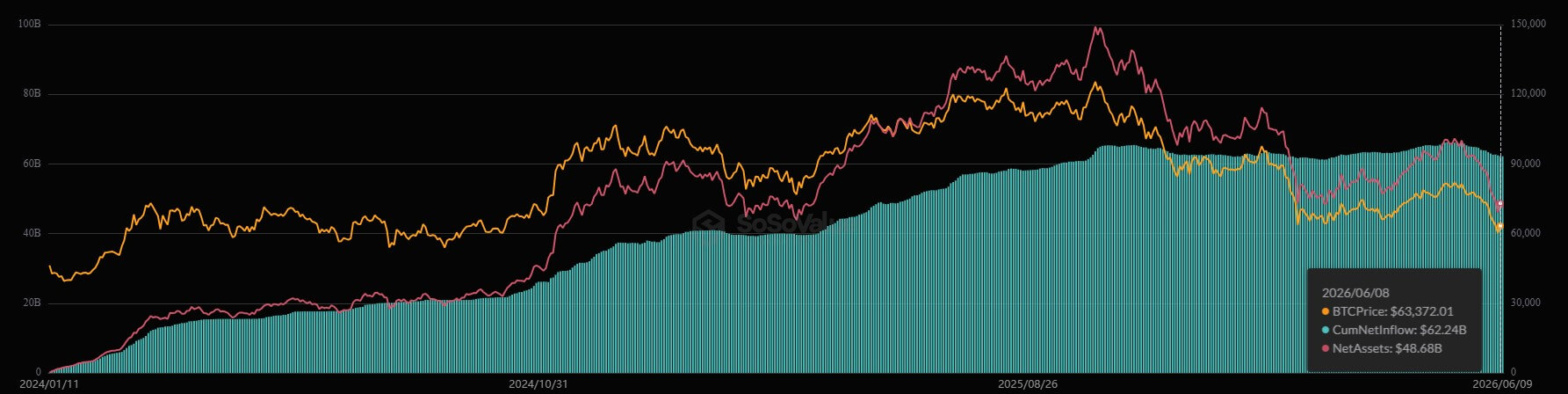
The introduction of BITA and Goldman’s competing product indicates that Bitcoin ETF income is becoming a distinct product category, beyond basic spot exposure.
Wall Street’s asset managers are now focusing on product differentiation to attract risk-averse institutional portfolios and wealth advisory networks that prioritize recurring cash flow over pure speculation.
This emerging segment is not without existing competition. The coming institutional offering will enter a market where specialty issuers have established an early foothold. For example, the NEOS Bitcoin High Income ETF (BTCI) has amassed over $1 billion in assets under management using a similar options-driven returns framework.
Meanwhile, the long-term viability of these premium income vehicles rests on educating investors on the distinction between structural returns and traditional fixed income securities.
The payouts generated by BITA and its peers are derived entirely from option price dynamics and market volatility, not from interest payments or underlying corporate cash flows.
Consequently, distribution rates will fluctuate based on macroeconomic shifts, trading volumes and changing options volatility indices.