

The market has clearly undergone a strong structural shift and the effects are starting to become visible.
In previous risk-off moves, capital was typically converted to Ethereum when Bitcoin encountered resistance, as altcoins still offered better risk-reward opportunities.
Recent whale activity with approximately $92 million in ETH accumulation suggests a similar setup could be forming again. But with the ETH/BTC ratio down nearly 7% this week, ETH is still lagging behind BTC, making the idea of a broad altcoin rally seem a bit exaggerated for now.
That said, capital is not rotating linearly this cycle. Bitcoin’s dominance is stagnating near the 60% resistance zone, with two weeks of steady outflows.
Even if ETH lags, it is quite clear that money is “selectively” rotating into certain altcoins, showing that this structural shift is already unfolding in real time.
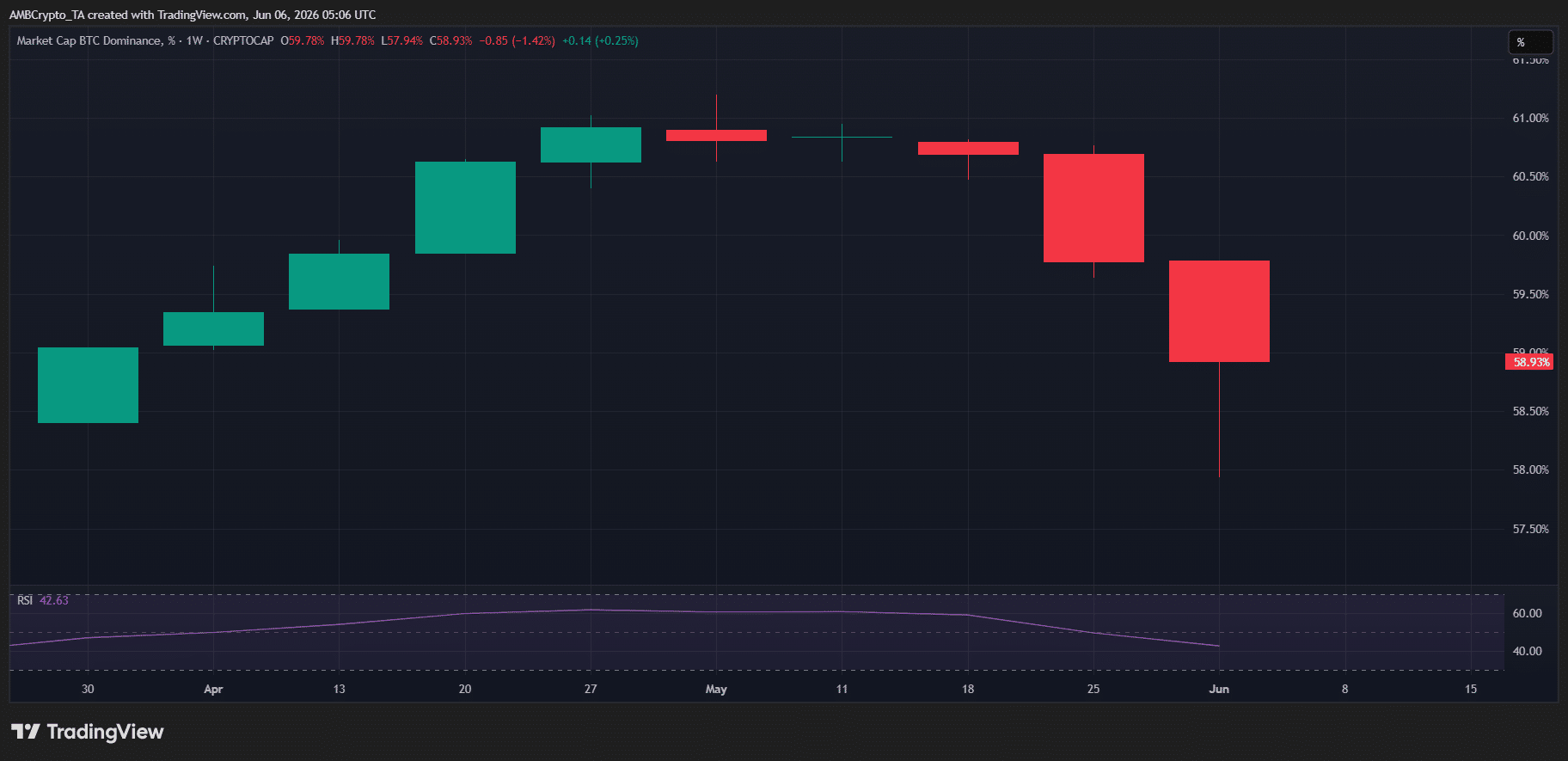
This momentum is also reflected in data about the chain.
According to data from BlockchainCenter, the Altcoin Season Index has risen almost 70% over the same period. This aligns with AMBCrypto’s view that capital has flowed into select altcoins, especially since BTC broke below $80,000 during its move in late May.
Fast forward to now, and the broader market is trending toward a more intense risk-off setup. Amid this volatility, BTC.D is encountering resistance as capital continues to rotate into select altcoins.
That opens up the possibility that the bottom of the market in this cycle could actually be led by altcoins rather than Bitcoin [BTC].
Early altcoin signals emerge as Bitcoin’s dominance retreats
The market is starting to look a lot like the 2017 cycle again.
From a technical perspective, things are clearly bearish. Bitcoin is down nearly 20%, while the S&P 500 is down 2.6%, mainly due to stock weakness.
Altcoins are still under pressure, with TOTAL3 (altcoin market cap excluding Ethereum) down around $520 billion, now back close to levels last seen in November 2024.
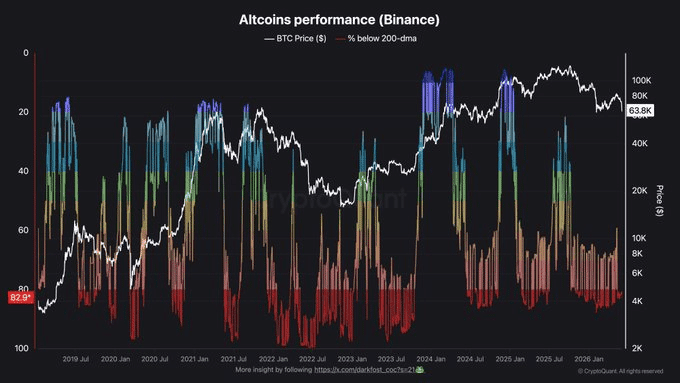
This weakness is also reflected in the market data. As the chart below shows, on Binance, almost 83% of altcoins are trading below their 200-day moving average (200-DMA), one of the weakest values of this cycle.
This means that most altcoins are failing to regain their long-term trend, and continued selling pressure is still dominating across the board.
Some analysts, however to expect this setup resembles the 2017 cycle, where extended weakness finally marked a major low.
When you combine this with the broader macro backdrop, risk sentiment, stock weakness and liquidity-driven swings, and the continued capital rotation between Bitcoin and the broader altcoin market, it starts to look like a potential inflection zone for the next phase of the cycle.
The idea that the bottom of this cycle could be led by altcoins cannot be ruled out.