

Unlike ETF flows, professional crypto holdings typically serve balance sheets and long-term objectives.
From a strategic perspective, institutions use ETF exposure to pursue returns and gain market exposure. Rather, private equity firms, hedge funds, governments and banks hold Bitcoin within broader investment mandates, risk frameworks and portfolio strategies. These entities typically treat Bitcoin as a long-term allocation rather than a short-term trading position.
A recent report from CoinShares highlighted this dynamic in the first quarter of 2026. Professional investors reduced their Bitcoin exposure by approximately 52.5K BTC during the quarter, increasing total holdings from 313K BTC to 261K BTC – a decline of 17%. Their share of total US Spot Bitcoin ETF assets also fell from 24.7% to 20.8%. This represented one of the sharpest quarterly declines since the launch of the ETF market.

That said, the decline appears to have been driven mainly by hedge funds and brokers.
According to the report, hedge funds reduced exposure by 31.4K BTC in the first quarter, while brokers reduced another 18.8K BTC. Notably, a large portion of the brokerage sales came from Morgan Stanley and Jane Street. Morgan Stanley exited its 8.3K BTC position, likely due to the launch of its own Bitcoin ETF, while Jane Street cut 10.8K BTC amid weaker ETF flows during the quarter.
From a technical perspective, this sale matched that of Bitcoin [BTC] 22% correction in Q1. The reduction in hedge fund and broker exposure suggested that short-term and trading-oriented participants took risks off the table as market conditions weakened, reinforcing the broader bearish trend.
Bitcoin ownership is shifting to long-term allocators
Notably, this sell-off follows a well-known Bitcoin bear market pattern.
The report highlighted that advisors largely maintained their positions during the first quarter. For example, banks continued to build their exposure, adding 7.8K BTC during the quarter. Major institutions including JPMorgan Chase and Citigroup have added to or initiated Bitcoin positions, highlighting the growing participation of TradFi players.
In particular, governments and private equity firms have also expanded their holdings, reinforcing the trend of strategic accumulation. Government investments increased by 1.1K BTC, driven by the Mubadala Fund from Abu Dhabi. While private equity exposure grew 24% quarter-on-quarter and 124% year-on-year.
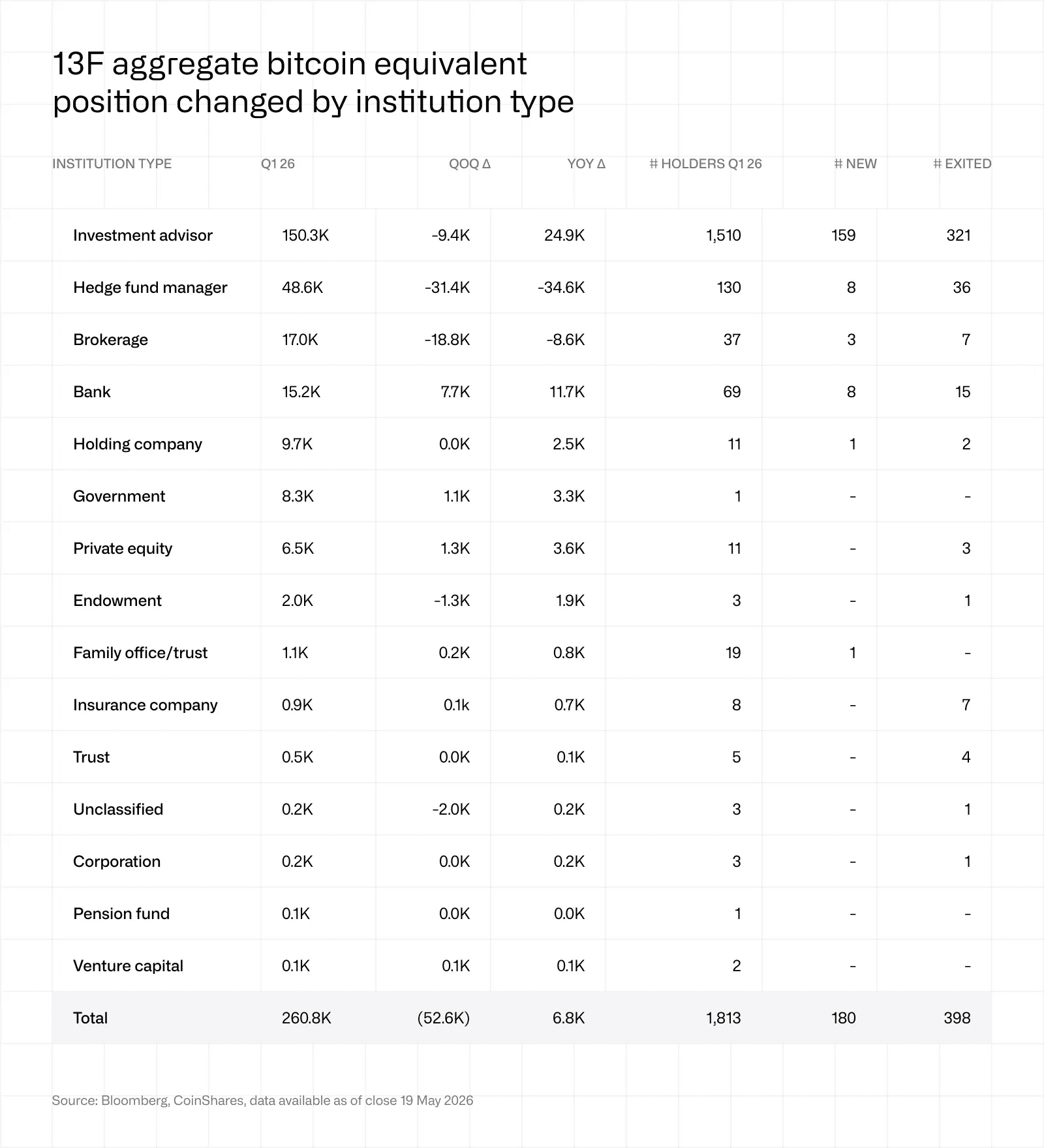
Together, these trends implied that while hedge funds and brokers accounted for the bulk of the selling, long-term allocators largely held steady or continued to increase their exposure during the recession.
In this context, the first quarter repositioning seems consistent with previous Bitcoin declines. As the market corrected, more tactical and ETF players reduced risk while long-term investors absorbed the offering. This shift effectively moved Bitcoin from STHs to strategic allocators such as banks and sovereign entities.
So while there was notable professional selling and weaker ETF positioning in the first quarter, the data could be evidence of ownership rotation rather than broad institutional exit. Selling remained concentrated among hedge funds, brokers and other tactical players, while long-term allocators continued to hold or gradually build up positions during the correction.
Final summary
- Professional investors cut exposure to Bitcoin in the first quarter, with hedge funds and brokers accounting for most of the selling, while BTC fell 22%.
- Banks, governments, private equity firms and advisors continued to hold or add to Bitcoin, signaling a shift from short-term traders to long-term investors.