

Bitcoin’s decline below $78,000 after a rejection near recent local peak levels has left options traders cautiously positioned, according to new data shared by Glassnode. The firm said the options market continues to exhibit compressed volatility expectations, increased demand for downside hedging and a gamma structure that could amplify weakness as BTC moves toward the mid-$75,000s.
The move follows a failed attempt to hold on to the top end of the recent local range. While the spot price action has weakened, Glassnode’s thread focused on what derivatives positioning suggests beneath the surface: Traders are still paying for protection rather than aggressively chasing upside.
“BTC broke back below $78K after being rejected near recent local range highs,” says Glassnode wrote. “Here’s what the BTC options data shows about positioning, volatility expectations, and sentiment beneath the surface.”
Bitcoin options traders remain defensive
One of the clearest signals came from implied volatility. Glassnode said BTC implied volatility resumed its decline after a short-lived recovery earlier this week. One-week implied volatility is now almost 31%, up from 39% earlier this week, while longer-term implied volatility has also turned slightly lower.
The implication is that the market is not yet pricing in a disorderly breakout in either direction, even if downside hedging remains high. “The market is again pricing in a calmer environment in the short term,” Glassnode said.
Related reading
However, that calm is not the same as bullish positioning. Glassnode said the 25-delta skew remains “firmly in put territory” after the rejection of nearly $82,000. The one-week skew briefly reached 24% before easing again, a sign that trading at a strong premium to call options continued.
“Traders remain in favor of downside protection,” the company wrote.
The same caution was evident in Glassnode’s skew index ratio, which compares upside and downside implied volatility. Most tenors remain below 1, meaning puts are richer than calls. The exception to this is the six-month term, where the ratio still shows a call premium, indicating that the upward demand with longer terms has not completely disappeared.
The short-term positioning is more defensive. Glassnode said upside demand outside longer-lived structures remains limited, while the broader options surface continues to demonstrate that investors are seeking protection from further downside developments.
Realized and implied volatilities also differ. One-month realized volatility has fallen to 27%, while one-month implied volatility remains closer to 35%. According to Glassnode, the volatility risk premium is therefore near recent highs.
“Options still cost more movement than BTC has recently delivered,” the company said.
The gamma profile adds another layer of risk. Glassnode identified a large short gamma cluster near $75,000, with approximately $3.2 billion in negative exposure under the spot. In options markets, short range positioning can force dealers to hedge in ways that amplify spot moves, potentially increasing volatility as the price approaches a key level.
Related reading
At the same time, positive gamma clusters near USD 78,000 and USD 80,000 could act as resistance. That setup leaves Bitcoin trapped between nearby upward friction and a lower zone where the downward movement could accelerate.
“This structure can accelerate downside volatility to nearly 75K,” Glassnode wrote.
The flows have also been defensive this past week. Put purchases led the way slightly, accounting for 25% of the premium, while purchased calls also accounted for 25%. Call selling remained high at 25.7% of sales, reinforcing the picture of moderate upward interest.
Glassnode’s conclusion was immediate: the implied front-end volatility continues to narrow, the volatility spread widens, the skew remains in the put area, only the six-month skew index ratio shows a call premium, the flows are lean defensive, and a short gamma acceleration zone is below the spot.
For traders, it is less about outright panic than about asymmetry. Bitcoin options don’t price in a large short-term increase in volatility, but the market is still paying for downside protection and showing limited confidence in short-term upside potential. Unless Spot can reclaim nearby resistance zones around $78,000 and $80,000, the options market appears positioned for continued caution.
At the time of writing, BTC was trading at $76,744.
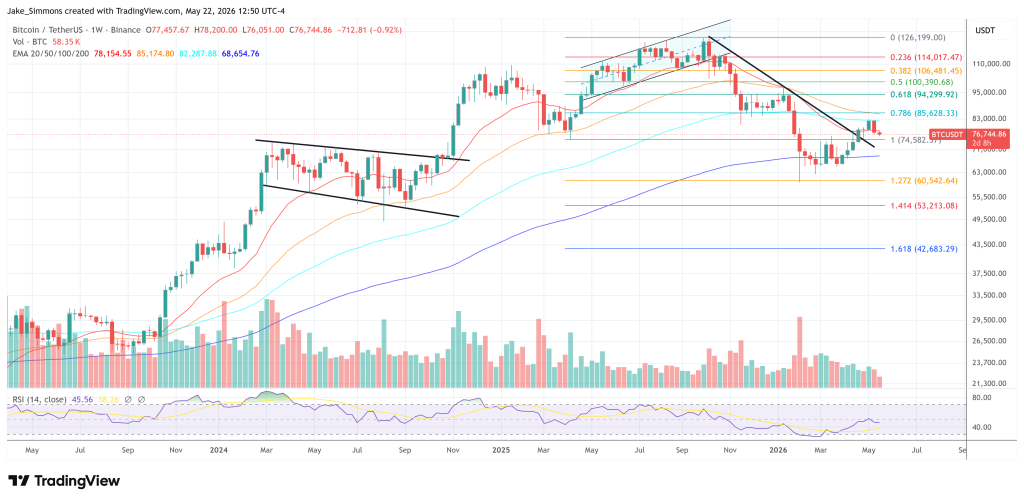
Featured image created with DALL.E, chart from TradingView.com