

Multicoin Capital co-founder Tushar Jain said the company’s recent investment in Zcash was driven by a convergence of stronger market traction, improved infrastructure and a broader return to crypto’s privacy roots. Speaking on the latest Bankless podcast released on May 19, Jain argued that Zcash has evolved from a “left for dead” asset to a credible private store of value competitor.
Jain said Multicoin had looked at Zcash for years without being convinced. He said the asset had long suffered from weak attention, poor usability and limited evidence that demand for privacy could translate into sustained market interest. That changed after Zcash recovered sharply, corrected and still maintained both community intensity and a higher market baseline than in previous years.
Multicoin’s Zcash Thesis
“When I see something like this, I always pause and wonder: Is this a manufactured thing? Is it sustainable? Is there a real groundswell of support here?” Jain said. “And when you see the price do what it did last year, and what we saw then, it pulled back very significantly. When I saw it pull back, what I saw was one, the people who were talking about it were still excited about it. Secondly, where it pulled back on the map actually demonstrated a lot more attention and power than where the thing was trading for years and years before.”
That, Jain said, helped get Multicoin “over the line.” The company did not interpret the correction as a failure, but as a stress test. Zcash, he argued, retained the “key people” who backed it and showed that interest in the asset was not just a short-lived speculative burst.
Related reading
The discussion, which also featured Helius Labs founder Mert Mumtaz, presented Zcash as a possible answer to what both guests described as crypto’s unfinished privacy problem. Mumtaz, who said he started looking more seriously at Zcash in early 2024 after reviewing its scaling plans, argued that privacy has become “the most important thing that crypto has forgotten,” especially as institutional adoption pushes more financial activity onto transparent rails.
Jain’s core investment thesis is not for Zcash to become a high-throughput payment network. He described the real market of assets as the sector of the store of value, where social coordination, brand and perceived monetary properties are as important as raw technical capacity. In that context, he argued, Zcash begins to form a Schelling point around private wealth storage.
“The market that Zcash competes for is the store of value market,” Jain said. “Like that’s the job it does is to store value and it’s much more scalable than Bitcoin and so allows for more transactions and things like that. But the core value is storing value.”
Jain compared that dynamic to Bitcoin’s early reflexivity: More people treating an asset as a store of value makes it a stronger candidate for that role. He said Zcash now has the potential to benefit from a similar feedback loop, especially if it remains the leading privacy asset based on market capitalization, volume, attention and other relevant metrics.
Related reading
The guests also contrasted Zcash with Monero. Mumtaz argued that Monero’s ring signature design relies on decoys, while Zcash’s shielded model provides a stronger cryptographic foundation. Jain emphasized a separate but related point: brand. In his narrative, Zcash is positioned less as a tool for illegal use and more as “privacy for the normal person.”
“Zcash is not meant for that,” Jain said, referring to Monero’s shady market associations. “Zcash is for the everyday person who says, no, I care about my privacy, not because I’m doing anything illegal or because I have anything to hide, but because I don’t have to reveal my entire history of financial transactions to every person I interact with.”
That positioning, he argued, could make Zcash more readable for institutions and a broader group of users. The asset’s transparent mode could enable institutional exposure, while improved wallet infrastructure and decentralized entry routes could push more activity into the ringfenced pool over time.
The podcast also addressed the bear case directly: Investors have repeatedly overestimated the demand for privacy, and previous privacy stories have often ended badly. Jain acknowledged that Zcash was previously “wildly inflationary,” difficult to use, weakly marketed and dependent on centralized exchanges for acquisition. But he said the past 18 months have changed the format, citing better wallet infrastructure, more attention and a macro backdrop that has made private value stores more salient.
Mumtaz added that upcoming catalysts could be important for adoption, including Ledger support for shielded ZEC, increasing shielded pool share from approximately 31% to 32%, planned block time reductions from 75 seconds to 25 seconds, and further work on quantum resistance.
At the time of writing, ZEC was trading at $584.82.
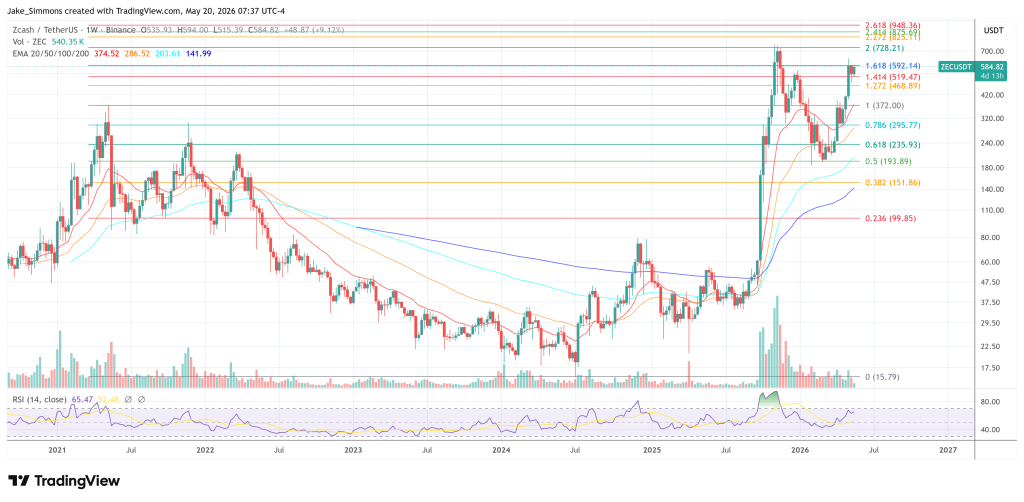
Featured image created with DALL.E, chart from TradingView.com