
Bitcoin’s latest on-chain picture is starting to change looks less like panic and more like patience. Data from CryptoQuant, highlighted by crypto analyst Darkfost, shows that long-term holder supply has climbed back to 15.26 million BTC, returning to a level last seen in August 2025.
The move comes at a sensitive point for Bitcoin, while the price is still trying to build strength around $80,000 with traders currently divided between a new fault and a recovery.
Related reading
Long-term holders add 316,000 BTC in 30 days
On a chain data kept by CryptoQuant shows that Bitcoin’s long-term supply (LTH) has recovered to 15.26 million BTC, a level last seen in August 2025. However, the most important detail in the CryptoQuant chart is not only that the longer-term The supply of holders is increasing, but also the speed of the increase in the past month.
LTH supply has grown by approximately 316,000 BTC over the past 30 days. That means there are more coins Moving to long-term holder status, a category used to identify investors who have held their Bitcoin for at least six months and are less likely to react to short-term volatility.
As seen in the chart below, the green bars showing the thirty-day change in LTH supply have risen into positive territory in recent weeks, marking a marked reversal from the red distribution phase that dominated in late 2025.
At the end of November, the same 30-day metric showed a negative change of around 650,000 BTC, meaning that a large amount of supply had disappeared from the portfolios of long-term holders during that period. That earlier phase coincided with a more vulnerable market structure as Bitcoin rolled through its all-time high in October 2025 and began a deeper correction.
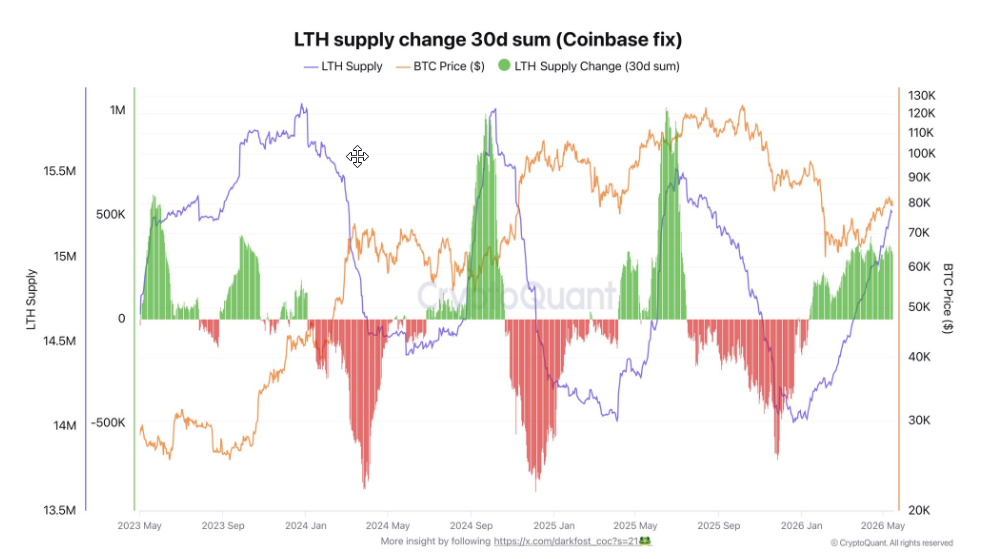
Darkfost also made this change to Coinbase’s previous 800,000 BTC move. His point is that May 23 could become an important date for discussions within the chain, as these coins will officially cross the six-month threshold. Once that happens, investors could see more commentary on how much of that supply is reclassified into the hands of long-term holders.
Bitcoin shows strength
The holder’s long-term data also fits in a separate vision of analyst Michaël van de Poppe, who noted that the market may be too focused on new lows. According to the analyst, Bitcoin’s 25% recovery from its recent lows despite concerns about the war in the Middle East and a rise in interest rates is a sign of resilience. In his argument, losing the 21-day moving average does not automatically mean Bitcoin must plummet to a new lowespecially since the price is still above $76,000.
Van de Poppe also compared Bitcoin to gold and said the BTC/gold RSI has fallen to one of its lowest values ever. However, previous lows of the BTC/gold RSI did not occur during the onset of a bear market, but during the onset of stronger Bitcoin phases.
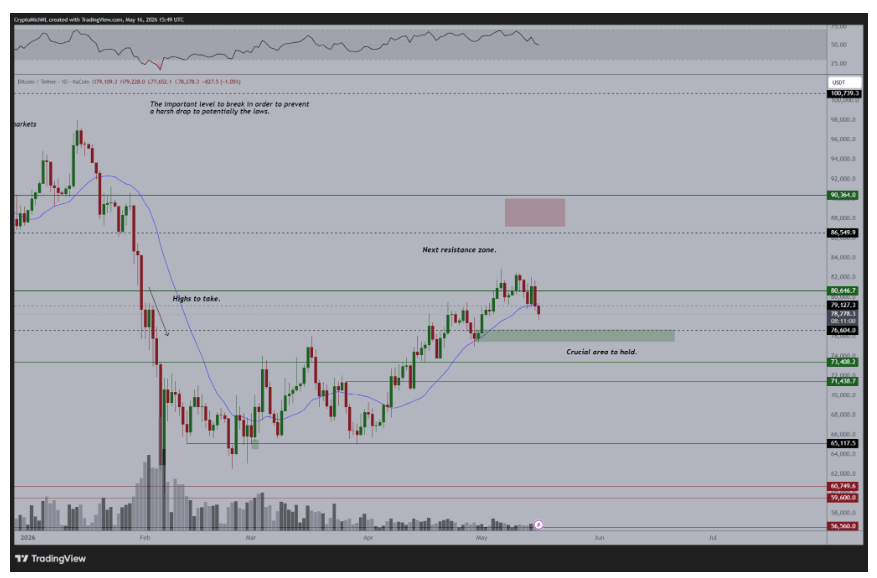
Bitcoin price chart. Source: @CryptoMichNL On X
A crash to new lows would require Bitcoin to invalidate the 200-week moving average, something that would break most cycle behavior barring extreme shocks like the Luna and FTX collapse in 2022.
Related reading
This doesn’t mean Bitcoin can’t test lower support. A move to $70,000 could still happen as a test of support, but the difference is that he doesn’t see new lows as the most likely outcome.
Featured image from Unsplash, chart from TradingView