
Bitcoin climbed back above $71,000 following news of a conditional ceasefire between the US and Iran linked to the reopening of the Strait of Hormuz.
Bitcoin is bouncing back… for now
According to the current QCP market colorAfter the ceasefire announcement, risk assets rose, stocks rose and oil cooled to the low $90s. However, the report warns that all this looks more like a temporary pause than a lasting solution. Let us not forget that, according to President Donald Trump himself, the ceasefire depends on how Iran handles the Strait of Hormuz in the coming weeks.
🚨President Donald J. Trump makes a statement on Iran: pic.twitter.com/9mqTayL0Q3
— The White House (@WhiteHouse) April 7, 2026
The attacks on Saudi Arabia’s energy infrastructure show how fragile de-escalation remains.
Related reading
This recovery is supported by a repricing of risks, and not by beliefs. Depending on the market color, the macro picture remains uneven. US wages recovered, but softer labor market data means the Fed continues to combine concerns about growth and energy-driven inflation. The upcoming inflation report (CPI), due this week, could determine whether Bitcoin’s return to above $71,000 is sustainable or just a short-lived rebound.
Options data from QCP shows compressed front-end volumes, but downside skew remains bid. The demand for hedges is still high. Notable call interest is between $75,000 and $85,000, while support is between $60,000 and $65,000, making $74,000 a key breakout level.
Exchange Netflow shows why Bitcoin is still defensive
Despite the price increase, on-chain data from CryptoQuant shows that foreign exchange reserves remain high, indicating cautious sentiment rather than full accumulation.
The report from CryptoQuant’s Novaque Research explains that Binance currently holds approximately 637.6K BTC in reserves, while Coinbase Advanced holds approximately 866.6K BTC. Both are still well below the level earlier in 2025.
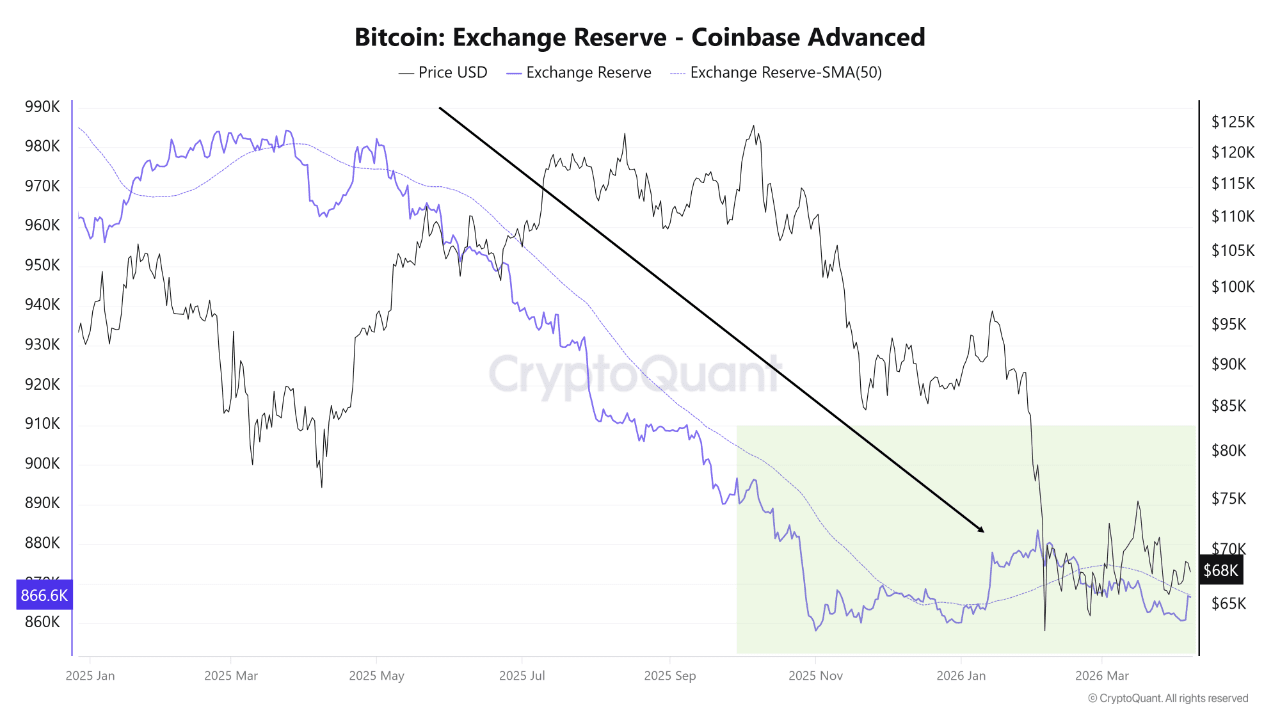
Bitcoin exchange reserve on Coinbase. Source: CryptoQuant.
According to the report, the division between the exchanges is important. Coinbase is more closely tied to US institutional flows, while Binance better reflects global crypto-native liquidity. Coinbase’s reserves have remained tight and largely sideways after a long downtrend, suggesting bigger players are reluctant to bring coins back onto the exchange to sell. Binance’s balances have recovered more visibly, but are still below previous highs and below the 50-day average.

Bitcoin exchange reserve on Binance. Source: CryptoQuant.
These signals suggest that the positioning is cautious rather than capitulating: holders are wary, but they are not behaving as if they need to dump Bitcoin at any price.
Exchange netflow supports that vision, CryptoQuant believes. Total AC is slightly negative, around -289.6 BTC, and there has been a consistent trend towards outflows since February, only occasionally interrupted by sharp spikes in deposits. In a real break in the single market, the analysis explains, you typically see persistent positive net flows as investors move coins to platforms to sell into weakness. Instead, the data still shows Bitcoin being taken off the exchanges during many sessions.

Bitcoin exchange netflow on all exchanges. Source: CryptoQuant.
This doesn’t automatically imply a bullish outcome, but it does highlight that Bitcoin is still backed by a group of holders who are more likely to take the supply away than continue to recycle it back into the market.
Related reading
In summary
Bitcoin’s defensive stance reflects institutional hesitation. Traders may wait for a clear macro or volatility shift before deploying new capital.
The short-term rally depends on headlines, not fundamentals. Unless the ceasefire holds and inflation eases, Bitcoin could struggle to convincingly break the $74,000 mark.
For traders, this means tight margins and tactical trading, and not full risk exposure, at least until the next macro signal.

Bitcoin bounced back and reclaimed $72k earlier today. At the moment of writing, BTC trades for the low $71ks on the daily chart. Source: BTCUSD on Tradingview.
Cover image of Perplexity. BTCUSD chart from Tradingview.