
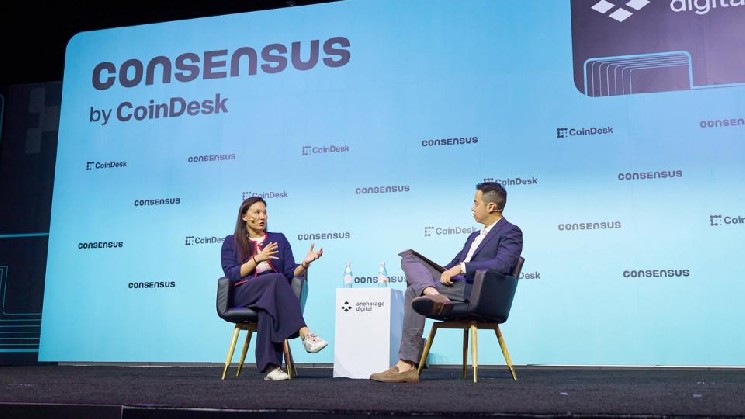
Solana Foundation President Lily Liu said the growing adoption of stablecoins by major corporations validates the evolution of blockchain into global financial infrastructure, while also laying the foundation for AI-driven “machine economies.”
Speaking at Consensus Miami 2026 on Tuesday, Liu pointed to recent announcements involving Meta and Western Union integrating stablecoin payments on Solana as evidence that large enterprises are increasingly viewing blockchain rails as practical infrastructure rather than speculative technology.
“It’s not new,” Liu said, referring to Visa’s 2023 decision to build stablecoin settlement capabilities on Solana after what she described as a “comprehensive objective review” of blockchain networks.
“Fast and cheap is a no-brainer for payments,” she said, adding that businesses also need deep liquidity, developers and a broad ecosystem of applications around these payment rails.
Liu described Western Union’s move to blockchain infrastructure as a particularly meaningful milestone for the crypto industry. “When I first came into this industry in 2014, Western Union was always the white whale crypto,” she said.
Exploring the intersection of crypto and artificial intelligence, Liu argued that blockchain-based payments are ideally suited to “agentic commerce,” where AI agents autonomously transact with other machines and services.
Traditional internet payment systems remain heavily dependent on credit cards, making micropayments economically impractical due to interchange fees, Liu said. Blockchain rails, on the other hand, enable sub-dollar transactions and real-time streaming of payments.
“The vast majority of transactions that take place on the Internet actually have a microtransaction value,” says Liu. “You literally can’t process those individual transactions because you have to process them through credit cards.”
Liu also defended the Solana ecosystem’s recent interventions following security incidents involving projects like Vault and Drift, saying that maintaining industry trust sometimes outweighs competitive rivalry within the decentralized finance sector.
Looking ahead, Liu argues that the industry still underestimates the ultimate role of blockchain. Rather than functioning primarily as general technology platforms, she said blockchains are primarily “financial rails.”
She added that the longer-term promise of crypto could extend beyond payments to what she called “internet capital markets,” allowing companies and sovereign entities around the world to gain more direct access to global capital formation.