
Consent management market
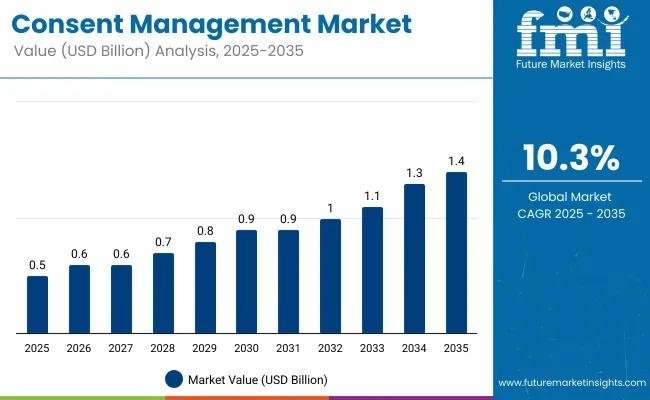
The global consent management market is entering a decisive growth phase, which is expected to grow from USD 0.47 billion in 2024 to USD 1.4 billion in 2035, registering a robust CAGR of 10.3% between 2025 and 2035. With an expected annual growth rate of 9.3% by 2025, the market reflects increasing regulatory scrutiny, rising consumer privacy awareness and the structural transformation of digital technology. business models.
Through implementation, on-premise solutions will continue to dominate with a 56.7% market share, while large enterprises are expected to account for 61.0% of total revenue, underscoring the enterprise-wide integration of consent as a core function of governance.
Request sample report | Customize report | Buy full report
https://www.futuremarketinsights.com/reports/sample/rep-gb-2182
Accelerating regulations drives market expansion
Strict global privacy regulations remain the key catalyst for market growth. Frameworks such as the General Data Protection Regulation, the California Consumer Privacy Act, Brazil’s LGPD, and India’s Digital Personal Data Protection Act require explicit consent from users for data collection, processing, and sharing.
These evolving frameworks require organizations to demonstrate verifiable consent tracking, automated opt-out recognition, and structured audit trails. Non-compliance carries significant financial penalties and reputational risks, forcing companies in the healthcare, e-commerce, financial and technology sectors to deploy advanced Consent Management Platforms (CMPs).
In addition to regulatory mandates, consumer sentiment is accelerating adoption. Research shows that nearly 79% of U.S. consumers are concerned about how organizations use their personal data, while 81% support stricter privacy laws. This behavioral change has transformed consent from a compliance checkbox to a trust-building mechanism embedded in digital experiences.
Machine-readable opt-out signals change platform requirements
By 2025, consent management systems will be fundamentally reshaped by machine-readable opt-out signals and state-level enforcement actions.
Colorado’s Universal Opt-Out Mechanism (UOOM) and Connecticut’s requirement to honor browser-based opt-out signals, such as Global Privacy Control, have elevated signal detection and state-aware scoping to basic platform requirements. Companies operating nationally must now implement automated signal recognition, geolocation-based policy enforcement, and audit-ready logs.
In Europe, regulators codify valid ‘choice architecture’. Under the supervision of the European Data Protection Council, cookie banner symmetry and non-coercive design become standard audit criteria. At the same time, the European Commission’s DMA actions emphasize an equivalent user experience for individuals who forego consent-enforcing product teams to design balanced ‘acceptance’ and ‘rejection’ flows.
These shifts are moving the industry beyond cosmetic banner optimization and toward a designed compliance infrastructure.
On-site implementation maintains leadership
Despite strong momentum in cloud, on-premise deployment continues to maintain a dominant 56.7% revenue share. Organizations in highly regulated industries, including financial services, healthcare and government, are prioritizing direct control over consent data storage, encryption and access management.
On-premise solutions provide tighter integration with internal IT environments, enhanced data location controls, and alignment with industry-specific compliance mandates. For many institutions, maintaining internal management of consent data remains a strategic priority amid growing cybersecurity threats.
However, cloud-based CMPs are growing rapidly, especially among digital-native enterprises looking for scalability, automation, and AI-powered analytics.
Large companies lead the market investments
Large enterprises account for 61.0% of the market share, reflecting the operational complexity of managing consent across multi-brand portfolios, mobile applications, connected devices and international jurisdictions.
Enterprise-level consent platforms are increasingly configured with policy engines that can localize purposes, legal bases, and retention rules by region. Consent events must propagate seamlessly to Customer Data Platforms (CDPs), CRM systems, analytics engines, and ad networks, while ensuring rapid revocation enforcement.
Advanced architectures now prioritize:
• Role-based access controls and Single Sign-On (SSO)
• SCIM provisioning and SIEM log integration
• Customer-managed encryption keys
• Low-latency SDKs for performance optimization
• Multilingual, omnichannel preference centers
This transformation positions consent as a fundamental layer of control embedded in enterprise technology stacks, rather than as a standalone website feature.
Regional outlook: US, India and China in the foreground
The United States is expected to maintain regional leadership in North America, with a 66.2% share by 2025 and growth of 8.3% by 2035. Increasing enforcement of state-level privacy laws and greater consumer awareness continue to drive business investment.
India is expected to grow at a CAGR of 11.1%, fueled by the implementation of the Digital Personal Data Protection Act and increasing digital transformation initiatives. Surveys show that more than 70% of Indian organizations plan to upgrade their data governance frameworks to align with new regulatory standards.
China is expected to grow at a CAGR of 10.7%, driven by advances in AI and blockchain-based privacy systems and alignment with Personal Information Protection Law (PIPL) mandates, which will strengthen its strong presence in East Asia.
Extensive market report: a complete investigation
https://www.futuremarketinsights.com/reports/consent-management-market
Competitive landscape and innovation momentum
The consent management market has been moderately consolidated, with Tier 1 vendors offering comprehensive privacy ecosystems that go beyond consent capture.
Leading companies include OneTrust, TrustArc, Crownpeak, Usercentrics, Didomi and Cookiebot.
Recent developments in the sector reflect strong consolidation and innovation:
• Usercentrics and Cookiebot CMP achieved Google certification for compliance with EU/EEA and UK law.
• InMobi introduced a self-service CMP platform and expanded privacy capabilities through acquisition.
• Osano secured $25 million in Series B funding to advance engineering and product innovation.
• Samsung Ads launched a OneTrust-powered CMP for Samsung TV Plus in Europe, strengthening privacy-first advertising in connected TV ecosystems.
Vendors are increasingly integrating artificial intelligence, automation and blockchain-based registration to improve interoperability and consent traceability across ecosystems.
Market Outlook: Consent as Business Infrastructure
Between 2020 and 2024, the market grew at a CAGR of 10.3%, from $288.4 million to $472.9 million. Similar momentum is expected to continue over the next decade, supported by AI-enabled compliance automation, IoT expansion, and the evolution of cookie-less marketing environments.
As machine-readable signals, regulatory-defined UX standards, and cross-border data governance frameworks mature, consent management is moving from tactical compliance software to an enterprise-grade privacy infrastructure.
As regulatory enforcement intensifies and digital ecosystems become increasingly interconnected, organizations that invest early in scalable, interoperable and audit-ready consent architectures will be positioned to ensure trust while unlocking compliant data-driven innovation.
The complete market analysis provides detailed forecasts, segment breakdowns, vendor benchmarking and strategic recommendations that will shape the global consent management landscape through 2035.
Similar industry reports
Market share analysis of consent management
https://www.futuremarketinsights.com/reports/consent-management-market-share-analysis
The demand for consent management in Britain
https://www.futuremarketinsights.com/reports/united-kingdom-consent-management-market
The demand for consent management in Japan
https://www.futuremarketinsights.com/reports/japan-consent-management-market
Future Market Insights Inc.
Christiana Business, 200 Continental Drive,
Suite 401, Newark, Delaware – 19713, USA
T: +1-845-579-5705
For sales questions: sales@futuremarketinsights.com
Website: https://www.futuremarketinsights.com
Future Market Insights, Inc. (FMI) is an ESOMAR-certified, ISO 9001:2015 market research and consulting organization trusted by Fortune 500 clients and global corporations. With operations in the US, UK, India and Dubai, FMI provides data-backed insights and strategic intelligence across more than 30 industries and 1,200 markets worldwide.
This release was published on openPR.