

- China is stepping up scrutiny of public RWA tokenization to prevent capital flight, preferring state-run blockchains over open crypto networks.
- This regulatory fragmentation increases the need for permissionless interoperability solutions that unify global liquidity beyond restrictive jurisdictions.
- LiquidChain addresses this by merging Bitcoin, Ethereum, and Solana into a single execution layer, allowing developers to deploy once and access users everywhere.
- The LiquidChain presale raised more than $530,000 at $0.01355, signaling strong market demand for infrastructure that solves friction between the chains.
The difference between Eastern and Western approaches to digital assets, and in particular Real World Assets (RWA), is increasing. Quick. Recent signals from the People’s Bank of China and agencies such as the National Development and Reform Commission and the Ministry of Public Security points to a renewed crackdown on ‘public’ tokenization. This strengthens the firewall between Beijing’s permissioned blockchain garden and the open, permissionless crypto economy.
While Hong Kong champions Web3 innovation with sandbox environments, mainland regulators are reportedly eyeing RWA platforms entering public chains like Ethereum with suspicion. The real concern is capital flight.
Beijing sees permissionless RWA, tokenized bonds, real estate or commodities as a backdoor in its capital control regime. If a Shanghai investor can buy a tokenized US Treasury Bill on-chain, the firewall will be breached.
As a result, the narrative shifts to “compliant, authorized tokenization” solely on state-sanctioned infrastructure such as the Blockchain-based Service Network (BSN), effectively banning public crypto from settlement.
This forces a division in global liquidity. We see a “splinternet” of value: a closed, state-run intranet in China, and a chaotic, highly efficient internet of value everywhere else.
For global DeFi, this tightening highlights the need for an infrastructure that is resilient, decentralized, and capable of unifying liquidity beyond restrictive jurisdictions. While countries build walls, crypto market funds bridge. That architectural question draws attention to interoperability protocols such as LiquidChain ($LIQUID)which quietly absorbs capital in its ongoing pre-sales.
Unified L3 architecture solves the silo problem
The core problem here is fragmentation. Whether caused by regulatory firewalls or technical incompatibilities, broken liquidity is detrimental to efficiency. When assets become trapped in one chain or within the digital borders of one country, slippage increases and the user experience deteriorates.
The market’s answer? A turn towards Layer 3 (L3) infrastructure designed specifically as connective tissue.
LiquidChain acts as a special ‘Cross-Chain Liquidity Layer’. Unlike traditional bridges that enclose assets (which often create honeypots for hackers), LiquidChain uses a Cross-Chain VM (Virtual Machine) to merge execution environments. It merges Bitcoin, Ethereum and Solana into a single interface.
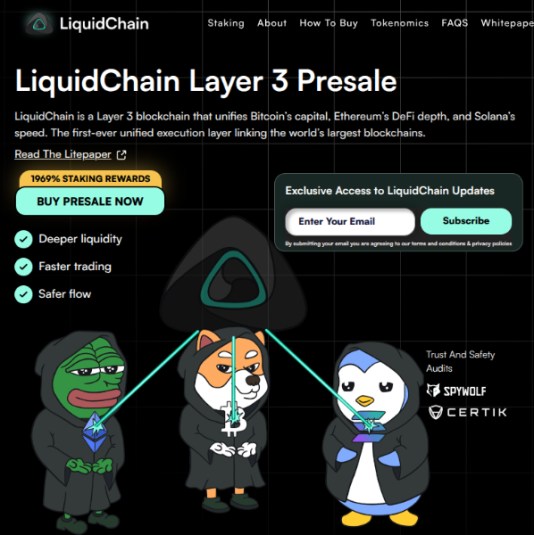
For developers, this is a deploy-once architecture. Instead of writing separate smart contracts for the EVM (Ethereum) and SVM (Solana), they are deployed on LiquidChain, and the protocol handles the asynchronous state changes on the underlying chains.
That technical nuance matters. In a market where regulators are trying to stifle entry points, protocols that remove underlying chain complexity offer the path of least resistance.
LiquidChain doesn’t just move tokens; it creates a unified settlement layer where a user’s Bitcoin can serve as liquidity for a Solana app without complex hopping. The data suggests that smart money is betting on this convergence thesis rather than the siled approach favored by state actors.
READ MORE ON THE OFFICIAL LIQUIDCHAIN WEBSITE
Presale data from LiquidChain indicates the need for infrastructure
While macro news headlines obsess over government bans and ETF flows, the venture capital cycle is returning to deep infrastructure. Speculative meme coins are certainly flashy, but the picks and shovels games are where the long-term conviction shines through. LiquidChain’s current presale performance reflects this shift toward utility-driven value.
According to the latest internal data, LiquidChain has raised $526,615.32, with the token currently priced at $0.01355. Raising more than half a million dollars ($530,000) during a period of regulatory uncertainty in key markets implies that investors are pricing in the success of cross-chain interoperability. The value proposition is clear: LiquidChain solves the “fragmented liquidity problem” that plagues the current L1/L2 landscape.
Frankly, tokenomics support a long-term hold thesis. By positioning $LIQUID as the fuel for this unified execution environment, the protocol extracts value from every cross-chain interaction. It could be one of the best crypto to watch.
As users deploy liquidity to secure the network, the floating supply shrinks. The risk here (as with any pre-sale) is foreclosure; Providing a mainnet that handles atomic swaps securely is difficult. But for investors looking at a price of $0.01355, the asymmetry lies in the potential for LiquidChain to become the default routing layer for the next generation of DeFi.
PURCHASE YOUR $LIQUID FROM THE PRE-SALE PAGE
This article is for informational purposes only and does not constitute financial advice. Cryptocurrency investments, especially pre-sales, involve high risk and volatility. Always do your own due diligence.