

Introduction
In 2008, Bitcoin heralded a revolutionary change in the financial world with the advent of blockchain technology. Decentralization, anonymity and transparency helped Bitcoin and subsequent blockchains gain traction among investors. Being a data structure, a blockchain relied on the connections of blocks that contained essential information about transactions. Each block contained information about the previous block in the form of a cryptographic hash. For years the technology had no competitor, but the introduction of a directed acyclic graph changed the situation.
What is the directed acyclic graph (DAG)?
The Directed Acyclic Graph (DAG) is a data structure like blockchains, but instead of operating on a single sequential chain, it is a network of many linked transactions. It first appeared in 2016 when IOTA, a crypto project, applied the concept to its transactions. The project called the transaction structure a tangle instead of a blockchain ledger. The term comes from the fact that it is a web made up of nodes that contain transactions.
If we try to represent a blockchain schematically, there are many blocks arranged in a row, with each block connected only to the previous one. On the other hand, the representation of a DAG structure shows points, many of which are connected to more than one point in such a way that the loop only moves forward and never returns to where it came from. Each point (or sphere) is a vertex and each line is an edge. From the following figure you can understand the nomenclature of the model. The edges are directed because they point in one direction, and they are acyclic because they never return to the vertex from which they originated.
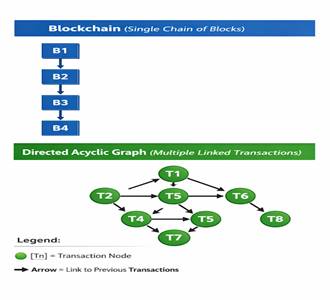
How the structure works
At every step of understanding DAG, you also need information about blockchain technology, because that is what DAG claims to improve or replace. A blockchain works on the basis of blocks that contain data from one or more transactions. It groups many transactions together to be space efficient. Each block is added and verified by miners or validators.
Rather, each transaction in the DAG structure stands alone, without being grouped into blocks. This structure also does not require miners or validators, nor is it sequential like the blockchain structure. Before a transaction is added, the user’s device does a tiny bit of work to prove it’s real. This small effort helps prevent spam and also helps confirm previous transactions, keeping the network safe and orderly.
Each new transaction in the DAG tree must connect to a previous unconfirmed transaction, or if all previous transactions have already been confirmed, the new transaction only needs to link to the last one. This structure refers to a previous unconfirmed transaction as a “tip”. When you propose a transaction to the network, it follows up on a number of previous tips that are automatically confirmed after your referral. Yours won’t be confirmed until someone else builds on it.
Advantages of DAG structure
No delay
With blockchains, your transaction must wait until a block is created. If too many transactions are sent at once, they will form a queue and wait a long time or pay a higher rate. But you can get your transaction processed in DAG networks at once, provided you confirm the previous unconfirmed transactions. Your wallet automatically checks the transaction it is about to confirm by tracing it back to the very first transaction on the network. Therefore, it is very unlikely that you will accidentally confirm an invalid transaction.
NO scalability issues
Think of a blockchain as a highway, which can be busy at times, so a few extra lanes need to be added. These additional lanes are the scalability solutions. Because there is no such thing as a block wait, DAG can process many more transactions on its own, without the need for scalability solutions.
No miners, no validators, no fees
The DAG structure does not operate on any consensus mechanism, so there are no miners or validators. That is why transactions are processed free of charge. However, there are a few special nodes that charge a very small fee to secure the network.
Disadvantages of DAG
Centralization poses a serious risk to DAG’s progress. Certain dedicated nodes and coordinator nodes operated by companies tend to predominate. This poses a potential danger of scams and attacks in the future. Furthermore, DAG is 8 years younger than blockchain technology, because it is not yet as proven.
In short
Both blockchain and Directed Acyclic Graph technology aim to enable decentralized and secure transactions, but they approach the problem in very different ways. While blockchain remains the more mature and widely adopted solution, DAG introduces notable improvements in speed, scalability and transaction costs. However, concerns around centralization and its relatively short track record still limit wider adoption. As innovation accelerates in 2026, DAG will likely complement rather than completely replace blockchain, with each technology serving use cases where its strengths are most effective.
Frequently asked questions
What is the main difference between DAG and blockchain technology?
Blockchain records transactions in consecutive blocks, while DAG processes individual transactions in a web-like structure, allowing faster and more scalable validation.
Is DAG more scalable than blockchain?
Yes, DAG can handle higher transaction volumes without relying on block creation, reducing congestion and scalability issues.
Does DAG need miners or validators?
No, DAG networks do not rely on traditional miners or validators. Each new transaction helps validate previous transactions, keeping the network operational.
Can DAG replace blockchain in the future?
DAG is unlikely to completely replace the blockchain, but can complement it by powering applications that require high speed, low cost and scalability.